
Social Media Marketing System (2026): Strategy, Content, and ROI
Here’s the truth: a social media marketing system is the difference between “busy” and “profitable.” If your week is a chaos loop of last-minute posts, random trends, and screenshotting likes like they pay your rent, you don’t have marketing—you have a hobby.
The problem is most people treat social like art class: vibes, inspiration, and “let’s see what happens.” Fast forward to 2026, platforms are noisier, attention is more expensive, and your competitors are running disciplined pipelines while you’re debating fonts.
This guide gives you a real operating model: a strategy template that’s actually usable, content pillars that don’t turn into repetitive sludge, and KPI tracking that lets you track social media ROI without lying to yourself.
Table of Contents
- The system definition (so we stop arguing about “content”)
- The social media strategy template that doesn’t suck
- Content pillars that scale without burning you out
- Production workflow: build once, ship everywhere
- Distribution engine: timing, formats, and repurposing rules
- KPI tracking: what to measure vs what to ignore
- How to track social media ROI without fairy tales
- Dashboards and operating rhythm (weekly, monthly, quarterly)
- Common failures and how to fix them fast
- Tools + low-tech gear that actually helps
- Frequently Asked Questions
- Bottom line
The system definition (so we stop arguing about “content”)
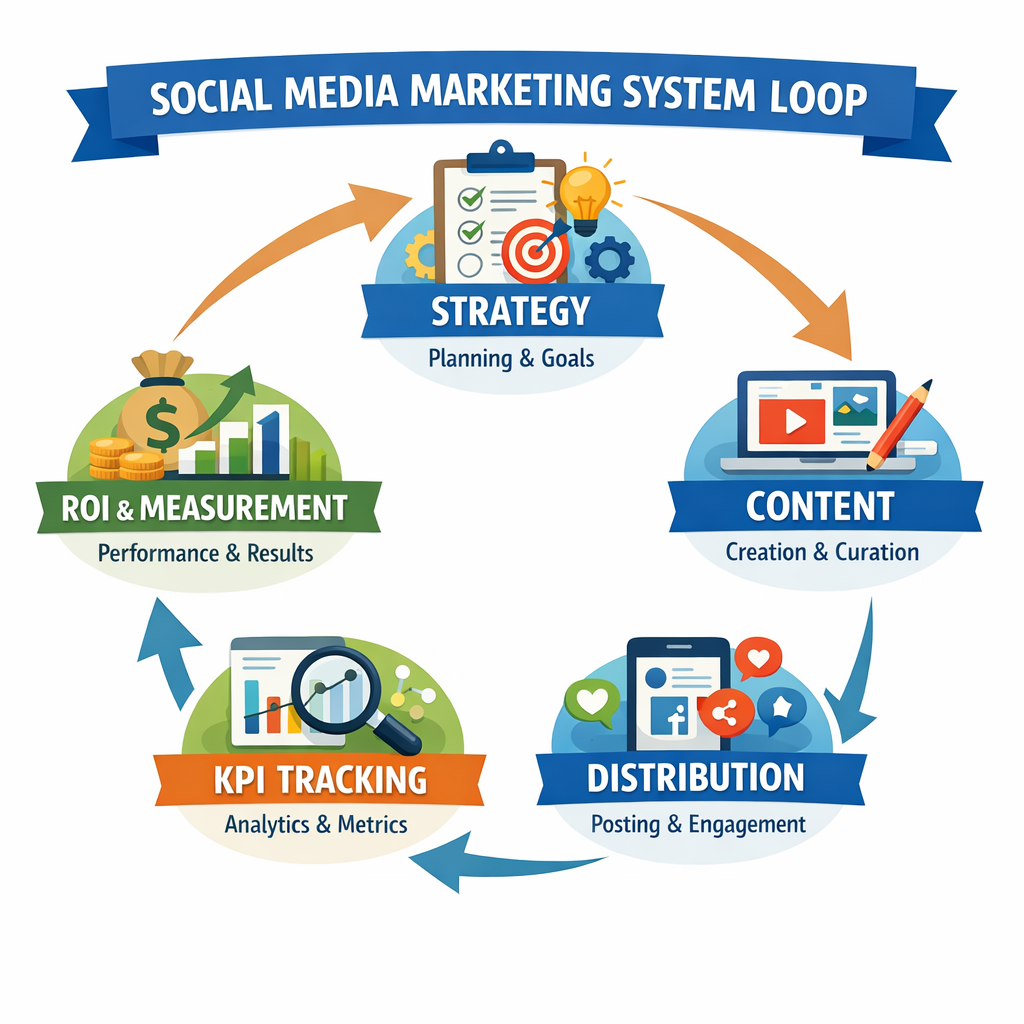
A social media marketing system is a repeatable machine that converts attention into business outcomes: pipeline, sales, retention, or at minimum qualified demand you can monetize later.
Snippet answer: A social media marketing system is a documented process that turns strategy into consistent content, distributes it with clear rules, and measures performance with KPI tracking so you can track social media ROI. It’s not “posting more.” It’s a loop you can improve.
If you can’t describe your process, you don’t have a system. You have a mood.
A real system has six components:
- Positioning (who you help, what problem you solve, why you win)
- Offer path (where people go after they trust you)
- Content pillars (themes that map to awareness → consideration → action)
- Production (how content gets made without heroics)
- Distribution (formats, cadence, repurposing, collaboration)
- Measurement (KPI tracking + ROI tracking, not dopamine metrics)
Want a simple gut-check? If you stopped posting for 14 days, would anything still run—scheduled content, email capture, evergreen posts, internal repurposing queue, reporting rhythm? If the answer is no, you’re running on hustle, not design.
If you want more frameworks like this, keep our social media systems guides open while you implement—treat it like your playbook, not a one-time read.
The social media strategy template that doesn’t suck
Most “strategy templates” are either MBA cosplay or a blank Notion page with inspiring quotes. You don’t need that. You need a decision document.
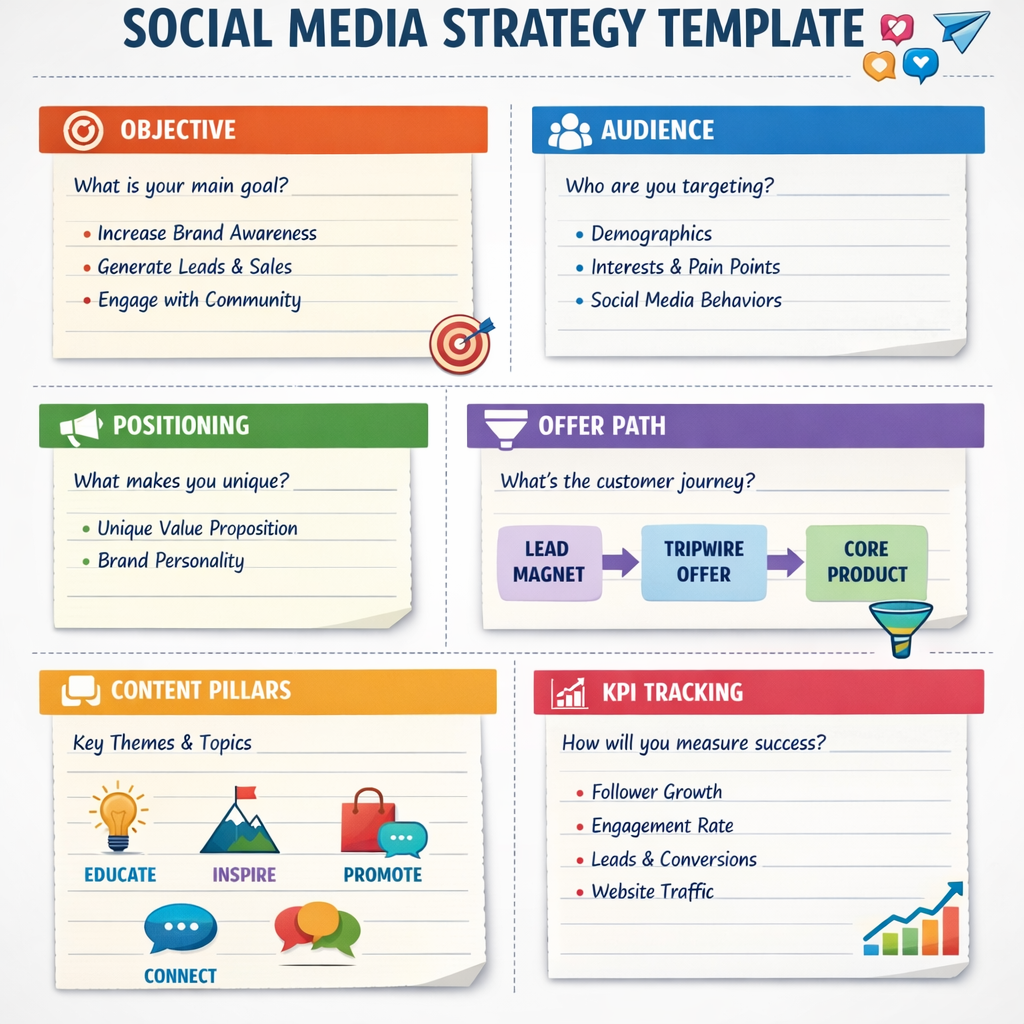
Here’s the template I’d put in front of a team that has to execute, not just brainstorm:
1) Objective: pick one scoreboard
Choose one primary objective for the next 90 days. Not five. One.
- Revenue: direct sales, trials, subscriptions
- Pipeline: qualified leads, booked calls, demos
- Audience asset: email subscribers, community joins
- Retention: returning customers, product adoption, renewals
If your objective is “grow,” that’s not an objective. That’s a wish.
If you want a structured goal model, OKRs are one clean option: one objective, a small set of measurable key results. Wikipedia’s overview is fine for grounding the concept and avoiding vague “we tried” reporting. Read the OKR definition and structure before you write yours. :contentReference[oaicite:0]{index=0}
2) Audience: define a single “primary buyer”
“Everyone” is not a market. Define:
- Role (job, identity, or responsibility)
- Pain (what costs them time, money, status, sleep)
- Trigger (what makes them actively look for help)
- Objection (why they don’t buy)
Write it like you’re explaining it to a skeptical teammate. If it sounds fluffy, it is.
3) Message: your 3-line positioning
Keep it brutally simple:
- We help [specific person]
- achieve [specific outcome]
- by [your method or edge]
This becomes your bio, your pin, your “why follow” story, and your content filter. Anything that doesn’t support it is noise.
4) Offer path: one primary CTA
The mistake: 11 links, 6 offers, 3 funnels, and a partridge in a pear tree.
Pick one primary CTA for 90 days:
- “Download the checklist” (email capture)
- “Book a call” (pipeline)
- “Start a trial” (product-led)
- “Read the pillar guide” (evergreen SEO + retargeting)
Then build secondary CTAs that support it, not compete with it.
For more examples of CTA paths and onsite architecture, see the on-site conversion patterns we break down on Social Media Marketing Techniques.
5) KPI tracking: define leading + lagging indicators
This is where adults separate from wannabes.
Lagging indicators (the scoreboard): revenue, leads, booked calls, trials, purchases.
Leading indicators (inputs that predict outcomes): profile clicks, saves, qualified comments, CTR, watch time, landing page engagement, email opt-ins.
If you only report leading indicators, you’re basically reporting “people looked at the store window.” Nice. Did they buy?
Content pillars that scale without burning you out
Content pillars are not “topics you like.” They’re demand buckets tied to the buyer journey.
Here’s a reliable 5-pillar model you can adapt to almost any niche:
Pillar 1: The problem (diagnosis)
This is where you earn trust. Show you understand the pain better than they do.
- Myth-busting: “Why your ‘consistency’ isn’t working”
- Failure modes: “The three reasons your posts don’t convert”
- Cost of inaction: “What you’re losing by not tracking ROI”
Pillar 2: The method (how you think)
This is the “I have a brain” pillar. Frameworks, process, systems.
- Templates (like the one above)
- Decision rules: “When to post what”
- Workflow breakdowns
Pillar 3: Proof (results and receipts)
If you don’t have case studies yet, use “proof surrogates”:
- Before/after audits
- Mini experiments (A/B tests)
- Transparent dashboards (even small wins)
Pillar 4: Tools (what you use and why)
Tools content is profitable, but most of it is garbage because it’s written for affiliate clicks, not outcomes. Your edge is explaining when a tool is the wrong choice.
Pillar 5: Perspective (your point of view)
This is the moat. Your opinions. Your standards. Your “here’s what I won’t do.” People follow people, not spreadsheets.
Bottom line: each pillar should map to a business result. If a pillar exists because it’s “fun,” keep it as a hobby lane, not your core calendar.
Want examples of pillar-to-post mapping and category hubs? Use our pillar and cluster planning guides as a reference while you build your list.
Production workflow: build once, ship everywhere
The #1 reason teams fail at social is not creativity. It’s throughput.
Most workflows look like this:
Idea → panic → post → disappear → repeat
A system workflow looks like this:
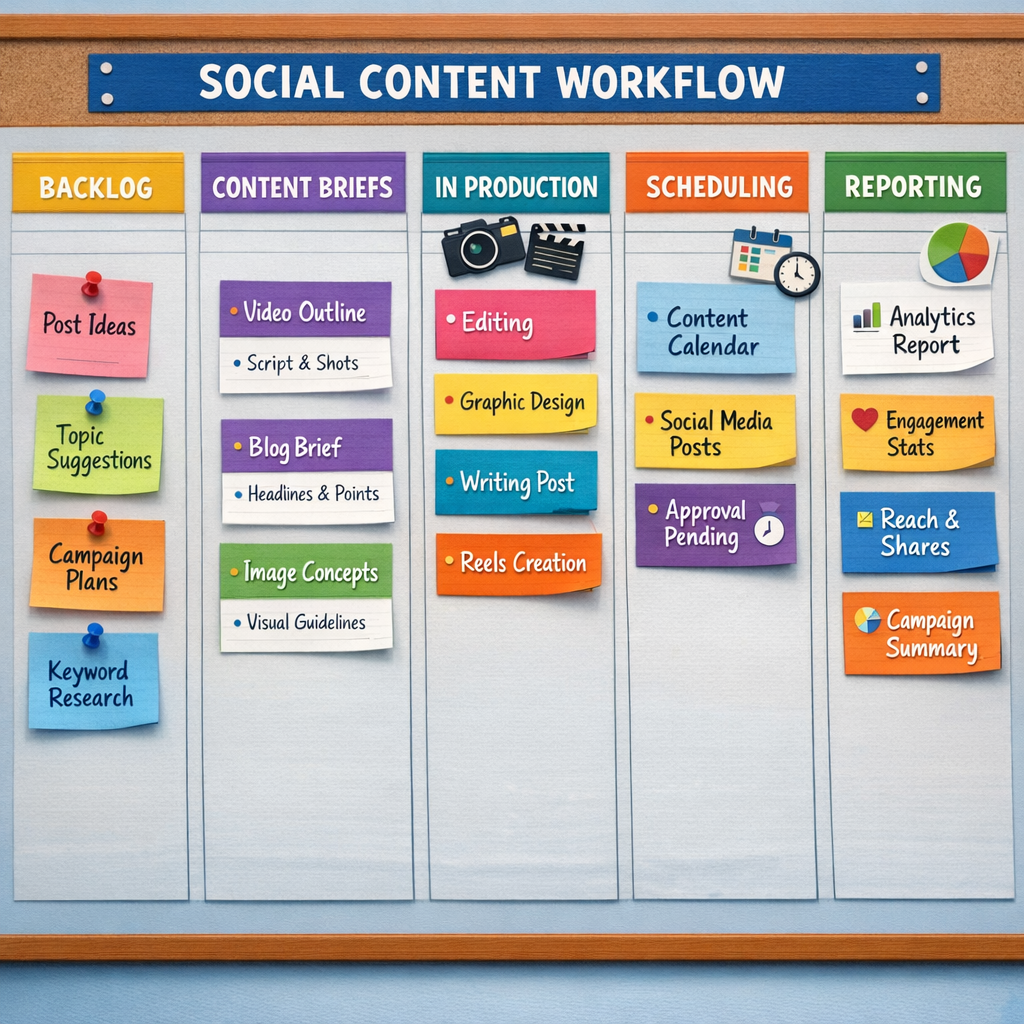
- Intake: capture ideas in one place (not 12 apps)
- Brief: write a 5-minute content brief (hook, promise, CTA, proof)
- Batch production: script/outline in batches, record in batches, edit in batches
- Packaging: captions, thumbnails, titles, first line hooks
- Scheduling: queue it, don’t “wing it”
- Post ops: respond, log insights, update the backlog
The 5-minute content brief (steal this)
- Hook: what stops the scroll in 1–2 lines?
- Promise: what will they know/do after this?
- 3 beats: three points max (you’re not writing a novel)
- Proof: example, mini story, data, demonstration
- CTA: one action (comment, save, click, download)
Notice what’s missing: “make it viral.” That’s not a plan. That’s gambling.
If you want your workflow to feed your website (which you should), the simplest loop is: social post → pillar section → internal link → email capture. That’s the engine we build around on Social Media Marketing Techniques—social isn’t separate from your site; it’s a distribution layer.
Distribution engine: timing, formats, and repurposing rules
Posting “when you have time” is a great way to never build momentum.
In 2026, distribution is a ruleset:
- Cadence: how often you publish per format (short video, carousel, text, live)
- Format fit: what each platform rewards (and punishes)
- Repurposing: how one idea becomes multiple assets
- Response loop: how you capture audience signals and feed them back into content
Cadence: pick a sustainable “minimum viable schedule”
Most people overcommit, burn out, then disappear. That’s not a strategy. That’s self-sabotage.
Try this baseline:
- 2 short videos/week (education or proof)
- 1 carousel/week (framework or checklist)
- 3–5 stories/updates/week (human + behind-the-scenes)
- 1 community touch (reply, collab, comment strategy)
Then scale up only when the system is stable.
Repurposing rules: one idea, five outputs
Here’s a clean repurpose chain:
- Pillar article section (your evergreen “source of truth”)
- Carousel (same logic, compressed)
- Short video (one point + example)
- Email (story + CTA)
- Community post (question + discussion)
That’s how you grow without doubling workload.
If your internal linking and content hubs aren’t set up yet, fix that first—social should push into a site structure that can capture demand. Start with your core category and pillar setup so distribution has somewhere to land.
KPI tracking: what to measure vs what to ignore
Let’s be blunt: most KPI dashboards are designed to make someone feel productive, not to make money.
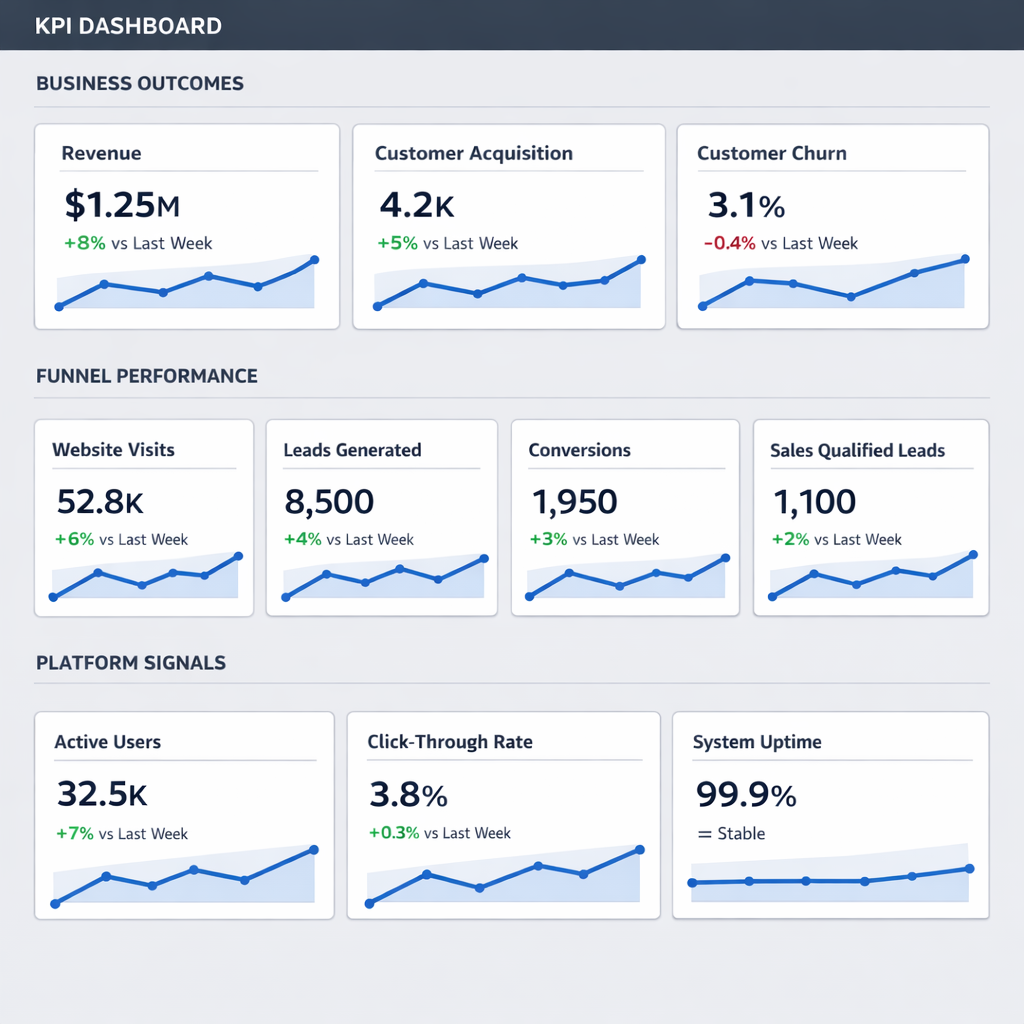
Here’s a practical KPI hierarchy you can actually run.
Tier 1: Business outcomes (the only scoreboard that matters)
- Revenue attributed (where possible)
- Qualified leads (not “leads,” qualified leads)
- Booked calls / demos
- Email subscribers (if you monetize later)
Tier 2: Funnel performance (the conversion reality check)
- Click-through rate on posts with CTAs
- Landing page conversion rate
- Cost per lead (if paid is involved)
- Assisted conversions (social helps, even when it doesn’t “close”)
Tier 3: Platform signals (leading indicators, not trophies)
- Saves and shares (intent + value)
- Average watch time / completion rate
- Profile visits (interest)
- Qualified comments (questions from real buyers)
What to ignore as a primary KPI: raw follower count, total impressions, generic engagement rate without context. Those are nice, but they’re not your P&L.
Want a measurement framework that’s written for actual operators? Purdue’s extension doc breaks down practical ROI thinking in plain language: goals first, measurement second, and ROI as more than vanity metrics. How to prove your social media work works (Purdue PDF). :contentReference[oaicite:1]{index=1}
Also worth skimming: Virginia Tech’s measurement guidance is basic but useful for setting definitions and steps so your team isn’t arguing over what “success” means. Measure success on social media (Virginia Tech PDF). :contentReference[oaicite:2]{index=2}
How to track social media ROI without fairy tales
“ROI” is where people get weird. Either they claim credit for everything (“someone saw a post once in 2023”), or they demand perfect attribution and quit when reality shows up.
Here’s the sane middle path: track social media ROI with a chain of evidence.
Step 1: Define what a “conversion” is (for your business)
Pick one primary conversion and one secondary conversion:
- Primary: purchase, booked call, trial start
- Secondary: email opt-in, quiz completion, lead form
If your sales cycle is long, your primary conversion might be “booked call,” not “sale.” That’s fine. Just don’t pretend it’s revenue.
Step 2: Tag everything you control
Use link tagging (UTMs) for any link you put in a bio, story, description, or pinned comment. Make naming conventions boring and consistent. The goal is clean data, not creativity.
If you don’t have a consistent tracking plan, your reporting becomes interpretive dance.
Step 3: Capture source data at the point of conversion
Add a “How did you hear about us?” field. Add hidden fields if you can. Use a CRM note. Use call tracking numbers if offline is part of the funnel.
Does it feel redundant? Yes.
Does it save you from guessing later? Also yes.
Step 4: Measure incremental lift, not just last-click
Last-click attribution is simple, and it’s often wrong. Social frequently assists demand. That’s why your system needs both:
- Direct response tracking (click → conversion)
- Assisted impact tracking (social influences conversion later)
How do you do that without enterprise tooling? Use cohorts: compare weeks where you executed your system cleanly vs weeks you didn’t. Compare conversion rates, not just traffic. Look for patterns.
If you’re running affiliate links or sponsored content, you also need disclosure discipline. The FTC guidance is not optional vibes—it’s the standard. Read their influencer/endorsement guidance and treat it like requirements, not suggestions: FTC guidance on endorsements, influencers, and reviews. :contentReference[oaicite:3]{index=3}
For more tracking tactics and reporting templates, keep a tab open to our ROI and analytics resources and build your measurement stack once, then reuse it every week.
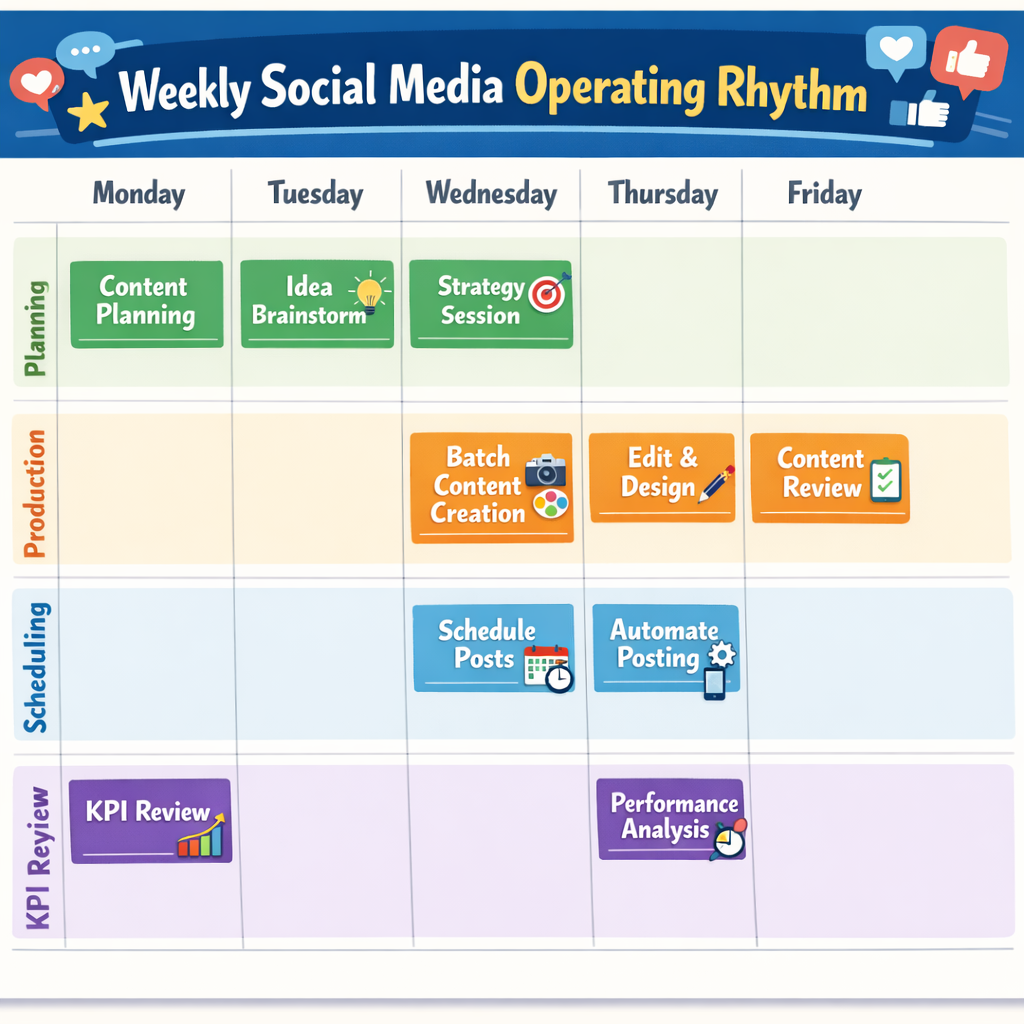
Dashboards and operating rhythm (weekly, monthly, quarterly)
A system without a cadence is just a document that slowly becomes fiction.
Weekly: the 30-minute operator review
- Wins: what performed and why (hook, format, CTA, timing)
- Losses: what flopped and why (be honest)
- Pipeline check: clicks → leads → sales (any drop-offs?)
- Content backlog: add 5 new ideas from real audience questions
- One experiment: test one variable next week
Keep it simple. If it turns into a two-hour meeting, you’ve already lost.
Monthly: the strategy alignment reset
- Which pillar drove the most qualified action?
- Which CTA converted best?
- Which format is worth doubling down on?
- What are we removing? (yes, removing)
Most brands never remove anything. They just pile on more. That’s how you become a noisy mess.
Quarterly: update the strategy template (not your feelings)
Update your objective, key results, and content pillars. Keep the workflow stable unless it’s broken.
One more thing: build your reporting so a stranger could understand it. If your dashboard needs you to narrate it, your dashboard is bad.
If you need a clean site structure that supports this rhythm (pillar pages, hub pages, internal linking), use the publishing architecture models here as your baseline.
Common failures and how to fix them fast
Let’s call out the usual offenders.
Failure #1: “We post a lot” but nothing converts
The problem is your offer path is broken. Your content is entertaining strangers, not moving buyers.
- Fix: one primary CTA for 90 days
- Fix: one landing page that matches your content promise
- Fix: rewrite your bio like a value proposition, not a diary
Failure #2: Content pillars are too broad
If your pillar is “motivation,” you’re basically saying “I have no strategy.”
- Fix: rewrite pillars as outcomes and objections
- Fix: add buyer-intent topics (pricing, comparisons, mistakes, timelines)
Failure #3: KPI tracking is a vanity parade
If your dashboard celebrates reach while revenue is flat, your system is lying.
- Fix: move outcomes to the top of the dashboard
- Fix: report conversion rates, not just totals
- Fix: track drop-offs from click → lead → sale
Failure #4: You’re stuck in “idea debt”
Too many ideas, not enough shipping.
- Fix: batch production (one day for scripts, one for recording)
- Fix: reduce formats (do fewer, better)
- Fix: reuse winners (yes, reuse them)
Failure #5: Compliance gets treated like an afterthought
If you do affiliate links, sponsorships, or endorsements, disclosure is part of the system. Not a “maybe.”
FTC guidance makes it clear that material connections should be disclosed. If you’re monetizing, act like a professional and build it into your templates. FTC’s Endorsement Guides FAQ document. :contentReference[oaicite:4]{index=4}
If you want more tactical fixes and teardown-style audits, browse the optimization playbooks on Social Media Marketing Techniques and apply one change at a time.
Tools + low-tech gear that actually helps
Tools won’t fix strategy. But the right stack removes friction so your system runs even when your motivation doesn’t.
Low-tech tools (shockingly effective)
A physical content planner beats a messy notes app when you’re batching ideas and scripts.
A simple whiteboard makes your weekly pipeline and posting rhythm visible. Visibility creates accountability.
Creator basics (don’t overthink it)
A decent USB microphone improves perceived quality instantly, especially for voiceovers and tutorials.
A ring light is not glamorous, but it prevents “this looks sketchy” vibes, especially indoors.
One caution: don’t tool-shop as procrastination. Buying gear feels like progress. It’s not.
If you want more system-level recommendations (not shiny-object lists), keep our tool stack breakdowns bookmarked and only add tools that reduce a specific bottleneck.
Frequently Asked Questions
What is a social media marketing system (and how is it different from “posting consistently”)?
A system includes strategy, content pillars, workflow, distribution rules, KPI tracking, and a measurement loop so you can track social media ROI. “Posting consistently” is just output. A system is output tied to outcomes, with feedback and improvement built in.
Which KPIs matter most if I want to track social media ROI?
Start with outcomes (revenue, qualified leads, booked calls, trials). Then track funnel health (CTR, landing conversion, assisted conversions). Use platform metrics like saves and watch time as leading indicators, not the final score.
How do I track social media ROI if my sales cycle is long or mostly offline?
Use a chain of evidence: tagged links, landing pages, lead capture, and CRM source fields. For offline, use call tracking, “how did you hear about us” fields, and conversion proxies like booked calls or in-store appointments.
Do I need to be on every platform in 2026?
No. Two platforms with a clean system beat six platforms with chaos. Pick the platforms that match your audience and your strongest content format, then repurpose intelligently so output scales without doubling labor.
What’s the fastest way to fix a social account that gets views but no leads?
Fix the offer path: one primary CTA, one focused landing page, and content pillars aligned to buyer intent. Then track drop-offs from click → lead → sale so you know where the leak is. If your link hub is a junk drawer, you built a leak factory.
Bottom line
Here’s the truth: if you want predictable results, you need a social media marketing system, not random bursts of effort.
Insider takeaway: The system is the advantage. Strategy template + content pillars + production workflow + distribution rules + KPI tracking = compounding results you can actually improve. And yes, it’s supposed to feel a little boring. Boring is reliable. Reliable is profitable.
Now go implement one piece today: pick your 90-day objective, define one primary CTA, and set up your first KPI dashboard. Fast forward to a month from now—you’ll either have data you can optimize, or you’ll still be “experimenting” (aka guessing). Your call.
If you need more templates and system examples, head back to Social Media Marketing Techniques and keep building the machine.
As an Amazon Associate, I earn from qualifying purchases.