Social Media Strategy & Planning: Powerful 2-Week Sprints
Social Media Strategy & Planning is not “posting consistently.” That’s like calling brushing your teeth a healthcare plan. The problem is most brands are running on vibes, recycled templates, and a content calendar that’s basically an anxiety generator. Here’s the truth: if you can’t point to one business outcome your content moves, you don’t have a strategy—you have activity.
Fast forward to 2026: platforms keep changing, attention keeps shrinking, and the only reliable advantage is a system you can run weekly without burning out or lying to yourself with vanity metrics. If you want a strategy that survives algorithm mood swings, you need structure, not hustle.
Table of Contents
- The 2026 system in one screen
- Strategy vs planning: the line you keep crossing
- Pick one business outcome (or admit it’s just content)
- Audience intent map: stop guessing what people want
- Content pillars: the engine, not the decorations
- The content calendar that doesn’t collapse on Wednesday
- Platform operating rules: what changes and what doesn’t
- KPI tracking that doesn’t lie to you
- The social media strategy template (2026 edition)
- Tools stack: what to use, what to skip
- Why most social strategies fail (and how to not be that guy)
- Frequently Asked Questions
- Closing insider takeaway
The 2026 system in one screen
Social Media Strategy & Planning in 2026 is simple: pick one business outcome, build 3–5 content pillars that support it, run a capacity-based content calendar, publish with platform-specific rules, and track KPIs that connect content to results. If any step is missing, you’ll get “engagement” and no money.
Let’s turn “strategy” into something you can run every week without needing a whiteboard, a latte, and a spiritual awakening.
Bottom line: your system needs four lanes that connect:
- Outcome lane: what the business needs (leads, sales, bookings, signups).
- Message lane: what your audience believes, fears, wants, and Googles at 2 a.m.
- Production lane: what you can actually publish with your time and team.
- Measurement lane: KPI tracking that proves what’s working and what’s cosplay.
If you want more frameworks, templates, and execution playbooks, keep this bookmarked: Social Media Marketing Techniques.
Strategy vs planning: the line you keep crossing
Strategy is deciding what you will not do. Planning is deciding when you’ll do what matters.
Most people flip it. They start with posting frequency and formats (planning), then retroactively invent a “strategy” to justify the calendar. That’s how you end up posting three reels a week about “tips” that nobody asked for.
Here’s the truth: if your strategy can’t survive a week where you only have 3 hours to create content, it’s not a strategy. It’s a fantasy novel.
A practical definition:
- Social media strategy = your outcome, audience, positioning, pillar themes, offer/CTA logic, and measurement rules.
- Social media planning = your content calendar, production workflow, asset library, publishing schedule, and repurposing loop.
Want a simple sanity check? If you can’t explain your strategy in 60 seconds to a smart friend without sounding like a LinkedIn post, it’s not ready.
For more tactical breakdowns, jump into the guides hub here: socialmediamarketingtechniques.com.
Pick one business outcome (or admit it’s just content)
Most social plans fail before the first post because the “goal” is a word salad: brand awareness, engagement, community, virality, thought leadership, vibes.
The problem is you can’t optimize for five outcomes at once. Platforms already do enough random stuff. Don’t add your own chaos.
Pick one primary outcome for the next 90 days:
- Leads: form fills, DMs, booked calls, quote requests.
- Sales: purchases, trials, paid subscriptions, cart starts.
- Audience capture: email signups, SMS, community joins (your “owned” audience).
Then attach a measurable definition. I’m not asking you to marry a spreadsheet. I’m asking you to stop lying.
Use a SMART goal (yes, it’s old, and yes, it works). If you need a quick refresher on what SMART stands for, it’s documented clearly on Wikipedia: SMART criteria.
Example goals that don’t make me roll my eyes:
- Leads: “Generate 40 qualified consult requests in 90 days from Instagram + LinkedIn.”
- Sales: “Drive 150 product page clicks/week from TikTok and convert at 2%+.”
- Audience capture: “Add 1,000 email subscribers in 60 days using a lead magnet + weekly nurture.”
Now you can build content pillars and a content calendar that serve something real, not the imaginary “algorithm gods.”
Need a broader execution blueprint? You’ll find more strategy frameworks here: Social Media Strategy resources.
Audience intent map: stop guessing what people want
People don’t open apps to be “marketed to.” They open apps to scratch an itch: curiosity, identity, entertainment, status, belonging, or a problem they want solved.
Your job is to map intent so your posts feel like answers, not interruptions.
Build a 3-layer audience intent map:
Layer 1: The job-to-be-done (the real reason they care)
- Functional: “Help me plan content faster.”
- Emotional: “Help me feel competent and consistent.”
- Social: “Help me look credible to my peers/customers.”
Layer 2: Buying stage (yes, even for “educational” content)
- Unaware: they don’t know the problem is fixable.
- Problem-aware: they know it hurts, not how to solve it.
- Solution-aware: they’re comparing approaches.
- Product-aware: they’re comparing vendors.
- Most-aware: they need a push and proof.
Layer 3: Objections (the landmines that stop action)
- Time: “I don’t have time to plan.”
- Confidence: “I’m not creative.”
- Trust: “Social doesn’t convert for my niche.”
- Complexity: “Every platform has different rules.”
Once you have this map, writing becomes easier because you’re not “brainstorming content.” You’re answering predictable questions with repeatable formats.
Pro tip: keep a living swipe file of real audience language—comments, DMs, sales calls, support tickets. Your best hooks are already written by customers.
If you want more examples and plug-and-play frameworks for this step, explore: audience research and intent guides.
Content pillars: the engine, not the decorations
Content pillars are not “education, inspiration, promotion.” That’s not a strategy. That’s a kindergarten poster.
Real content pillars tie directly to outcomes and objections. They’re the repeatable themes that make your brand feel consistent while your formats can change every week.
Use 3–5 pillars. If you have 9, you don’t have pillars—you have a junk drawer.
A 2026-ready pillar model (steal this)
- Pillar 1: Problem diagnosis (why the current approach fails, what’s misunderstood)
- Pillar 2: System and process (step-by-step frameworks, templates, workflows)
- Pillar 3: Proof (case studies, before/after, teardown of results)
- Pillar 4: Tools and tactics (stack recommendations, demos, comparisons)
- Pillar 5: POV and positioning (your opinionated takes, myth-busting, boundaries)
Here’s the truth: “tips” content is cheap. Anyone can generate 100 tips with AI in five minutes. Your advantage is judgment: what to do, what to ignore, and why.
Turn each pillar into 10–15 repeatable angles
This is how you avoid repeating yourself.
- Myth: “Posting daily is the key.”
- Rule: “One KPI per outcome, two diagnostics.”
- Checklist: “Pre-post QC in 60 seconds.”
- Teardown: “Why this post worked (and what to copy).”
- Case study: “From 0 to 40 leads: what changed.”
- Template: “The 5-slide carousel structure.”
Build your content calendar from these angles and suddenly planning stops feeling like inventing a new TV show every week.
Want more pillar ideas and examples built for monetization? Start here: content pillars frameworks.
The content calendar that doesn’t collapse on Wednesday
A content calendar is supposed to reduce stress. Most calendars do the opposite because they’re built like you have infinite energy and zero emergencies.
Capacity-based planning fixes that. You plan based on what you can reliably produce, not what looks impressive on a calendar screenshot.
Step 1: Set your weekly production quota (your real capacity)
Pick a number you can hit even when life punches you in the face.
- Solo creator: 3 posts/week + 2 stories/day + 1 short video/week
- Small team: 5 posts/week + 2–3 short videos/week + 1 long-form repurpose/week
One sentence reality check: consistency is not a personality trait, it’s a workload decision.
Step 2: Lock your “pillar distribution” (so you don’t drift)
- 60%: Pillars 1–2 (problem + system)
- 20%: Pillar 3 (proof)
- 20%: Pillars 4–5 (tools + POV)
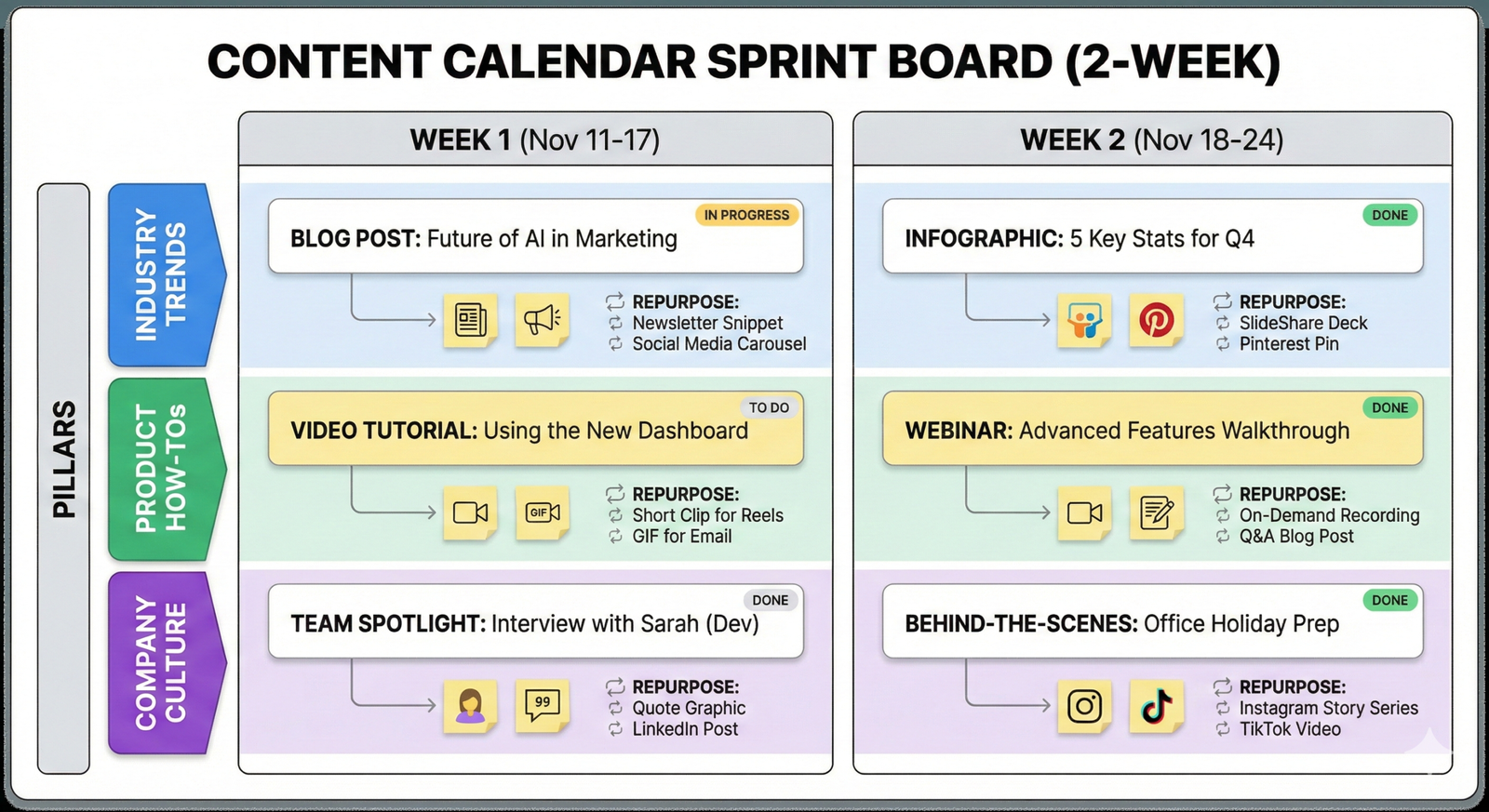
Step 3: Use a 2-week planning cycle (not monthly perfectionism)
Monthly calendars look organized until week two, when reality shows up and sets them on fire.
Plan in two-week sprints:
- Week A: publish + collect signals (comments, saves, watch time, clicks)
- Week B: publish + refine + repurpose winners
Step 4: Build a repurposing loop (the most underrated multiplier)
Bottom line: you don’t need more ideas. You need more mileage from the good ones.
Simple repurpose rule:
- 1 strong idea = 1 short video + 1 carousel + 3 short posts + 1 story sequence
Don’t let your best ideas die as single posts. That’s like doing a great workout once and quitting because you “already exercised.”
If you want a deeper breakdown of calendar structures and publishing workflows, browse: content calendar planning systems.
Platform operating rules: what changes and what doesn’t
Platforms will keep changing. That’s the business model: keep creators chasing carrots.
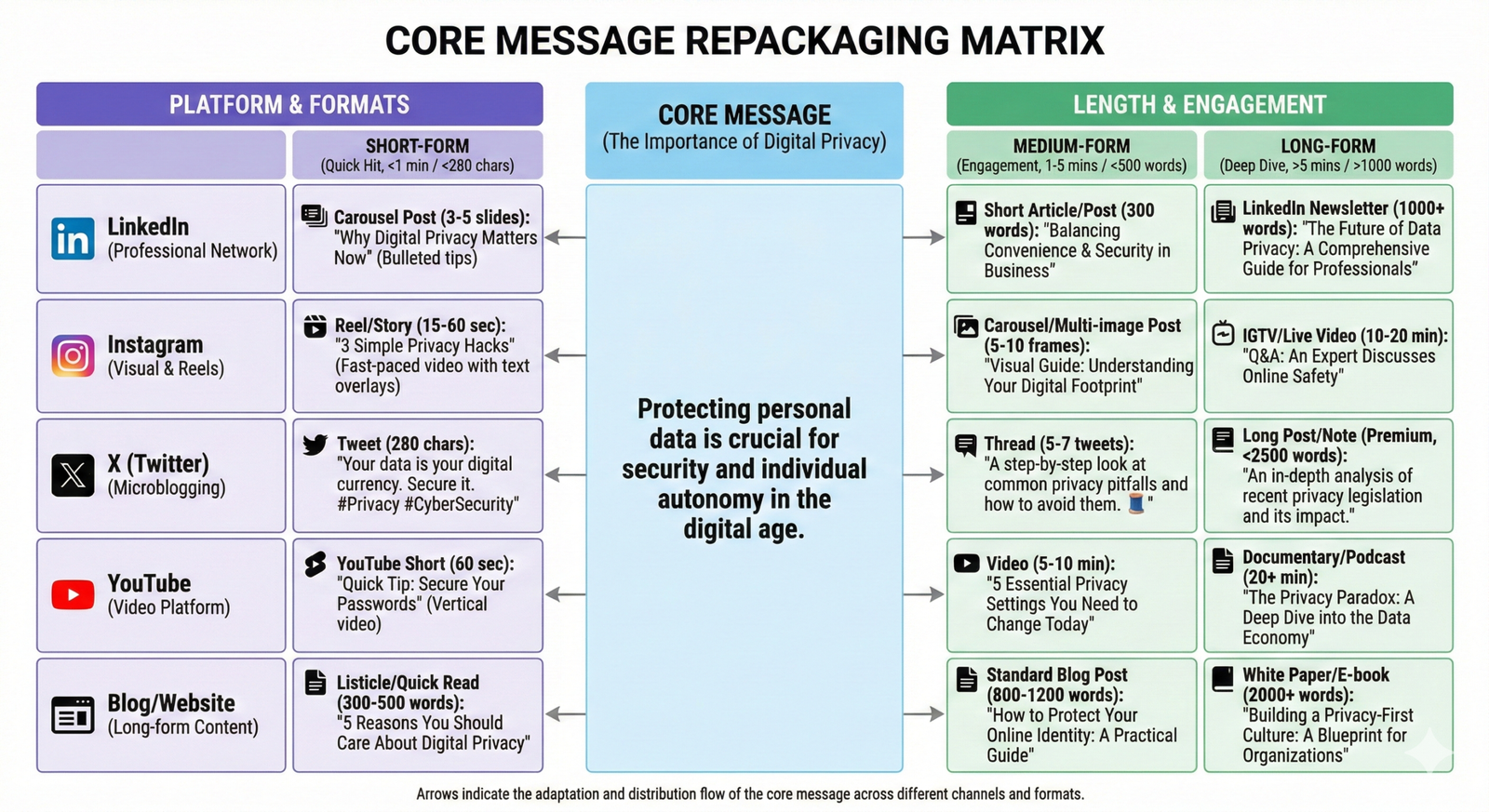
Your job is to separate fundamentals from fads.
What doesn’t change (the fundamentals)
- Hook speed matters: you’re competing with infinite scroll.
- Clarity beats clever: if they don’t “get it” instantly, they leave.
- Retention signals rule: watch time, saves, shares, re-reads.
- Consistency is structural: you need a workflow that ships.
What changes (and how to adapt without panic)
- Formats favored: short video vs carousel vs long captions.
- Distribution features: search surfaces, recommended feeds, topic tags.
- Creative norms: editing styles, pacing, meme language.
So what do you do? You operate with a core “message system” and adapt the packaging.
“Operating rules” that keep you sane
- Rule 1: Every post must do one job: educate, prove, convert, or polarize. Not all four.
- Rule 2: If the first line doesn’t signal the payoff, rewrite it.
- Rule 3: If a post performs, immediately create 3 variations. Don’t “move on.”
- Rule 4: Comments are product feedback. Treat them like research, not applause.
Want more platform playbooks and real-world examples? You’ll find a growing library here: platform strategy and audits.
KPI tracking that doesn’t lie to you
Vanity metrics are the junk food of marketing: they feel good, they don’t nourish the business.
Here’s the truth: you can get 10,000 views and still have a dead pipeline. You can also get 800 views and 12 leads if you aim at the right intent.
Pick one primary KPI tied to the outcome
- Leads outcome: qualified form fills, booked calls, DM-to-call conversions
- Sales outcome: purchases, trials started, revenue per visitor
- Audience capture outcome: email signups, lead magnet conversions
Add two “diagnostic” KPIs so you can troubleshoot
- Attention KPI: retention (watch time, completion rate, saves)
- Action KPI: clicks (link clicks, profile visits, CTA taps)
That’s it. Three KPIs. Anything more becomes a dashboard you stare at instead of a system you run.
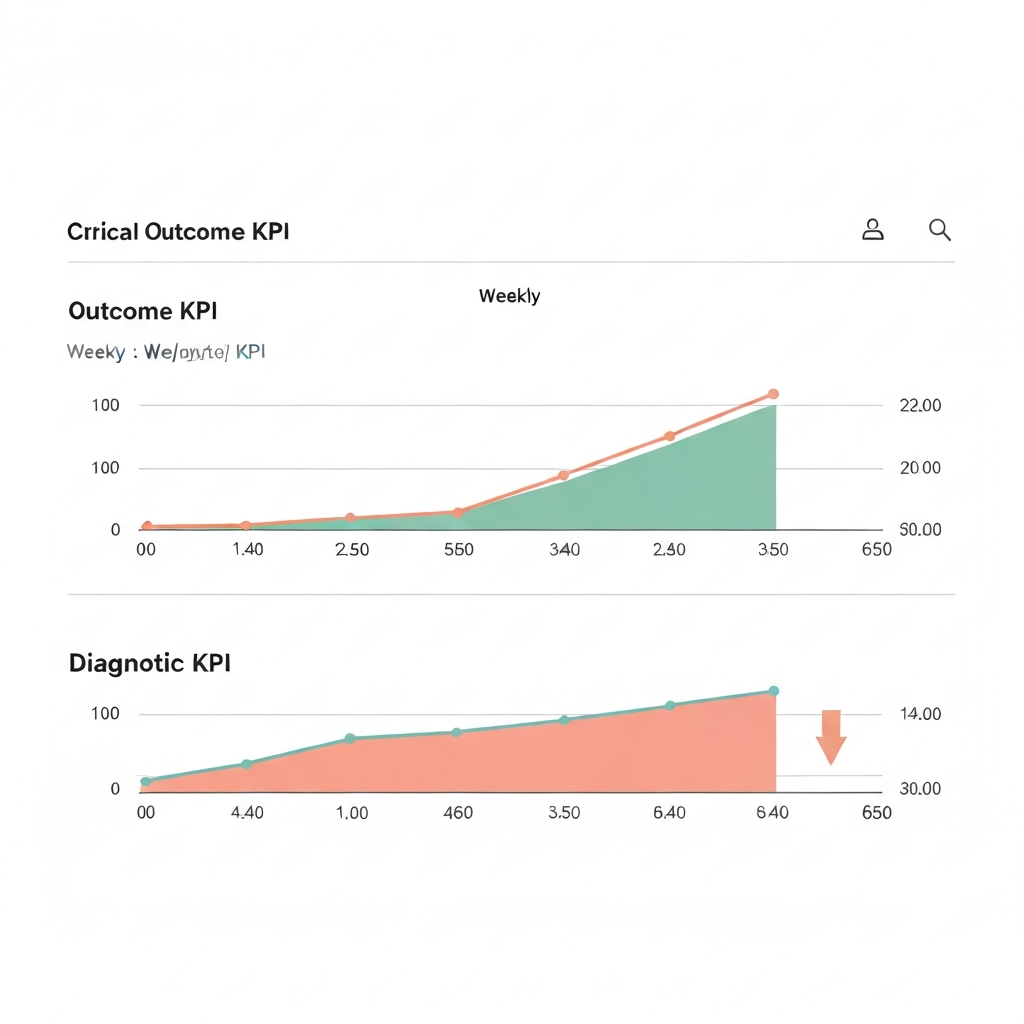
Weekly KPI review (15 minutes, no drama)
- Identify winners: top 3 posts by retention and actions.
- Identify laggards: bottom 3 posts; spot the pattern (weak hook, wrong audience, unclear CTA).
- Decide one change: tweak hooks, swap CTAs, adjust pillar distribution, or test a new format.
Pro tip: track by “post intent,” not just by platform. A conversion post should be judged differently than a reach post. Otherwise you’ll stop making conversion content because it’s “less viral.” That’s adorable. Also broke.
If you’re building a more advanced measurement stack, start from the basics and grow: measurement and optimization guides.
The social media strategy template (2026 edition)
You asked for a social media strategy template that doesn’t read like corporate wallpaper. Here it is.
This template is designed to be filled in once, then reviewed weekly. It’s a living document, not a PDF you admire and ignore.
Section A: Outcome and constraints
- Primary outcome (90 days): __________
- Primary KPI: __________
- Constraints: time/week, team size, budget, approvals
- Non-goals: what you will not optimize for (be honest)
Section B: Audience and positioning
- Who it’s for (specific): __________
- Core pain: __________
- Desired identity: “I want to feel like __________”
- Your positioning: “We help X achieve Y without Z.”
Section C: Pillars and angles
- Pillar 1: __________ (10 angles)
- Pillar 2: __________ (10 angles)
- Pillar 3: __________ (10 angles)
- Pillar 4: __________ (10 angles)
- Pillar 5: __________ (10 angles)
Section D: Offer and CTA logic
- Primary offer: consult, product, lead magnet, trial
- CTA ladder: soft CTA (save/share) → medium (comment/DM) → hard (click/book/buy)
- Landing destination: link-in-bio page, landing page, DM keyword automation
Section E: Content calendar rules
- Weekly quota: ____ posts, ____ short videos, ____ stories
- Two-week sprint: plan, publish, review, repurpose
- Repurpose rule: winners get 3 variations within 7 days
Section F: KPI tracking rules
- Primary KPI target: ________ per week
- Diagnostics: retention + clicks
- Weekly review time: 15 minutes, same day/time
Bottom line: if this template feels “too simple,” that’s because you’re used to complicated plans that don’t ship.
If you want more templates and printable versions, you can pull inspiration from: strategy and planning templates.
Tools stack: what to use, what to skip
Tools don’t fix a broken strategy, but the right stack reduces friction so you publish more and measure better.
Here’s the truth: most teams overbuy tools and underbuild workflow. Start lean, then upgrade based on pain.
Category 1: Planning and calendar execution
You need a place to store pillars, angles, drafts, and publish dates—without turning it into an admin job.
- Lightweight: a single master calendar + content bank
- Team-ready: approvals, comment threads, asset storage
If you want a physical-style planner for content sprints (some people think better on paper), a simple “content planner” notebook can help:
Category 2: Production (audio, lighting, stabilization)
Short-form video is still a workhorse format. You don’t need a cinema rig, but you do need clean audio and stable video. Bad lighting screams “I don’t take this seriously,” even if your advice is gold.
Three practical items that punch above their cost:
- Lavalier microphone: cleaner speech, less background noise. Check Price on Amazon
- Ring light or small LED panel: consistent face lighting. Check Price on Amazon
- Tripod: stability and repeatable framing. Check Price on Amazon
Category 3: Measurement and compliance
For KPI tracking, you don’t need a $500/month dashboard to start. You need consistent tagging and a weekly review habit.
Also: if you do affiliate or paid partnerships, you need to disclose properly. The FTC’s endorsement guidance is not optional reading; it’s the rules. Start here: FTC endorsements and testimonials guidance.
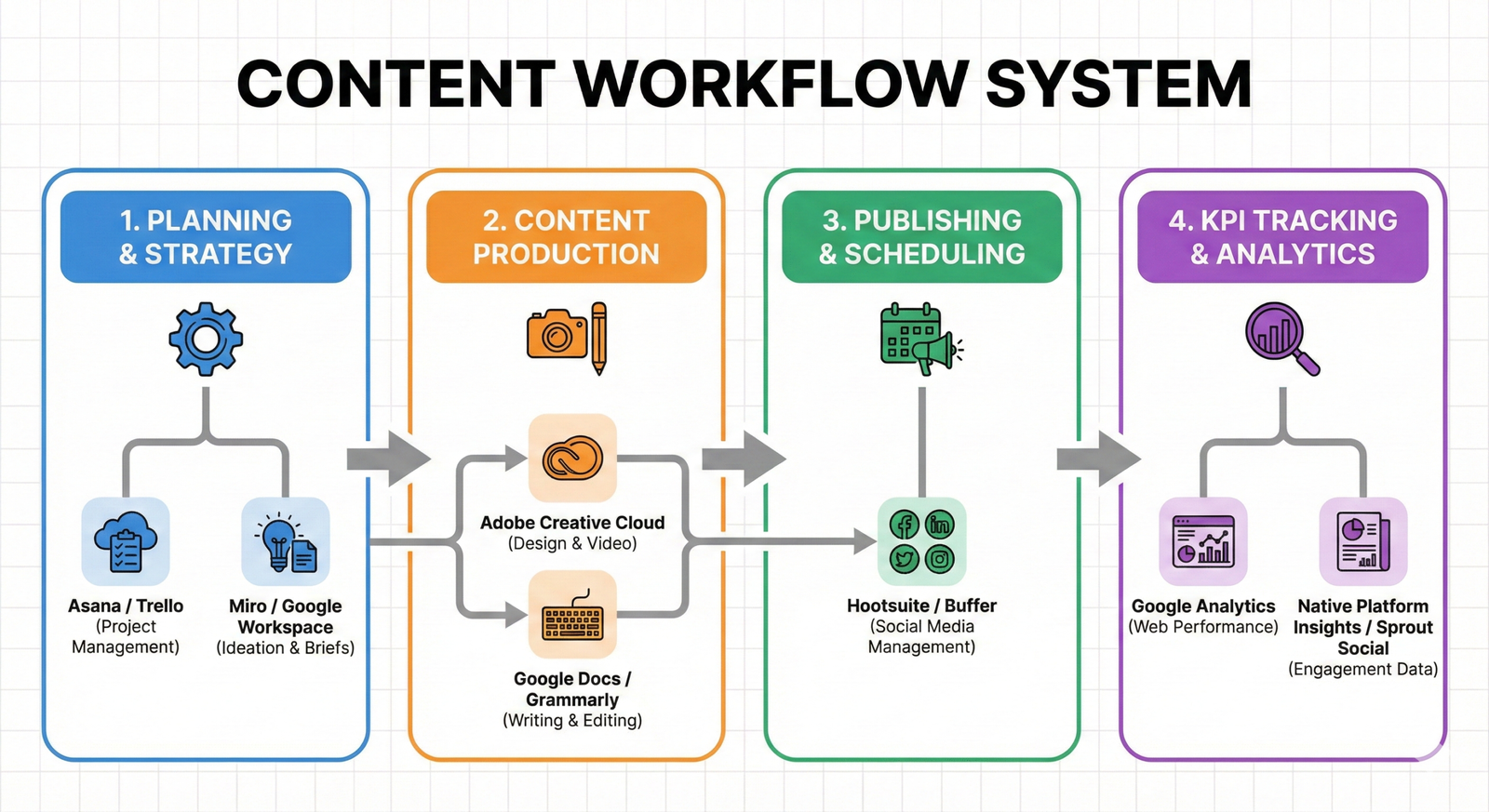
Want more tool comparisons and no-fluff reviews? Browse: tools and workflows.
Why most social strategies fail (and how to not be that guy)
This is the part where I ruin your excuses. You’re welcome.
Failure mode 1: The “content calendar as coping mechanism”
People build massive calendars because planning feels productive. Then production hits, and the calendar becomes evidence of your own optimism.
Fix: plan to capacity. Always.
Failure mode 2: The “one platform romance”
Betting everything on one platform is like building your house on rented land. It works until it doesn’t.
Fix: run one primary platform + one secondary distribution channel, and push audience capture (email list) as the long-term hedge.
Failure mode 3: KPI tracking without attribution
“We got more engagement” is not an outcome. It’s a feeling.
Fix: tag your links, track clicks and conversions, and hold content accountable.
Failure mode 4: Pillars that don’t connect to money
If your pillars don’t map to objections and buying stages, you’ll attract the wrong audience: people who love free tips and hate paying.
Fix: run proof content and conversion content every week, even if it’s not the “most viral.”
Failure mode 5: Borrowed strategy, borrowed results
Copying a creator’s format without understanding their audience intent is the fastest way to get mediocre results.
Fix: copy structures, not stories. Translate to your audience’s pain and your offer.
If you want a deeper library of audits and teardown methods, you’ll find it here: strategy audits and fixes.
Frequently Asked Questions
How often should I post on each platform in 2026?
Post as often as you can maintain quality and measurement. Start with 3–5 quality posts/week per core platform, then scale frequency only after your KPI tracking shows the extra volume improves reach, clicks, or leads. If it doesn’t, you’re just accelerating into a wall.
Do I need a social media strategy template if I already have a content calendar?
Yes. A content calendar is scheduling. A social media strategy template defines the outcome, audience, positioning, content pillars, offers, CTAs, and KPI tracking rules. Without the template, your calendar becomes a list of posts that feel “busy” and produce nothing.
What KPIs matter most for small businesses doing social media planning?
Pick one primary KPI tied to your business outcome (leads, sales, booked calls, email signups). Support it with two diagnostic KPIs: retention (watch time/saves) and actions (clicks/profile visits). Likes are a health signal, not a revenue metric.
How do I build content pillars that don’t get repetitive?
Define pillars by audience problems and buying stages, then rotate formats: how-to, teardown, myth-bust, checklist, case study, POV. Build 10–15 angles per pillar so you keep the theme consistent while the execution stays fresh.
What’s the biggest reason content calendars fail?
They assume perfect execution. Real life doesn’t care about your Monday brainstorm session. The fix is capacity-based planning: set your weekly quota first, plan only what fits, and bake in repurposing so your winners do more work for you.
Closing insider takeaway
Here’s the truth: the “secret” to Social Media Strategy & Planning in 2026 is not a hack. It’s a system you can run every week without burning out, plus KPI tracking that forces honesty.
If you do only three things this week:
- Pick one outcome for the next 90 days and define the primary KPI.
- Lock 3–5 content pillars tied to objections and buying stages.
- Run a two-week content calendar sprint with a repurposing rule for winners.
Fast forward to a month from now, you won’t just have “more content.” You’ll have momentum, signal clarity, and a strategy that actually behaves like a strategy. And yes, your future self will thank you—probably while deleting the 47-tab “content ideas” document you were emotionally attached to.
As an Amazon Associate, I earn from qualifying purchases.