Social Media Strategy for Beginners usually fails for one dumb reason: people try to act like a “brand” before they can act like a reliable publisher.
The problem is you don’t need a “presence.” You need a repeatable output system you can run even when you’re busy, tired, and not feeling “creative.” If you can’t execute for 30 days, your strategy is cosplay.
Table of Contents
- Why Most Beginner Strategies Fail (And How to Avoid It)
- Pick One Goal and One Metric
- Choose Two Platforms (Not Five)
- Build Your Beginner Content Plan in 30 Minutes
- A Posting Schedule You’ll Actually Follow
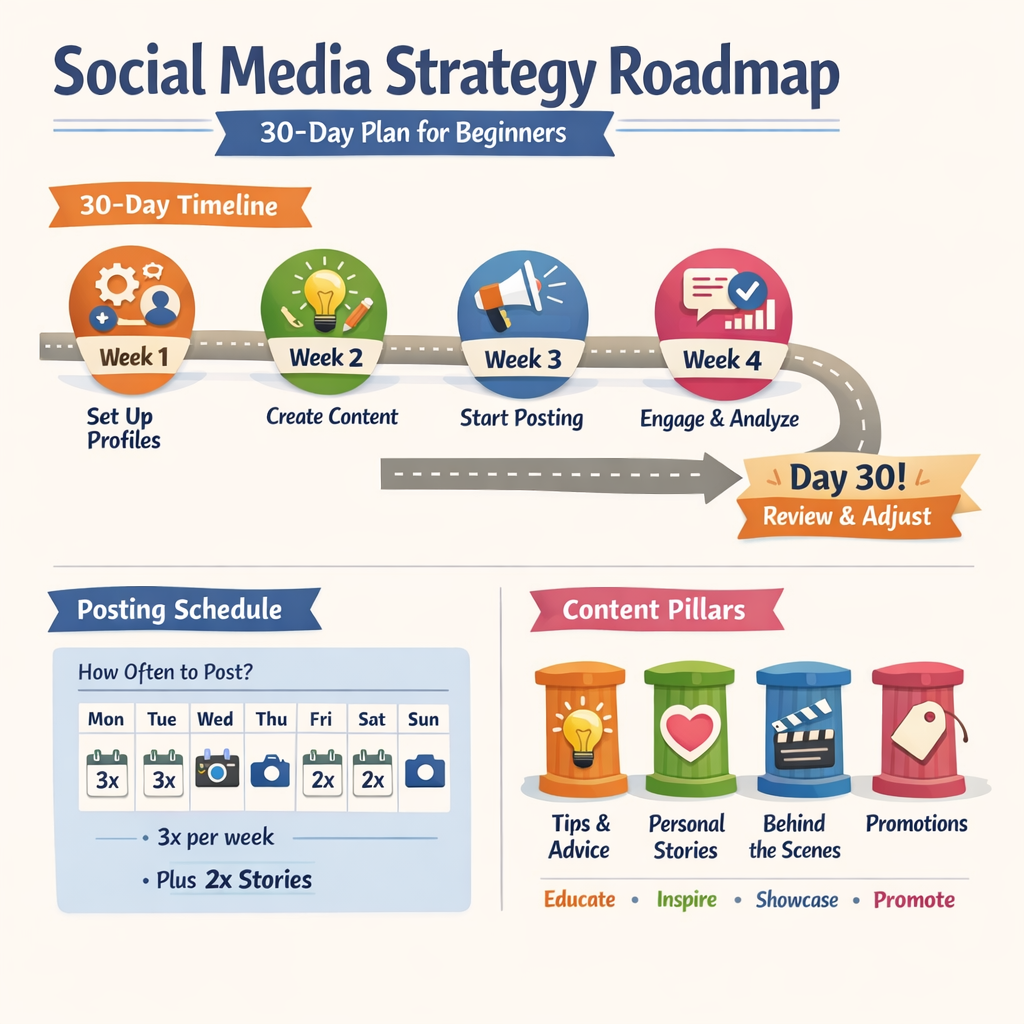
- Your First 30 Days: Week-by-Week Execution
- Tooling That Doesn’t Suck (And What to Skip)
- When to Add Paid Ads Without Setting Money on Fire
- Frequently Asked Questions
- Final Insider Takeaway
Why Most Social Media Strategy for Beginners Fail (And How to Avoid It)
Snippet answer: A simple social media strategy for beginners is: pick one outcome, choose one primary platform, post 3–5 times per week using 3–4 content pillars, and review results weekly. Your first 30 days should focus on consistency, not “going viral.”
Fast forward to what actually happens: you start strong, you post three days in a row, then you disappear for two weeks because you ran out of ideas and motivation. That’s not a discipline problem. That’s a systems problem.
Here’s the truth: algorithms don’t reward “intention.” They reward sustained signals. If your account looks like a ghost town, the system treats you like one.
And no, you don’t need to “learn the algorithm” like it’s sacred scripture. You need to ship. A lot. Consistently. (Also, if you’re wondering why people are so addicted to feeds: social platforms are literally built for constant interaction and user-generated content loops—Wikipedia’s summary is a decent baseline.) Source
One more uncomfortable detail: attention is fragile. Even five minutes of short-form scrolling can measurably impact focus in controlled settings. If your audience is distracted (they are), your content must earn attention fast. Source
Pick One Goal and One Metric
If you try to grow followers, sell products, build a newsletter, and become “a thought leader” in your first month, you’ll do none of it well.
Choose one outcome for 30 days. Examples:
- Lead generation: email signups, contact form submissions
- Sales: clicks to a product page or affiliate hub
- Awareness: profile visits or saves (not “likes,” calm down)
Then pick one metric that actually maps to that outcome. Not vanity. Not vibes.
- If you want leads: link clicks and email opt-ins
- If you want sales: click-through rate and conversion rate
- If you want awareness: shares and saves
Insider rule: track one “input metric” and one “output metric.” Input = how many posts you ship. Output = what the business gets.
Choose Two Platforms (Not Five)
Beginner mistake: “I’ll post everywhere.” Translation: “I’ll burn out everywhere.”
Pick:
- One primary platform where you’ll post your best stuff first.
- One secondary platform where you’ll repurpose with minimal effort.
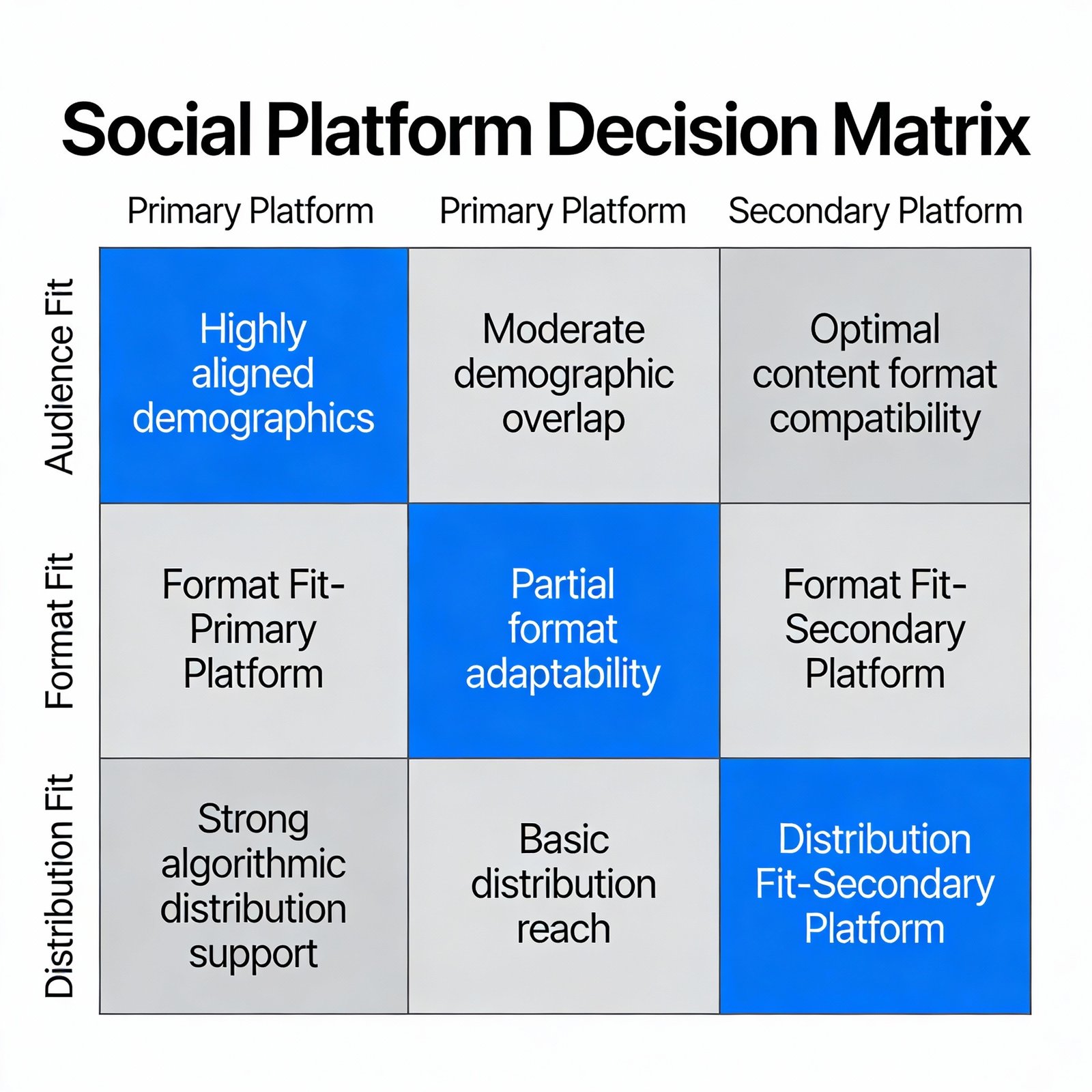
How do you decide? Use this boring-but-effective filter:
- Audience fit: Are your people already there?
- Format fit: Can you produce native content without hating your life?
- Distribution fit: Does your content type get reach without an existing audience?
If you’re truly stuck, default to the big reality: most people are already on major platforms like YouTube and Facebook in large numbers. That doesn’t mean you must use them, but it’s a useful sanity check when you’re tempted to pick an obscure platform because a guru said it’s “underrated.” Source
Build Your Beginner Content Plan in 30 Minutes
A beginner content plan isn’t a 40-tab spreadsheet. It’s a small set of repeatable angles you can run on autopilot.
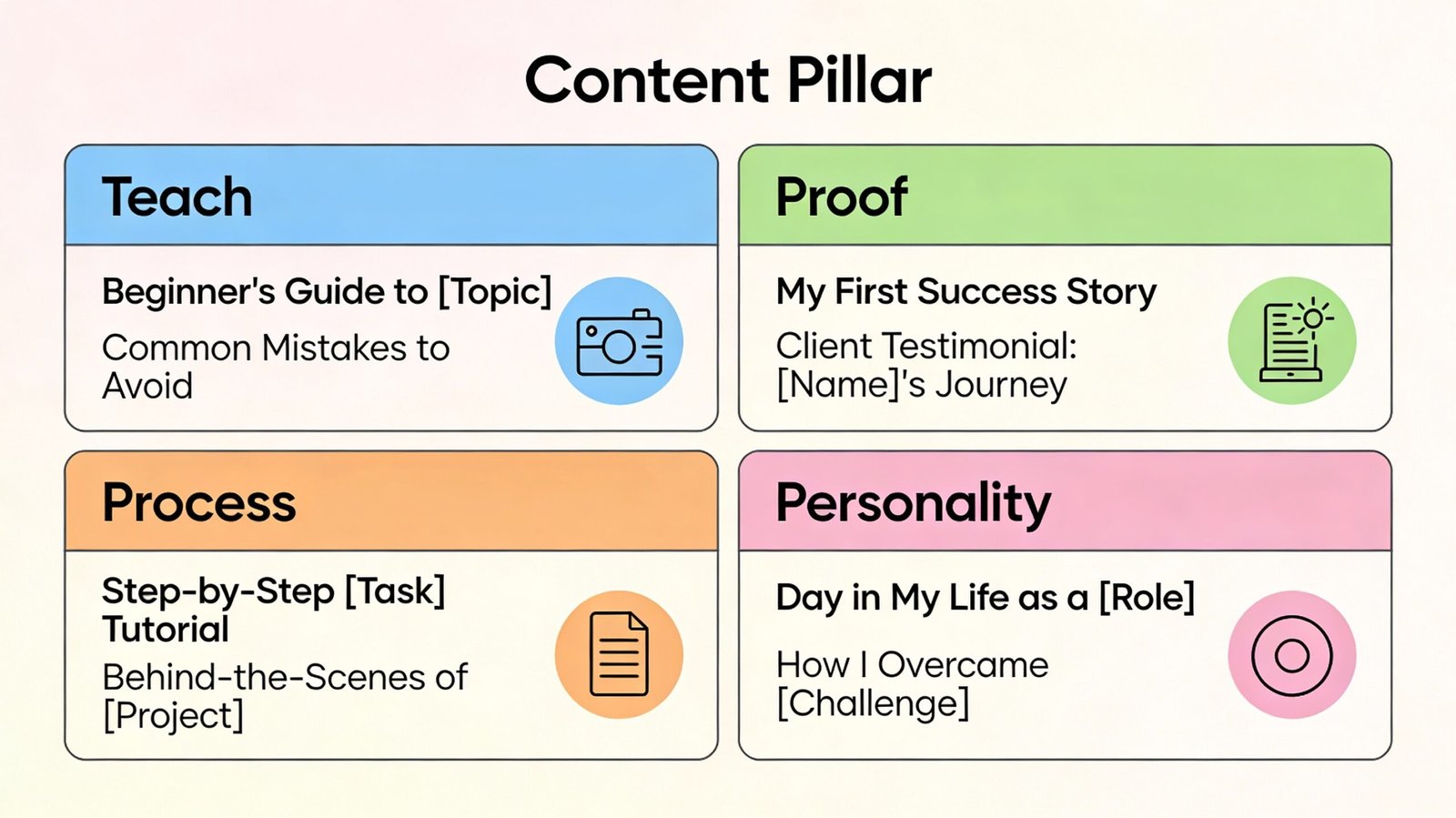
Build 3–4 content pillars. Not 12. Not “everything I know.” Keep it tight.
- Pillar 1: Teach (how-to, checklists, “do this not that”)
- Pillar 2: Proof (case studies, before/after, results, screenshots)
- Pillar 3: Process (behind-the-scenes, how you work, your tools)
- Pillar 4: Personality (opinions, hot takes, stories, lessons learned)
Now give each pillar 5 post ideas. That’s 20 ideas. You just built a month.
And yes, “Process” works even if you’re not famous. Documenting your learning is a growth hack that isn’t gross. It’s also harder to fake, which is why it builds trust.
One compliance note, because you don’t need the FTC tapping your shoulder: if you promote affiliate products or partnerships, disclosures need to be clear and close to the endorsement. Not hidden. Not cute. Clear. Source
A Posting Schedule You’ll Actually Follow
Your posting schedule should be designed like engineering: stable, repeatable, and resistant to chaos.
Start here:
- 3 posts/week if you’re busy (most humans)
- 5 posts/week if you can batch content (the smarter move)
And make the schedule specific. Not “I’ll post more.”
- Monday: Teach
- Wednesday: Proof
- Friday: Process or Personality
Here’s the truth: random posting teaches your audience to ignore you. Patterned posting teaches them what to expect.
If you want to save time and keep quality high, batch creation and schedule posts. And yes, sometimes physical planning beats another app you’ll abandon. Simple tools work because they don’t need motivation to boot up.
Also: don’t buy a $900 camera setup on day one. Your phone is fine. Your lighting probably isn’t.
Your First 30 Days: Week-by-Week Execution
This is the part most people skip because it’s not glamorous. Which is exactly why it works.
Week 1: Setup + Baseline (Days 1–7)
- Fix your profile: who you help, what you post, what to do next (one link).
- Define your pillars (from the earlier section) and draft 20 ideas.
- Ship 3 posts and log baseline metrics (views, saves, profile visits, clicks).
One internal shortcut if you plan to run ads later: build your foundation early so you don’t have to rebuild under pressure. This setup sprint is a good reference for getting your paid side organized without chaos. paid ads setup sprint
Week 2: Consistency + Feedback (Days 8–14)
- Ship 3–5 posts.
- Double down on the winner: replicate the top post format once.
- Reply to comments/DMs like a human, not a chatbot in a suit.
Insider rule: your first “strategy” is basically a debugging cycle. Ship, observe, adjust. Repeat.
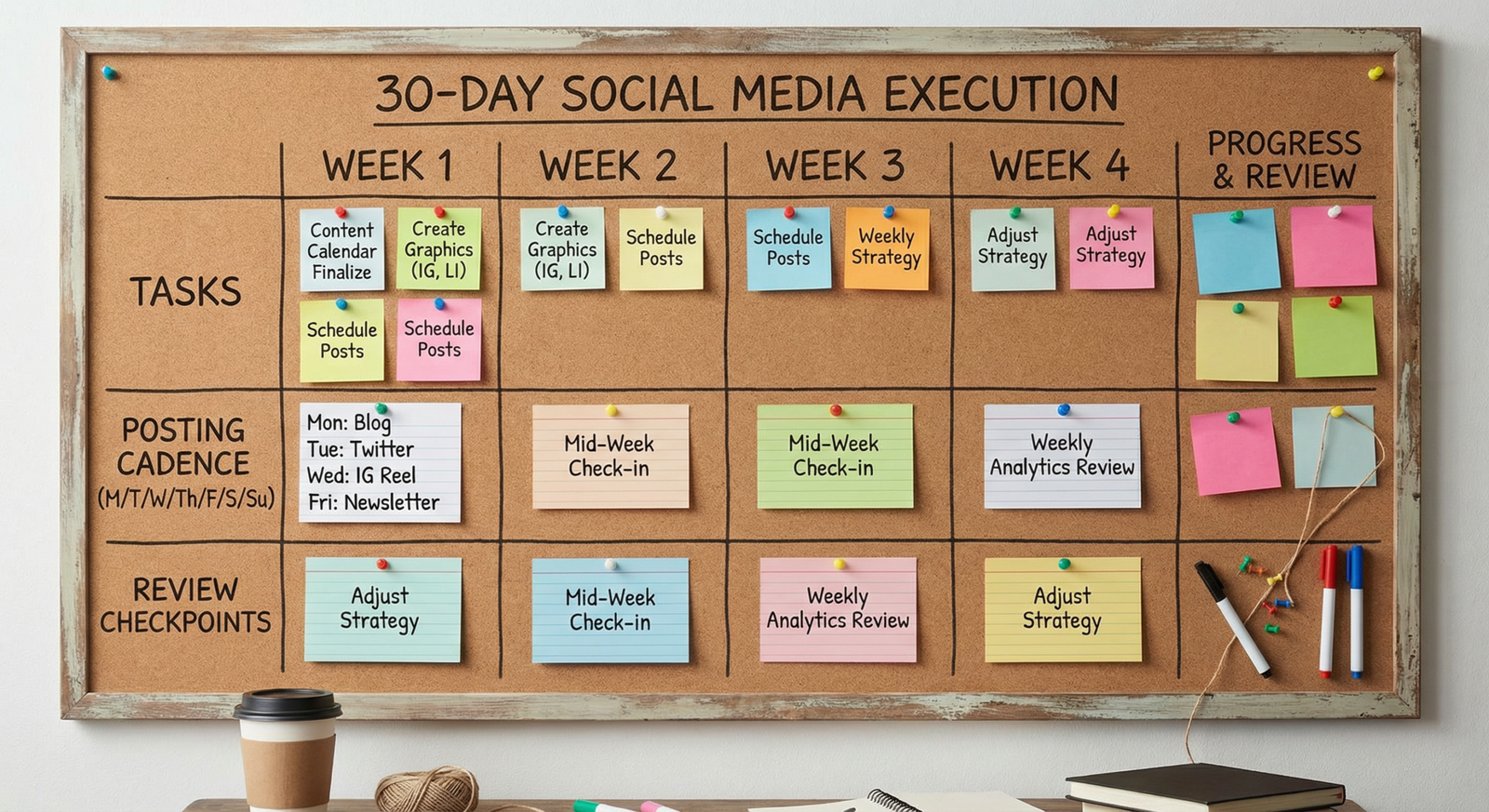
Week 3: Systemize + Repurpose (Days 15–21)
- Create templates: one hook structure, one caption structure, one CTA.
- Repurpose: turn one strong post into 2–3 variations (different hook, same core).
- Batch: write or record two weeks of content in one sitting.
If your content takes three hours per post, you don’t have a strategy—you have a hobby with deadlines.
Week 4: Conversion + Small Experiments (Days 22–30)
- Add a single CTA: one landing page, one offer, one next step.
- Run one experiment: different hook style, different posting time, different format.
- Review: keep what works, kill what doesn’t.
Bottom line: your first 30 days are about building the machine, not perfecting the paint job.
Tooling That Doesn’t Suck (And What to Skip)
You can spend $0 and still execute a simple social media strategy. But you can’t spend $0 and buy discipline.
Use tools to reduce friction, not to feel productive. If you’re collecting tools instead of publishing, you’re procrastinating with receipts.
- Notes app / Google Docs: idea bank + captions
- Calendar: posting schedule you can see at a glance
- Basic design tool: simple visuals, consistent templates
Skip anything that promises “automatic virality” or “AI growth in 24 hours.” That’s not strategy. That’s snake oil with a subscription.
If you use affiliate links or recommend gear, add a disclosure that’s obvious. The FTC doesn’t care about your aesthetics. They care about clarity. Source
When to Add Paid Ads Without Setting Money on Fire
Paid ads are a megaphone, not a life coach.
Do not run ads if:
- You have no clear offer or conversion goal.
- Your profile is confusing or incomplete.
- You don’t know which organic post formats actually land.
Run ads when:
- You’ve posted at least 10–20 times and can identify what resonates.
- You have one conversion target (email opt-in is a solid start).
- You can commit to basic tracking without guessing.
If you want a structured ramp, use a sprint approach to get the plumbing right fast. This guide lays out a practical setup path that avoids the “boost button” trap. rapid paid ads setup sprint
Frequently Asked Questions
How many times per week should a beginner post on social media?
Start with 3–5 posts per week on one primary platform. Consistency beats volume. If you can’t keep it for 30 days, it’s too aggressive.
Do I need to be on every platform to grow?
No. Pick 1–2 platforms and do them well. Most beginners spread too thin, then wonder why nothing sticks.
What should I post if I’m not an expert yet?
Document what you’re learning: tests, results, lessons, and mistakes. People trust a real journey more than a fake “guru” voice. Keep claims grounded and show receipts when you can.
When should I start running paid ads?
After you have 10–20 solid posts and one conversion target. Ads amplify what exists; they don’t fix weak messaging. Use a setup sprint if you want to avoid sloppy tracking: paid ads setup in 7 days
How do I disclose affiliate links or partnerships correctly?
Make disclosures clear and close to the endorsement. Not buried. Not vague. The FTC’s guidance is straightforward: be obvious. Source
Final Insider Takeaway
Here’s the truth: the best Social Media Strategy for Beginners is the one you can execute without negotiating with yourself every day.
Build the smallest machine that produces consistent posts. Run it for 30 days. Review weekly. Improve one thing at a time.
And if you’re tempted to chase every shiny tactic, remember: the algorithm doesn’t pay your bills. Your output does.
Now go post something useful. I’ll be over here, drinking coffee and quietly judging your draft folder.
As an Amazon Associate, I earn from qualifying purchases.





One Comment