
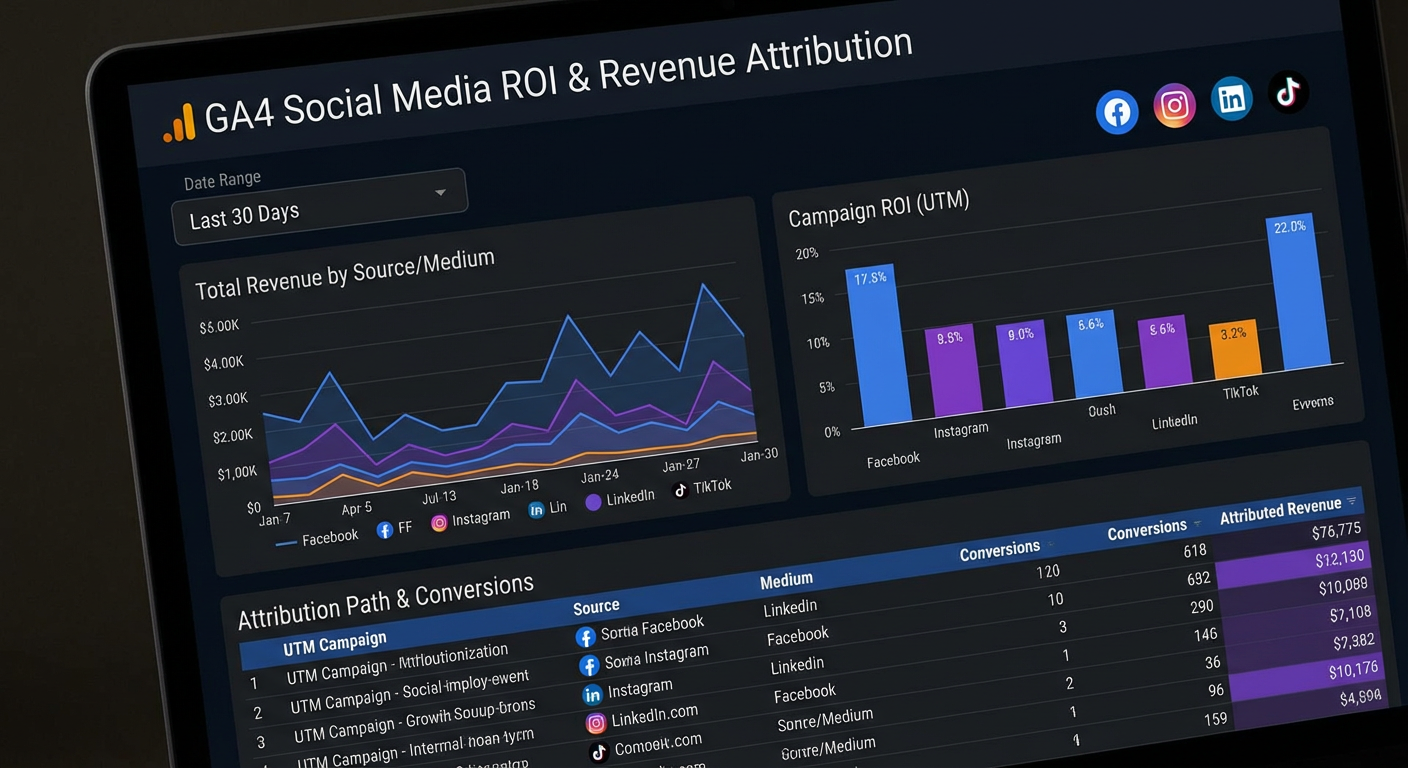
Social Media ROI Tracking is where optimism goes to die… unless you instrument it like an adult. The problem is most “ROI reports” are really engagement reports wearing a fake mustache.
If your boss/client/inner critic keeps asking “Cool post… but did it sell anything?” you don’t need more content. You need clean tracking. And yes, GA4 can do it—if you stop treating UTMs like optional accessories.
Here’s the uncomfortable truth: social is messy, multi-touch, and full of app-to-browser weirdness. But you can still prove what makes money. You just need a system that’s consistent, boring, and hard to break.
Table of Contents
- The ROI definition that doesn’t lie
- Set up GA4 so social traffic isn’t a black hole
- UTM tracking for social media that doesn’t implode
- Social media attribution: pick a model, know its bias
- Track revenue from Instagram (without guessing)
- Dashboards and cadence: report like you mean it
- Tools that help (and tools that waste time)
- Frequently Asked Questions
- The insider takeaway
The ROI definition that doesn’t lie
Measure ROI with one formula and never change it mid-quarter. Social media ROI is not “likes × vibes.” It’s a ratio of outcome to cost, and the outcome has to be tied to a conversion event you actually care about. If you keep redefining “success,” your numbers will magically improve… and your credibility will magically vanish.
Snippet Trap: Social media ROI is measured by tracking conversions (revenue, leads, or pipeline) back to social campaigns using UTMs in links, capturing those sessions in GA4, and comparing the conversion value to total social costs (ads + labor + tools). If UTMs and conversions aren’t configured, ROI is guesswork.
At a minimum, pick one of these outcomes:
- Revenue ROI: eCommerce purchase value or paid bookings.
- Lead ROI: form submits, calls, demos, trials—assigned a realistic value.
- Pipeline ROI: CRM-driven revenue, delayed but highest-fidelity.
And define cost like you’re not trying to win an argument on the internet:
- Paid spend (obvious).
- Creative + management time (yes, your time counts).
- Tools (schedulers, reporting, link-in-bio, etc.).
Want a baseline definition? ROI is commonly expressed as (Gain − Cost) / Cost. It’s not glamorous, but it’s stable and widely understood. Wikipedia’s ROI overview is perfectly fine for this part. Use it to end debates fast.
Set up GA4 so social traffic isn’t a black hole
GA4 is not “broken.” Your implementation is. Most GA4 social reporting failures come from three things: missing UTMs, missing conversions, and messy cross-domain or referral settings. Fix the plumbing before you blame the dashboard.
Start with the non-negotiables:
- Install GA4 properly: use Google Tag Manager if you value your sanity, and verify events are firing consistently.
- Define conversions: pick 1–3 “money events” (purchase, lead, booking) and mark them as conversions in GA4.
- Attach value: purchases get value automatically; leads need assigned value (more on that later).
Then, make GA4 usable for social analysis:
- Check Default Channel Grouping: social should land in “Organic Social” or “Paid Social,” not “Direct.” If it’s “Direct,” your links are dirty or stripped.
- Verify referral exclusions and cross-domain tracking: if you use third-party checkout/booking, you can accidentally credit the sale to Stripe/PayPal/Calendly instead of the social click.
- Use Explorations for reality checks: Traffic acquisition is fine for quick glances, but Explorations is where you validate campaign and source/medium patterns.
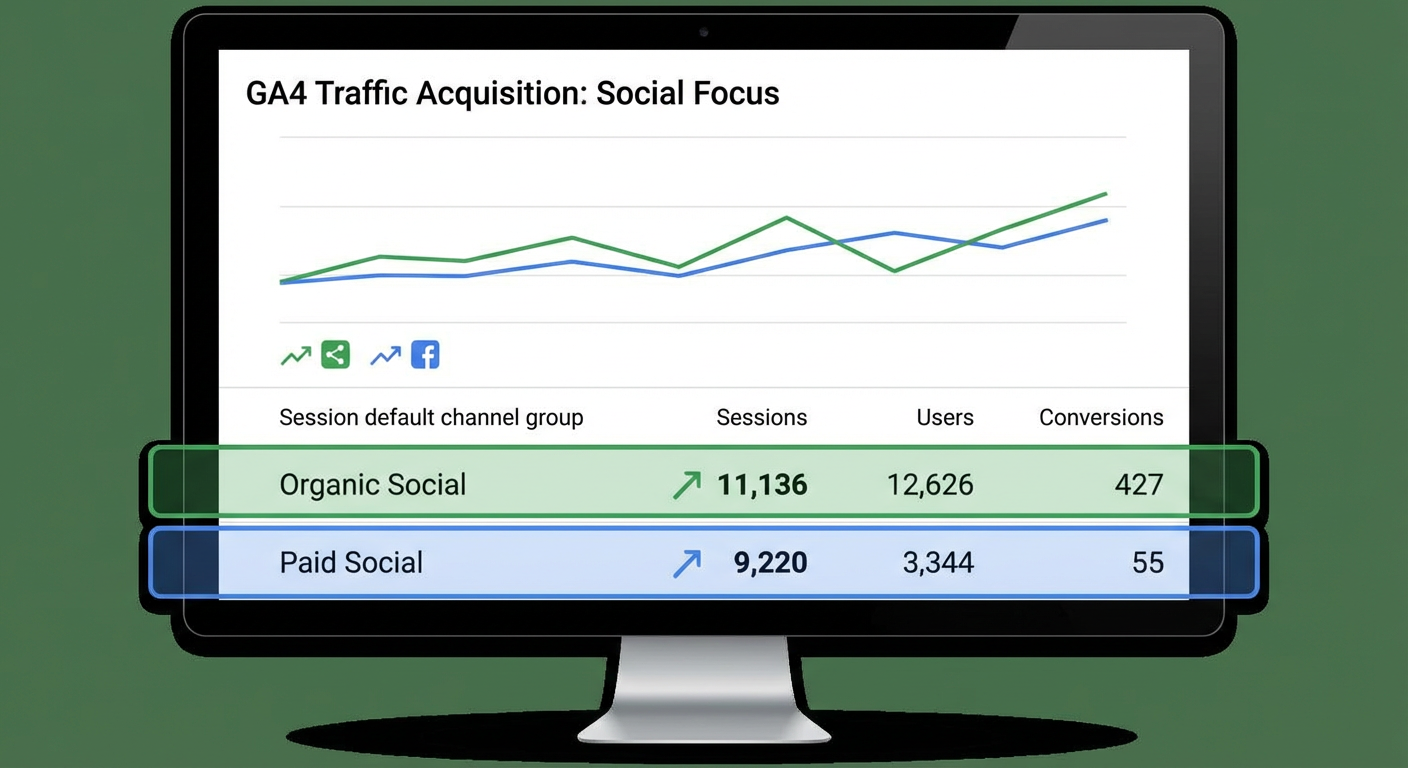
Google’s own GA4 documentation is clear on how acquisition dimensions and event-based measurement work—so if your team argues about “how GA4 counts things,” point them to the source and move on. Google Analytics Help Center is the canonical reference.
Also: if you don’t have a written strategy, ROI tracking turns into random act reporting. If you need a clean framework for goals, content intent, and measurement alignment, plug this into your foundation: social media strategy & planning.
UTM tracking for social media that doesn’t implode
UTMs are the difference between “we think” and “we know.” If you want to know how to measure social media ROI without hallucinating, you need consistent campaign tagging. Period.
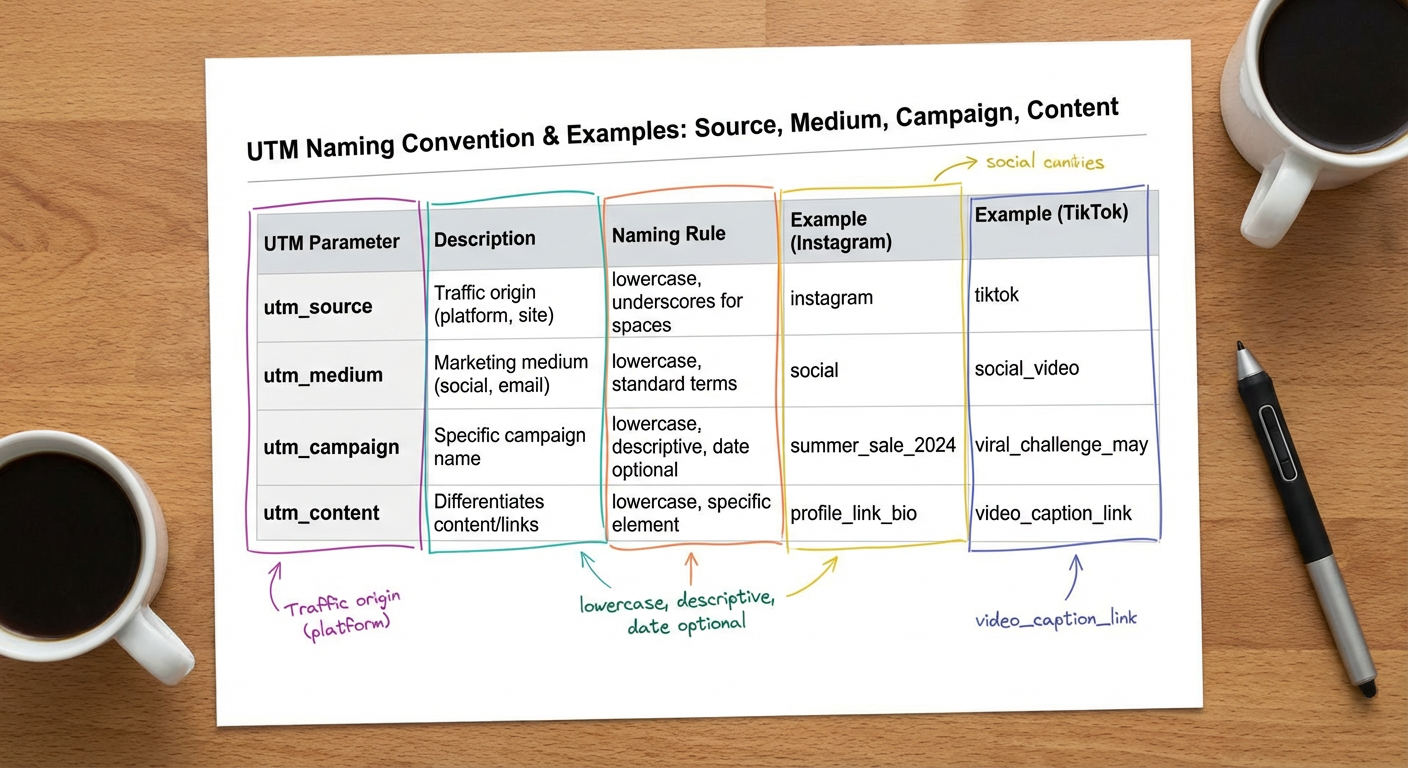
Here’s the truth: most UTM tracking for social media fails because humans freestyle naming conventions. “instagram,” “IG,” “Insta,” “insta_paid,” and “InstaPaid2_FINAL” all end up in GA4 as separate buckets. Congratulations, you just invented data fragmentation.
Fix it with a strict UTM taxonomy:
- utm_source: platform (instagram, tiktok, linkedin, youtube)
- utm_medium: paid_social or organic_social (don’t get cute)
- utm_campaign: offer_or_content_pillar + quarter (leadmagnet_q1_2026)
- utm_content: creative_id (reel_hook03, carousel_benefits02)
- utm_term: optional; use only if you have a clear meaning
One-sentence rule: if two people would label it differently, the label is too vague.
Use Google’s Campaign URL Builder when you need a quick link and don’t want to fat-finger parameters. Google’s UTM builder guidance exists for a reason.
And watch for the usual UTM killers:
- Link shorteners that strip params: some are fine; some are absolute garbage.
- Redirect chains: each hop is a chance to lose UTMs.
- In-app browsers: especially on Instagram—expect weirdness and test your links like you don’t trust anyone (you shouldn’t).
UTMs themselves aren’t mystical; they’re just query parameters used for campaign tracking. If anyone on your team needs the “what are these things?” baseline, here’s the neutral reference. Wikipedia’s UTM parameters summary.
Social media attribution: pick a model, know its bias
Attribution is not truth. It’s a model. Models have assumptions, and assumptions have blind spots. Your job isn’t to find the perfect model. Your job is to pick one, understand what it over-credits, and use it consistently.
Here’s what usually happens in social reporting:
Last-click says social is useless. Because social often starts the journey, then email/search/retargeting closes it.
View-through says social is magic. Because it credits impressions that might not have caused anything.
Pick your poison, then mitigate it:
- Last-click: conservative, undervalues top-of-funnel social. Good for “what closed?” not “what created demand?”
- Position-based: gives credit to first and last touch; decent for social-heavy funnels.
- Data-driven attribution: best when you have volume; still not perfect, but less arbitrary than rules-based models.
Engineer move: report two views side-by-side. One “conversion capture” view (last-click) and one “demand creation” view (data-driven or position-based). If both say the same story, you can walk into any meeting with a straight face.
If you want a strong foundational concept for why multi-touch gets messy, read up on attribution in marketing science and the broader idea of causal inference. You don’t need a PhD, but you should know the difference between “correlated” and “caused.” A practical starting point: marketing attribution overview.
Track revenue from Instagram (without guessing)
Tracking Instagram revenue is doable. Pretending it’s easy is the lie. Instagram is full of app handoffs, link-in-bio tools, DMs, and “I saw it on your story” behavior. So you build a measurement chain that can survive reality.
There are three common revenue paths. Pick the one you actually have:
1) E-commerce or checkout
If you sell directly, you want GA4 purchase events, clean UTMs, and proper cross-domain settings if checkout happens elsewhere. Then you can see purchase value by source/medium and campaign.
2) Leads (most businesses live here)
Leads are where social ROI tracking goes to die because people refuse to assign values. Don’t be that person.
Assign lead value like this: Lead Value = (Close Rate) × (Average Profit per Sale). If you only know revenue, use revenue as a placeholder and tighten later. The point is directional truth, not accounting purity.
3) DM-driven conversions
DM attribution is the Wild West. You can still track it:
- Use DM-specific links: “DM me ‘QUOTE’” then reply with a UTM-tagged link unique to that campaign.
- Use coupon codes: campaign-specific codes (yes, it’s crude; it works).
- Use a short form with hidden fields: carry UTM parameters into lead capture so your CRM retains source data.

Bottom line: if someone says “Instagram can’t be tracked,” what they mean is “we didn’t set up a measurement chain.” That’s a solvable problem.
Dashboards and cadence: report like you mean it
Don’t report everything. Report what drives decisions. The fastest way to make executives ignore you is to send a 47-metric dashboard where none of the numbers connect to money.
Here’s a lean reporting stack that actually works:
- Weekly (operational): sessions, conversions, conversion rate, top campaigns, top landing pages, basic spend (if paid).
- Monthly (business): conversion value, cost, ROI, CAC (if you can), and one narrative: “what we’re doubling down on / what we’re killing.”
- Quarterly (strategy): attribution comparisons, cohort quality, and whether social is improving pipeline quality over time.
One more unpopular opinion: if you don’t tie social reporting to your actual plan, you’ll chase random spikes. This is why strategy and measurement have to lock together—again, this is where a structured plan helps: social media strategy planning.
Pro move: include one “confidence note” in every monthly report. Example: “Instagram revenue attribution is directional because X% of conversions occur after DM follow-up.” That single sentence builds trust and prevents future blame games.
Tools that help (and tools that waste time)
Tools don’t fix broken measurement. They just automate it. Automating chaos gives you faster chaos.
Tools that actually help:
- A shared UTM builder sheet: a boring spreadsheet that forces naming consistency. Unsexy. Effective.
- Tag Manager + a clean GA4 config: reduces “who changed what?” drama.
- A dashboard layer (optional): Looker Studio is fine if you keep it simple.
Tools that often suck (with love):
- “All-in-one social ROI” platforms that promise perfect attribution without UTMs. If a tool says it can read your mind, it’s selling you fiction.
- Heavy reporting suites for small teams. If it takes three weeks to onboard, you’re buying a second job.
If you want a tangible “make it hard to mess up” asset, grab a UTM campaign tracking planner or GA4 tracking reference and keep it in your ops stack. Use a search link so you can pick what fits your workflow:
And yes, you can do all of this without buying anything. The point is discipline, not shopping.
Frequently Asked Questions
What’s the simplest way to measure social media ROI?
Use one ROI definition and one conversion definition. Track UTM-tagged social sessions in GA4, measure conversions, assign value, then compare against cost. If your links aren’t tagged, you don’t have ROI—just vibes with charts.
Why does GA4 show “Direct” or “(not set)” for social traffic?
Usually missing UTMs, parameters stripped by redirects/shorteners, or messy app-to-browser handoffs. Also check channel grouping and cross-domain/referral exclusions. GA4 is literal; it won’t infer what you “meant.”
Can I track revenue from Instagram if I don’t have a webshop?
Yes—track lead value. Mark lead events as conversions in GA4 (forms, calls, bookings), then assign value based on close rate and profit per sale. It’s not perfect, but it’s honest.
Which attribution model should I use for social media attribution?
Start with data-driven attribution if you have enough conversions; otherwise compare last-click and a position-based model. The goal is consistency plus awareness of bias, not a mythical “true” number.
The insider takeaway
Social Media ROI Tracking is a systems problem, not a reporting problem. If you want numbers that hold up under pressure, build a chain you can defend: strict UTMs → clean GA4 conversions → sane value assignment → consistent attribution view.
Fast forward to next month: you’re not “asking for budget.” You’re showing what paid back and what didn’t.
And if someone still insists ROI is “impossible to measure,” smile politely. That’s not a measurement insight. That’s a process confession.
As an Amazon Associate, I earn from qualifying purchases.




One Comment
Comments are closed.