
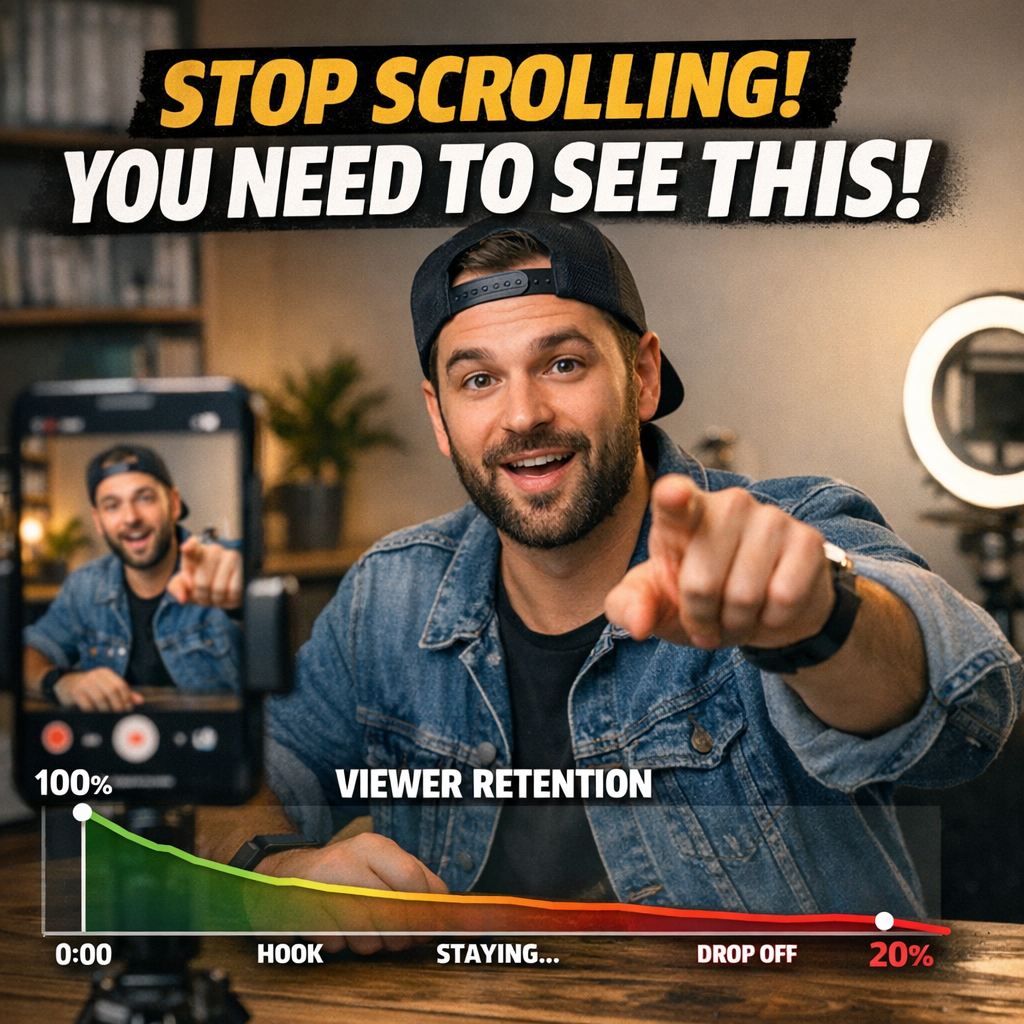
Here’s the truth: hooks that increase watch time aren’t “clever lines.” They’re engineered commitments—promises your video must keep. If your first seconds are fuzzy, slow, or self-indulgent, you’re donating views to creators who understand attention like a system, not a vibe.
Watch time is a referendum on expectations. The viewer makes a micro-decision: “Will this pay me back for staying?” Your job is to answer that in the first frame, then keep answering it every few seconds until the loop closes.
Table of Contents
- Why Most Hooks Fail (And Why Your “Energy” Doesn’t Fix It)
- The Hook Engineering Model: Clarity, Tension, Proof, Payoff
- 12 Video Hook Templates You Can Steal Today
- Retention Hooks: The Mid-Video Moves That Keep People Glued
- Stop the Scroll Hooks for Reels, Shorts, and TikTok
- Tools That Make Hooks Easier (Because Friction Kills Output)
- Frequently Asked Questions
- Final Takeaway
Why Most Hooks Fail (And Why Your “Energy” Doesn’t Fix It)
Snippet answer: Hooks that increase watch time work when they deliver instant clarity, create a specific open loop, and prove the payoff is real—fast. Use tight video hook templates, then add retention hooks every few seconds so viewers keep choosing “next second” instead of scrolling.
The problem is creators treat hooks like decoration.
They open with “Hey guys,” a logo animation, or a throat-clearing mini TED Talk. That’s not a hook. That’s a hostage negotiation where you offer nothing.
Your hook has one job: earn the next second. Not educate, not impress, not “set the vibe.” Just earn the next second. Then do it again.
Platforms don’t have feelings. They have feedback loops. “Did people stay?” is the whole game. This is basically the attention economy playing out at 60fps—human attention is scarce, and products (feeds) are optimized to maximize time spent. If you want the big-picture framing, read the primer on the attention economy here: Wikipedia: Attention economy.
Also: if you’re still pretending retention is “optional,” YouTube literally gives you retention tooling and highlights key moments because it matters. See YouTube’s own audience retention guidance: Measure key moments for audience retention.
Fast forward to the part nobody wants to hear: your content probably isn’t “too advanced,” it’s too vague. Vague promise. Vague payoff. Vague visuals. And then people scroll because scrolling is easier than guessing.
Want the blunt diagnosis playbook? I break down the algorithm side of this here: how feeds react to retention signals and distribution.
The Hook Engineering Model: Clarity, Tension, Proof, Payoff
If you want repeatable results, treat hooks like a system. Every winning hook (long or short) usually hits four elements—sometimes all at once, sometimes in a rapid sequence:
- Clarity: What is this and who is it for?
- Tension: What’s unresolved? What’s at risk if I keep scrolling?
- Proof: Why should I believe you? (Visual evidence beats words.)
- Payoff timing: When do you deliver, and how often?
Clarity is not “context.” Context is the 12-second backstory you want to share. Clarity is the 0.5-second answer the viewer needs. Example: “3 hook ideas for reels that doubled my retention in 7 days” + screen recording proof + a countdown overlay. Done.
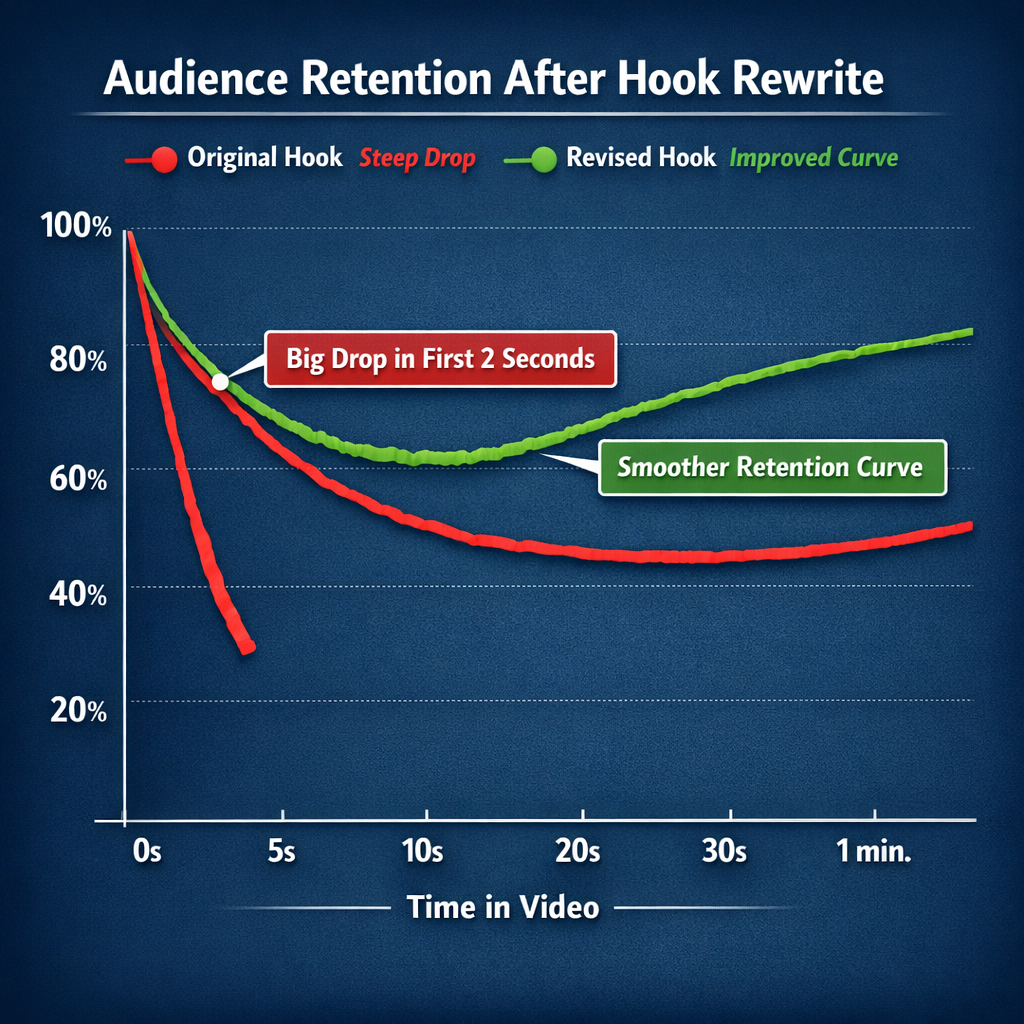
Tension is an open loop with teeth. Not clickbait. Not fake drama. A real gap: “You’re losing 40% of viewers before second 2—here’s the one line that fixes it.” The viewer stays because their brain hates unfinished business.
Proof is your credibility shortcut. Show the analytics. Show the before/after. Show the result. Meta’s own business content frames “the hook” as something you can test and optimize for Reels performance: Meta: The Science of the Hook.
Payoff timing is where most creators faceplant. They build tension… then they meander. If your payoff arrives late, your retention curve will look like a ski slope.
Bottom line: a hook is a contract. Break it, and the viewer leaves. Break it repeatedly, and the platform learns your content is a bad bet.
12 Video Hook Templates You Can Steal Today
These video hook templates work because they bake in clarity + tension in one breath. Use them as starting points, then tailor the nouns to your niche.
- The “You’re Doing It Backwards” hook: “If you start your video with X, you’re tanking retention. Do this instead.”
- The “I tested this” hook: “I A/B tested 5 hooks—this one won by a mile.”
- The “3-second demo” hook: “Watch this for 3 seconds and you’ll see why your hooks fail.”
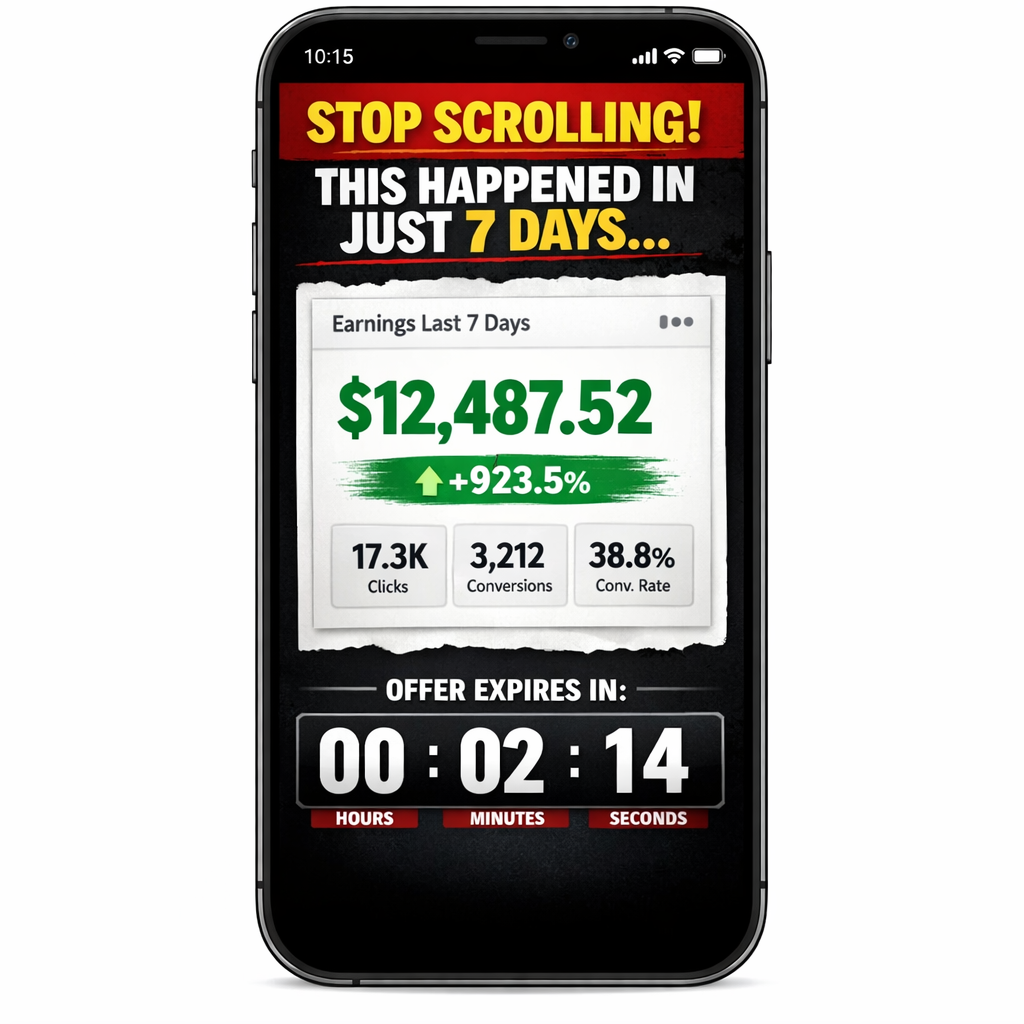
- The “Stop scrolling if…” hook: “Stop scrolling if your views die after the first second.”
- The “Tiny change, big result” hook: “I changed one word in my opener. Retention jumped.”
- The “Common mistake” hook: “This is the #1 mistake killing your short form hooks.”
- The “Do NOT do this” hook: “Don’t start with ‘Hey guys.’ Here’s what to do instead.”
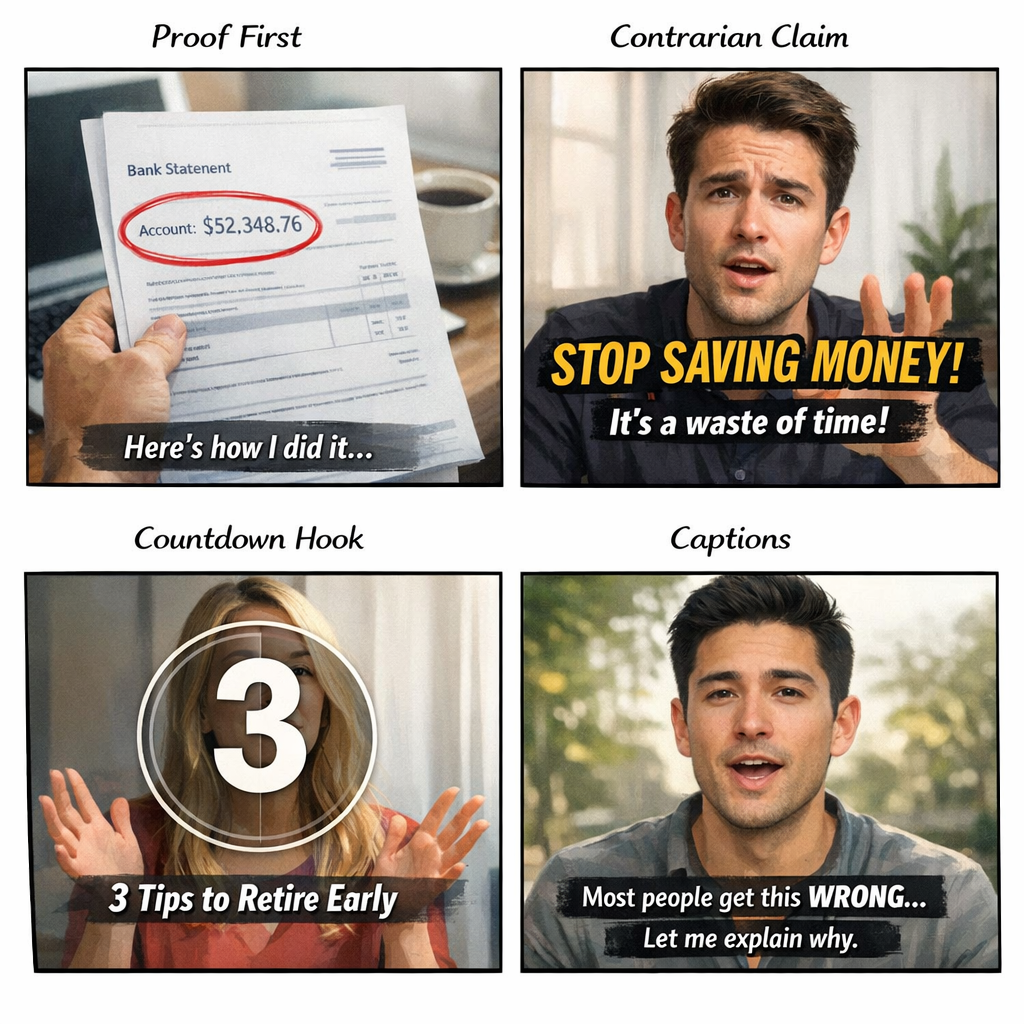
- The “Proof-first” hook: “Here’s the retention graph. Now I’ll show you what caused it.”
- The “Contrarian truth” hook: “Hooks aren’t the problem. Your payoff is.”
- The “Countdown” hook: “3 hook ideas for reels—#2 is the retention cheat code.”
- The “One-sentence promise” hook: “Give me 15 seconds and I’ll fix your opener.”
- The “Identity callout” hook: “If you’re a creator who hates cringe, use this hook format.”
One sentence of advice that pays rent: write the hook last. Build the payoff first. Then write the shortest possible promise that accurately predicts that payoff. That’s how you avoid clickbait and still win.
And yes, you should treat hooks like experiments. Your “creative intuition” is cute, but data wins. If you need a refresher on what the platforms reward and why, revisit this: the distribution mechanics behind watch time and recommendations.
Retention Hooks: The Mid-Video Moves That Keep People Glued
Here’s the part most hook lists ignore: the opening hook is only the entry ticket. Retention hooks are the micro-structures that keep people watching once they’ve stopped scrolling.
Use these as “beats” every 2–5 seconds in short-form, and every 15–30 seconds in longer videos:
- Micro-promises: “In 10 seconds, I’ll show the exact wording.”
- Progress markers: “Step 2 is where most people mess up.”
- Pattern interrupts: camera angle change, on-screen diagram, quick cut to proof.
- Open-loop stacking: “Hold that thought—this next part explains why it works.”
- Specificity spikes: numbers, timeframes, names, constraints (“1–3 seconds,” “first frame,” “three beats”).
- Payoff sampling: show the end result early, then explain how you got there.
What sucks (and I mean sucks) is when creators confuse “fast cuts” with retention. Cuts don’t create retention. Meaning creates retention. Cuts just help meaning land.
And if you want the cleanest signal in your analytics, look for a retention curve that flattens after the opening instead of continuing to bleed. YouTube’s retention tooling exists for a reason: YouTube Analytics metrics documentation even explains how retention is measured across time buckets.
Bottom line: your job is to keep paying off the hook in installments. If your video becomes a lecture, viewers treat it like homework.
Stop the Scroll Hooks for Reels, Shorts, and TikTok
Stop the scroll hooks have a specific job: interrupt autopilot. You’re not competing with “other creators.” You’re competing with the viewer’s thumb.
Here are practical, non-cringey ways to do it without turning into a carnival barker:
- Proof-first frame: open on the result (analytics, transformation, outcome), then label it.
- Text overlay that finishes the thought: “If your hook is longer than 7 words, fix this.”
- Hard constraint premise: “One hook format. No face cam. 15 seconds.”
- Visual contradiction: show the “wrong” way while saying “Don’t do this.”
- Direct niche callout: “Reels creators: stop using generic openers.”
Meta has talked openly about hooks and testing different versions to improve Reels performance. That’s not “guru advice,” that’s platform reality: Meta: The Science of the Hook.
Also, don’t confuse “louder” with “better.” If your opener is yelling but your promise is unclear, you’re just louder confusion.
If you want to get nerdy (in a useful way), map your first 3 seconds like an engineer:
- Frame 1: what is this?
- Second 1: why should I care?
- Second 2–3: what proof do I see that this is legit?
Then run 3 variations of the opener while keeping the rest the same. If you’re not testing, you’re guessing. And guessing is expensive.
For a deeper breakdown of how watch-time-based distribution tends to snowball, this is worth a read: algorithm hacking and growth mechanics.
Tools That Make Hooks Easier (Because Friction Kills Output)
Hooks are thinking work. Editing is execution work. If your workflow is slow, you’ll publish less, test less, and learn less. That’s not a motivation problem—it’s an ops problem.
Here are boring-but-effective tools that help you crank out better short form hooks without spending your life in post-production:
1) A solid lav mic (so your hook doesn’t sound like a voicemail)
If your audio is trash, viewers leave. They won’t comment, “Your audio is trash.” They’ll just disappear.
2) A small ring light (because clarity includes visual clarity)
Shadowy face + messy background = “hard to parse” = scroll. Simple lighting is a retention cheat nobody wants to admit works.
3) A teleprompter setup (for tight delivery, not robotic delivery)
Stop rambling. A teleprompter helps you hit the hook cleanly, keep pacing, and land the payoff without “umm” tax.
Search smartphone teleprompters on Amazon
And before someone says “tools don’t matter”: correct, they don’t matter as much. But they reduce friction. Reduced friction increases publishing volume. Increased volume increases testing. Testing produces winners.
Frequently Asked Questions
Do hooks that increase watch time work differently for Reels vs Shorts vs TikTok?
Yes and no. The core mechanics are identical—clarity, tension, proof, payoff—but each platform has different viewer norms. Reels loves clean context + loopable endings, Shorts loves tight pacing, and TikTok often rewards premise + escalation. Same engine, different tuning.
How long should the hook be in short-form videos?
1–3 seconds to earn the next 3–5 seconds. If your opener needs a paragraph, the premise is doing too much. Shorten the promise, show proof faster, and tighten the first sentence.
What is the biggest reason viewers drop in the first few seconds?
Ambiguity. If viewers can’t instantly tell what they’re watching and what they’ll get, they bounce. Front-load the “what + why + proof” so the brain doesn’t have to guess.
Can a strong hook save boring content?
No. A strong hook can get the click/stop. If the content doesn’t deliver, retention collapses and you train the algorithm (and your audience) to distrust you. Match the hook to the payoff, then speed up the payoff.
Final Takeaway
Here’s the truth: the best hooks aren’t “creative.” They’re clear contracts that get paid off quickly, with retention hooks sprinkled like clockwork.
Build one week of tests. Same video body, three different openers. Track retention. Keep the winner. Repeat.
And if you find yourself saying “the algorithm hates me,” I’ve got a technical diagnosis for you: it doesn’t hate you. It just prefers videos that keep people watching. Rude, but fair.
As an Amazon Associate, I earn from qualifying purchases.



3 Comments