
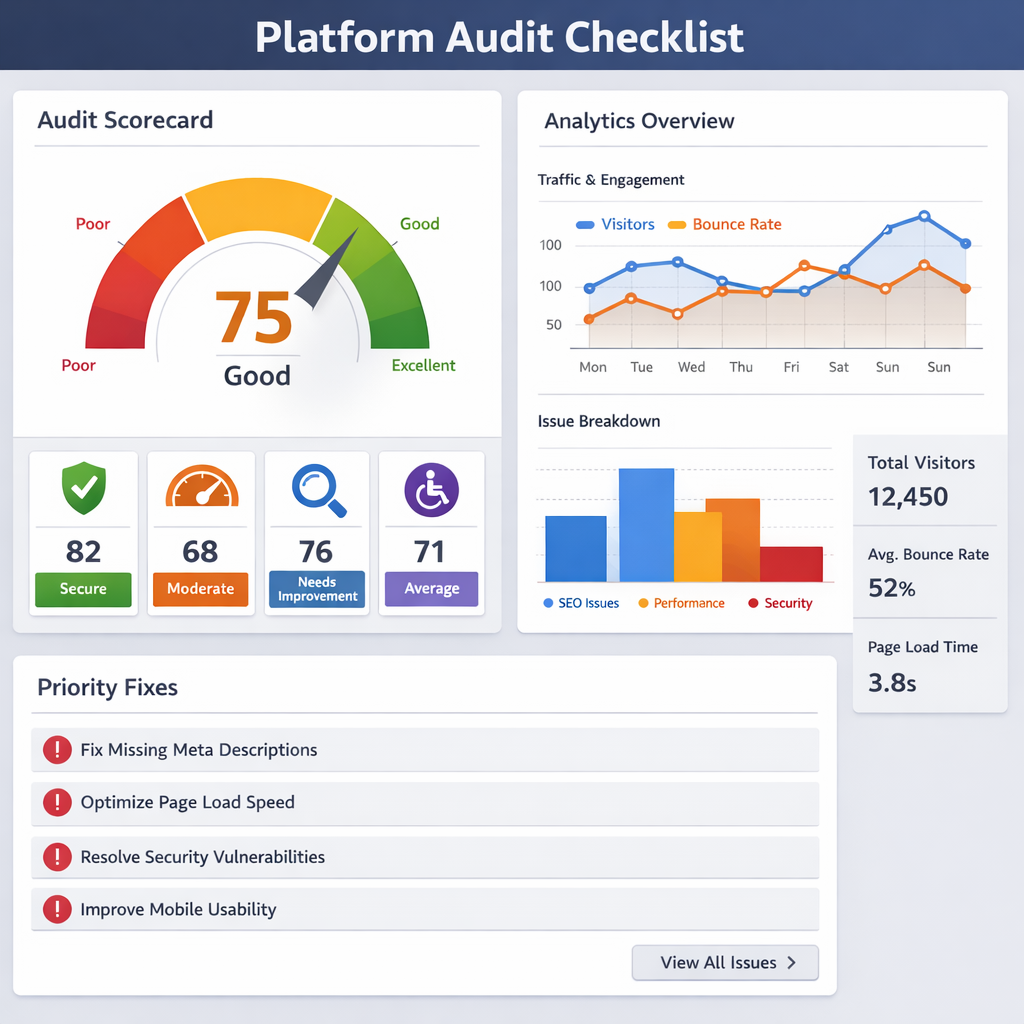
Here’s the truth: a platform audit checklist is the fastest way to stop posting into the void and start making your social accounts behave like a business asset. The problem is most “audits” are just people admiring their grid, sprinkling buzzwords, and calling it strategy.
If you want a real platform strategy audit, you need receipts: measurement that isn’t lying, a profile that converts, content that earns attention on purpose, and an execution plan that doesn’t collapse the moment you get busy.
Table of Contents
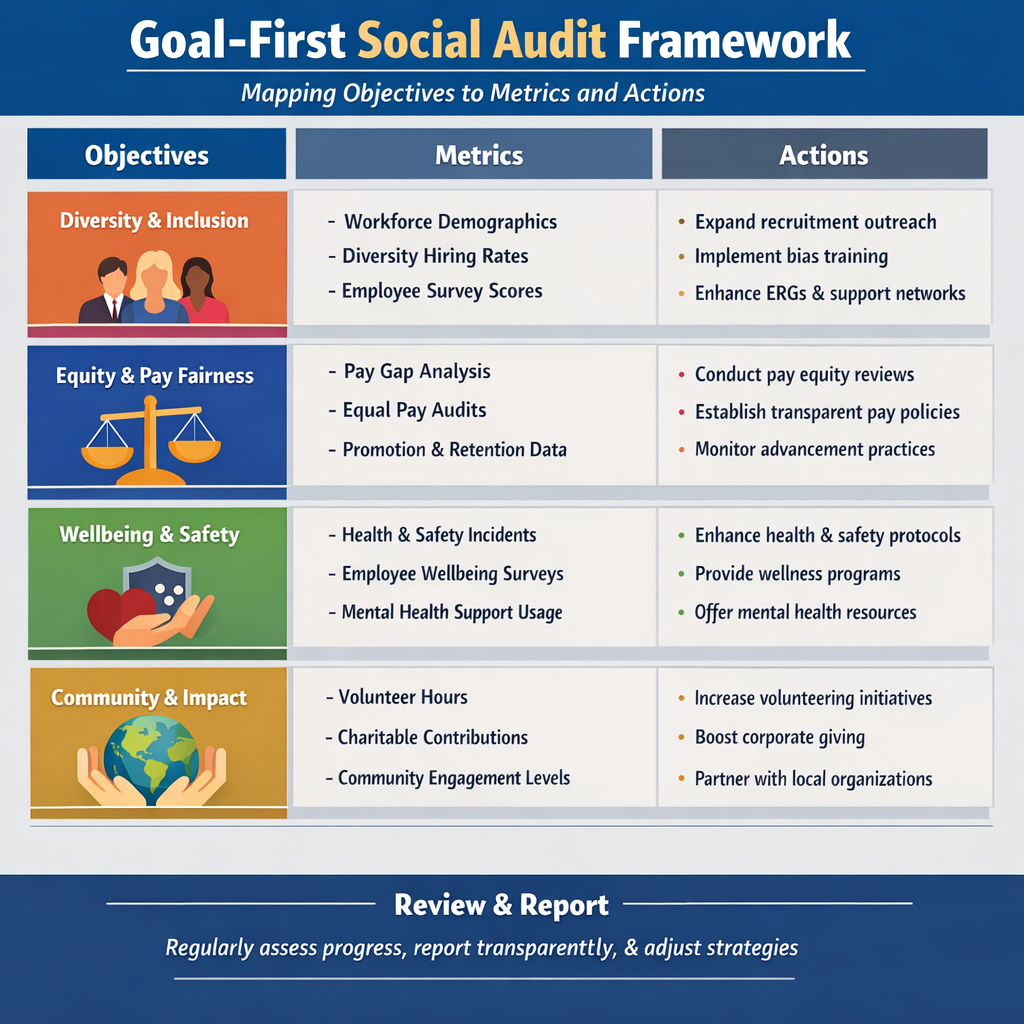
- 1) Set the goal (or you’re auditing vibes)
- 2) Tracking & data hygiene
- 3) Profile & positioning checks
- 4) Content performance diagnostics
- 5) Audience & community signals
- 6) Creative & production system
- 7) Competitive benchmarks (without copying)
- 8) Platform audit scorecard & priorities
- 9) Tools, templates, and the “don’t be lazy” kit
- Frequently Asked Questions
- Final takeaway
1) Set the goal (or you’re auditing vibes)
Snippet answer: A platform audit checklist is a structured review of your social account’s setup, tracking, content, audience signals, and conversion path so you can identify what’s working, what’s wasting time, and what to fix first. The output should be a prioritized action plan, not “notes.”
Before you touch analytics, decide what “good” means. If you can’t define success, you can’t diagnose failure. Simple.
- Primary objective: brand discovery, lead capture, sales, retention, support deflection, or creator growth.
- Primary conversion action: email opt-in, call booking, product page click, DM keyword, app install, store visit.
- Time horizon: 30 days (quick wins), 90 days (system fixes), 6 months (compounding).
Fast forward to what most teams do: they chase reach because it’s easy to screenshot. Reach is fine, but reach without downstream action is just entertainment.
If you want a deeper structure for this, borrow the logic from this platform strategy audits playbook and map your audit to the funnel stages you actually care about.
2) Tracking & data hygiene
The problem is your analytics are probably lying to you. Not maliciously—just because you’ve got inconsistent links, sloppy UTM tags, and “link in bio” chaos.
Tracking checklist (non-negotiable)
- UTM naming system: consistent source/medium/campaign. If you’re improvising UTMs, stop. Use a naming rule and enforce it.
- Single routing layer: one link hub (or a dedicated landing page) that you control, so you can update destinations without breaking posts.
- Event clarity: define what counts as a conversion (signup, purchase, booking) and ensure the site analytics can see it.
- Spam filtering: remove bot traffic and internal traffic where possible, or your “growth” will look fantastic right up until payroll.
Want a standard to steal? The U.S. government has practical guidance for measuring digital services and performance (yes, really). If you want a sanity anchor for measurement discipline, start at digital.gov and compare your measurement posture to what competent teams do.
Compliance reality check
If you do affiliate promotions, paid endorsements, or “gifted” product placements, you need disclosures that pass the sniff test. The FTC’s endorsement guidelines exist because marketers kept pretending ads were friendship. Read the official guidance at ftc.gov and bake disclosure checks into the audit.
Bottom line: if your tracking is garbage, your audit becomes performance cosplay. Fix measurement first, then score the rest.
3) Profile & positioning checks
Your profile is not a biography. It’s a conversion surface.
Profile audit checklist
- One-line promise: who you help + what outcome + how you do it (in plain language).
- Proof signal: credential, methodology, results, media feature, or case study reference.
- Call-to-action: one primary action. Not seven. If everything is “important,” nothing is.
- Link hygiene: link goes to the next step, not your homepage “because branding.”
- Pinned content: 2–3 pinned posts that explain (1) the promise, (2) the proof, (3) the offer/next step.
Here’s the truth: most bios fail because they’re written for the creator’s ego, not the visitor’s decision.
Also: stop stuffing keyword soup into the name field unless it still reads like a human. Yes, discoverability matters. No, “SOCIAL MEDIA MARKETING | GROWTH | HACKS | 1M VIEWS” is not a personality.
If you want a structured “what goes where” approach, this platform strategy audit walkthrough is the closest thing to a social platform audit template that doesn’t insult your intelligence.
4) Content performance diagnostics
This is where most audits go off the rails: people look at likes, nod thoughtfully, and change nothing.
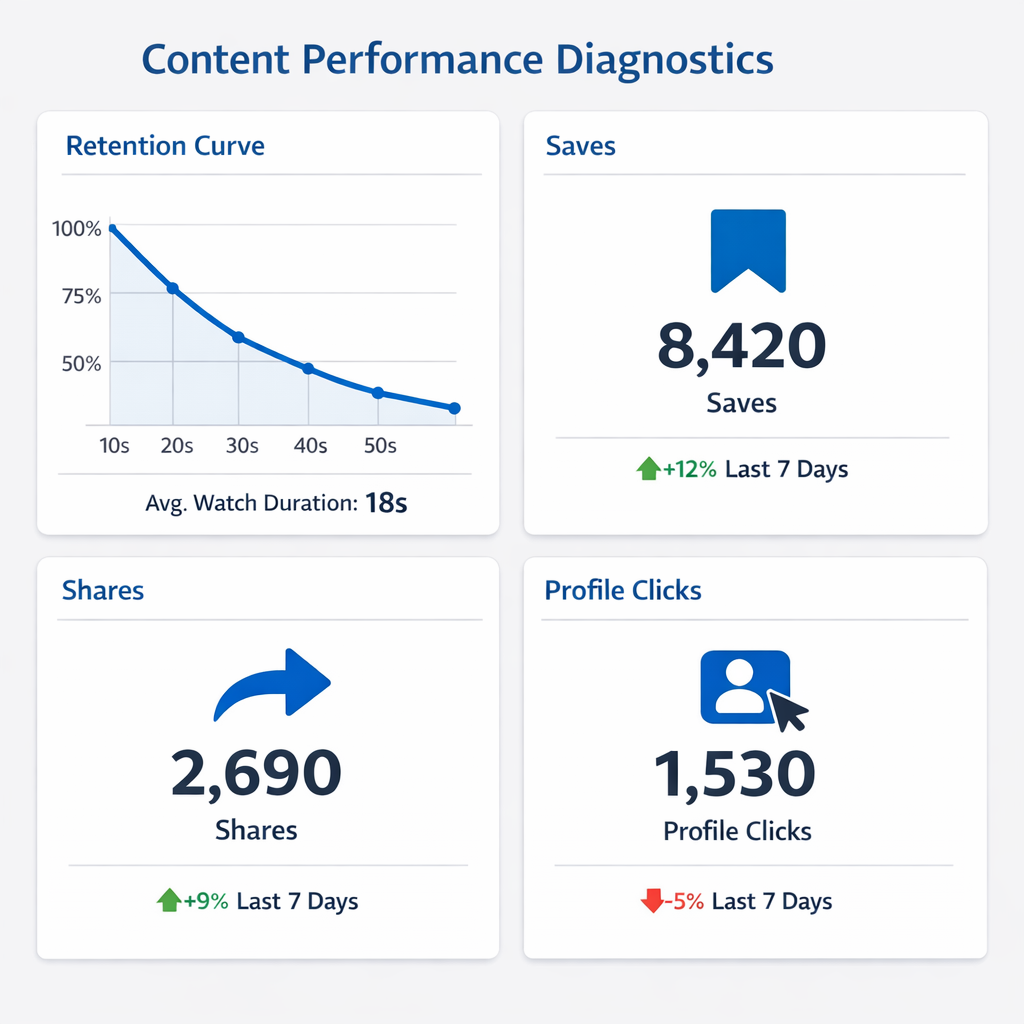
Audit the metrics that actually map to behavior
- Retention (video): does the audience stay, or do they flee at second 2?
- Saves & shares: are people bookmarking and forwarding, or just double-tapping and forgetting?
- Profile clicks: does content create curiosity that leads to action?
- Link clicks: are you earning intent, or begging for it?
And yes, reach matters. But reach is the top of the pipe. If your content gets reach but no saves/shares and no profile movement, you’re producing “scroll candy.”
Post-by-post checklist (quick and brutal)
- Hook: does the first line/frame earn attention or waste it?
- Value payload: did the viewer learn something, feel something, or decide something?
- Clarity: could a stranger explain the point in one sentence?
- Call-to-action: does it match the intent of the content (save/share/comment/click), or is it random?
- Creative pattern: is there a repeatable format, or is every post reinventing the wheel?
If you need a definition anchor for what you’re measuring, “social media” isn’t mystical—it’s just networked content distribution plus feedback loops. Wikipedia’s overview is boring, but accurate: en.wikipedia.org/wiki/Social_media.
5) Audience & community signals
Your comment section is free user research. Treat it like it matters.
- Objections: what do people resist, misunderstand, or argue about?
- Language: what words do they use to describe their pain and desired outcomes?
- Requests: what do they repeatedly ask for (templates, examples, tools, “show me your setup”)?
- Sentiment: do you get trust, skepticism, confusion, or “cool story bro”?
One-sentence truth:
If you’re not capturing audience questions, your content roadmap is guesswork with better lighting.
Also audit response time and tone. If your brand voice is “friendly expert,” but your replies are “K.”, you’re leaking trust.
6) Creative & production system
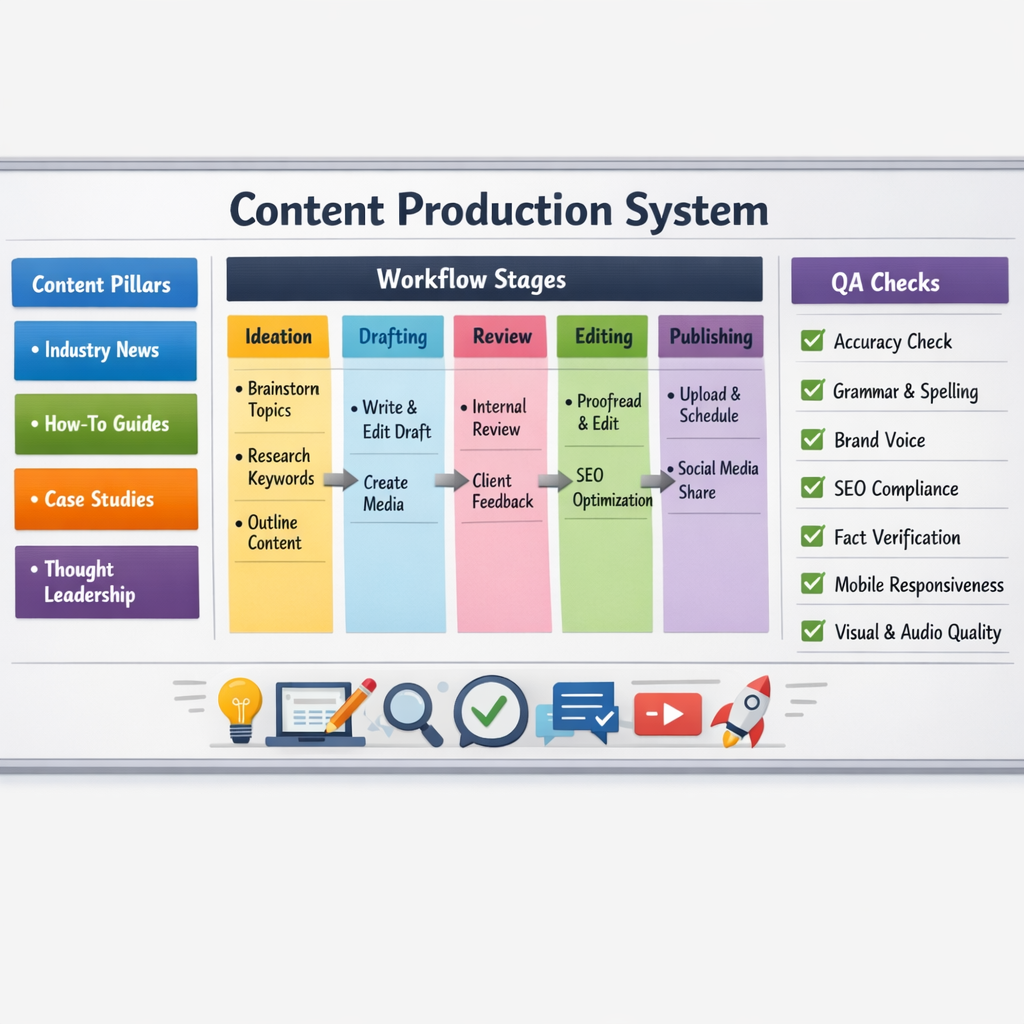
Most teams don’t have a content system. They have a mood.
System checks
- Content pillars: 3–5 repeatable buckets tied to business outcomes (not random interests).
- Format library: at least 8–12 repeatable formats (myth-bust, teardown, checklist, demo, case study, POV).
- Production constraints: who writes, who films, who edits, who posts, who approves—document it.
- QA rules: brand terms, banned claims, disclosure rules, accessibility basics (captions, readable text).
Here’s the problem: if you can’t produce consistently, the algorithm doesn’t “hate you.” You just don’t show up.
Need a practical framework to turn this into an actual operating rhythm? This platform strategy audit guide pairs well with a weekly production cadence and a monthly review loop.
7) Competitive benchmarks (without copying)
Competitor audits are useful—until you start cosplaying their brand.
What to benchmark
- Positioning: what do they “own” in the audience’s mind?
- Format velocity: how many repeatable formats do they run, and how often?
- Series strategy: do they build sequels (Part 1/2/3) or just post singles forever?
- Conversion path: what happens after the follower follows?
Do not benchmark vanity metrics across niches and call it insight. A finance creator’s “good” engagement rate won’t match a meme page’s “good.” Context matters.
8) Platform audit scorecard & priorities
This is the part that separates a platform strategy audit from a scrapbook.
Use a simple 0–5 score per category
- Measurement: UTMs, routing, conversions, reporting (0–5)
- Positioning: promise, proof, CTA, pinned content (0–5)
- Content engine: pillars, formats, cadence, QA (0–5)
- Performance: retention, saves/shares, profile movement, clicks (0–5)
- Community: insights capture, response quality, trust signals (0–5)
Then weight it. If your business is lead-gen, profile/CTA and tracking should weigh more than “aesthetic consistency.”
Bottom line: a platform audit scorecard forces you to pick the next 3 fixes instead of “improving everything” (which means improving nothing).
9) Tools, templates, and the “don’t be lazy” kit
You can run a clean audit with native analytics plus a spreadsheet. But if you want speed and consistency, tools help.
Two categories worth paying for: (1) reporting/measurement helpers, and (2) production workflow tools. Everything else is optional.
If you want a ready-made structure to copy, use this social platform audit template-style playbook as your baseline, then customize the scorecard weighting for your business model.
And if you’re the type who learns better with a physical reference or workbook (respect), here are a couple of Amazon search shortcuts that won’t break stock links:
One more boring-but-useful source: if your audit touches account access, passwords, and operational security, don’t invent rules. NIST has public guidance for digital identity and authentication practices at nist.gov. You don’t need to become a security nerd—just stop using “password123” energy.
Frequently Asked Questions
How often should I run a platform audit checklist?
Run a lightweight audit monthly (tracking, content mix, top posts, profile hygiene) and a deeper platform strategy audit quarterly (positioning, funnel alignment, creative system, competitive benchmarks). If you’re running paid media or launching offers, audit before and after every major campaign.
What if my analytics are messy or incomplete?
Fix measurement first: consistent UTM naming, clean link-in-bio routing, and platform-native event setup where applicable. If the data is unreliable, you’re not auditing performance—you’re auditing noise. Start collecting clean data for 14–30 days, then re-score.
What’s the difference between a social platform audit template and a platform audit scorecard?
A social platform audit template is the checklist of what to inspect. A platform audit scorecard is how you quantify it (0–5 scoring per category, weighted by business impact). The scorecard forces prioritization so you stop “optimizing everything” and start fixing what moves revenue.
Do I need third-party tools, or can I do this with native analytics?
Native analytics are enough for the first pass (reach, retention, clicks, saves, follows). Third-party tools help with consistency, cross-platform reporting, and workflow automation—but they won’t rescue weak positioning or sloppy creative. Tools amplify whatever system you already have.
Final takeaway
Here’s the insider takeaway: your audit is only as good as your willingness to turn findings into a short, brutal priority list. Not a “backlog.” Not a “nice-to-have.” Three fixes, shipped fast, measured cleanly, repeated monthly.
Do that and your platform audit checklist becomes a growth engine. Don’t do that and it becomes another document that dies in Google Drive next to “Q4 Strategy FINAL FINAL_v7.” I’ve seen that movie. It’s bad.
As an Amazon Associate, I earn from qualifying purchases.



One Comment