Here’s the truth: Social Media marketing B2B Strategy fails when you treat it like a content hobby instead of a revenue system. The problem is most teams chase “engagement” and wonder why the pipeline graph looks like a flatline.
B2B buyers don’t need more noise. They need fewer bad decisions.
Fast forward to the real world: buying groups research quietly, share internally, and only talk to sales when they feel safe. Gartner has been blunt about how little time buyers spend meeting suppliers during a purchase journey, which means your “sales pitch” has to happen before the meeting even exists. Source
Table of Contents
- What “pipeline-first” actually means in B2B social
- The B2B social media framework that doesn’t lie to you
- Channel strategy: LinkedIn-first, not LinkedIn-only
- A B2B social media plan that turns posts into meetings
- B2B social media lead generation: the mechanics
- B2B social media ROI: measure what finance respects
- Tooling stack: boring tools, aggressive consistency
- Frequently Asked Questions
- Exit strategy: the insider takeaway
What “pipeline-first” actually means in B2B social
Snippet Trap: A pipeline-first B2B social approach means every post is designed to move a specific buyer group one step closer to a sales conversation—by clarifying a problem, reducing perceived risk, and creating a trackable path to a next action (click, reply, meeting). It’s not “brand awareness.” It’s pre-sales engineering.
Let’s define “pipeline-first” without the marketing theater.
Your content is part of the sales process. Not a vibe. Not a brand moodboard. A process.
And yes, that means you need a lead generation mindset where content and follow-up work together as “pipeline marketing” (Wikipedia even uses that phrase, which should tell you how old this idea is). Source
Two brutal realities drive this:
- Buying groups are bigger than your CRM contact record. Edelman and LinkedIn call out “hidden buyers” and internal stakeholders who can stall deals; their research notes that more than 40% of B2B deals stall due to internal misalignment. Source
- Buyers trust thinking, not slogans. Edelman reports that 73% of B2B buyers consider thought leadership a more trustworthy basis for judging competence than traditional marketing materials. Source
So if your “strategy” is posting product updates and praying, you’re not doing B2B social.
You’re doing public journaling.
Pipeline-first means your social output supports three jobs:
- Deal education: give stakeholders the language to defend the purchase internally.
- Risk reduction: show tradeoffs, implementation realities, and who you’re not for.
- Next-step routing: create obvious paths to a checklist, a teardown, a demo, or a fit call.
If you want the “big picture” on how this fits into your overall planning, plug this into your broader social media strategy planning workflow and treat social like a revenue channel, not a posting schedule.
The B2B social media framework that doesn’t lie to you
The internet loves a “framework.” Most are just re-labeled common sense with a logo slapped on it.
Here’s the one that actually holds up under revenue scrutiny: Signal → Proof → Route.
1) Signal: make your ICP feel “they get us”
Signal content is what earns attention from the right people without begging. It’s specific, opinionated, and grounded in real constraints.
- Bad signal: “5 tips to improve efficiency.” (Thanks, fortune cookie.)
- Good signal: “If your onboarding takes more than 14 days, your churn isn’t a retention problem. It’s a handoff problem.”
2) Proof: show you can deliver, not just talk
Proof content is artifacts: teardown posts, anonymized case metrics, implementation diagrams, “what we learned shipping X,” and failure stories.
Opinion: Testimonials without context are basically decorative pillows. Nice, useless.
3) Route: create a clean path to action
Route content connects the idea to a next step: a checklist, a scoring worksheet, a “reply with X” CTA, or a simple “want the template?” offer.
And you track it. If you can’t track it, it’s theater.
This is where most teams screw up: they post Signal and Proof… then route to nothing but “Book a demo.”
The problem is B2B buyers want a smaller commitment first.
Build one practical asset and route to that. Then route from the asset to the meeting.
Need to tighten the strategic layer? Keep your working doc inside your strategy planning system so you’re not reinventing your positioning every Monday.
Channel strategy: LinkedIn-first, not LinkedIn-only
Let’s be direct: for most B2B offers, LinkedIn is the highest-leverage place to start because the buyer graph is already there.
It’s also where “hidden buyers” live—finance, ops, compliance, procurement—the people who never fill out your “Contact Sales” form but can absolutely kill your deal. Source
But “LinkedIn-first” does not mean “LinkedIn-only.” It means:
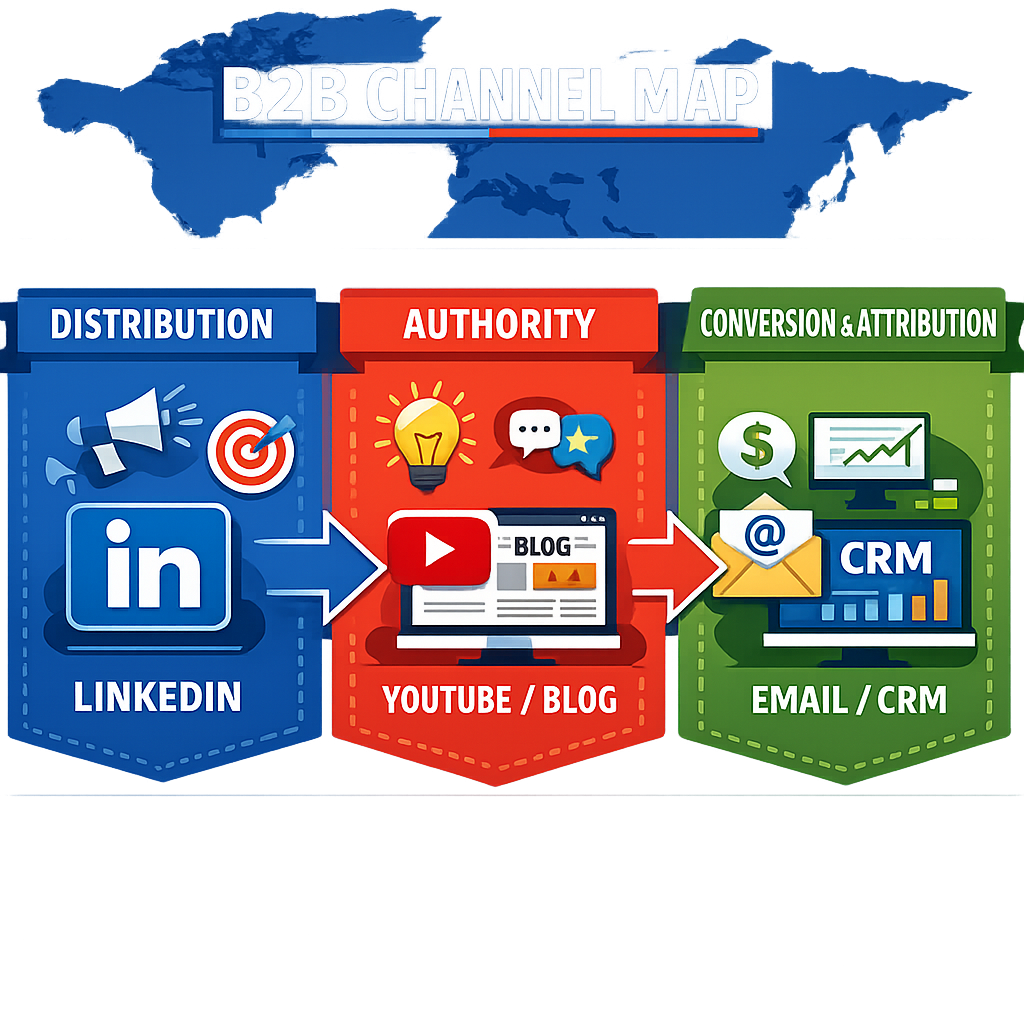
- Primary distribution: LinkedIn (fast feedback, network effects, stakeholder reach)
- Durable authority: YouTube (search + long-form proof) or a blog (owned media)
- Conversion: email (follow-up sequences that don’t rely on algorithms)
And yes, this is still a b2b social media strategy even when some steps happen off-platform. Social’s job is to create and harvest intent, not to close the deal inside a comment thread.
One more inconvenient truth: buyers spend less time with sellers than you want, and more time self-educating than your sales team admits. That’s why your content needs to do pre-sales work while they’re still “quiet.” Gartner’s research on reduced face time makes this painfully clear. Source
A B2B social media plan that turns posts into meetings
If your b2b social media plan is “post 5x a week,” you don’t have a plan. You have a quota.
Here’s a plan that behaves like engineering: inputs, outputs, and feedback loops.
The weekly output model (simple, sustainable, effective)
- 2x Signal posts: sharp POV + specific problem framing (no generic tips)
- 1x Proof post: teardown, mini case study, before/after, system diagram
- 1x Route post: “Want the checklist/template? Comment ‘X’ and I’ll send it.”
That’s it.
Now the part most people avoid: the follow-up.
The follow-up workflow (where pipeline actually happens)
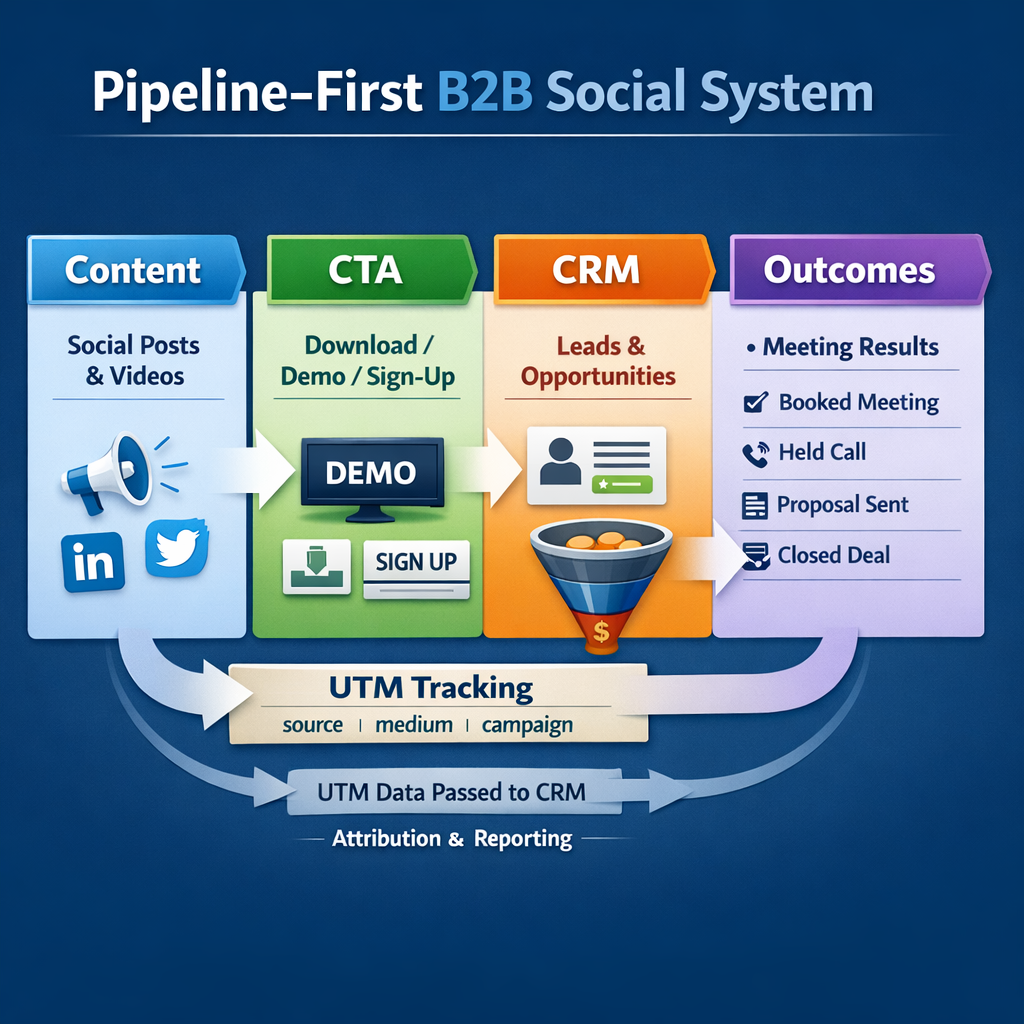
- Capture intent: comments, DMs, link clicks, profile visits (use UTMs)
- Deliver the asset fast: within 24 hours or you’re wasting momentum
- Ask one diagnostic question: “What’s the current system for X?”
- Offer a low-friction next step: “Want me to sanity-check it in 15 minutes?”
Opinion: If your sales team can’t handle fast, human follow-up, no content calendar will save you.
Also: your content topics should be engineered around pipeline stages:
- Problem-aware: “Why onboarding fails in regulated teams”
- Solution-aware: “3 architectures: build, buy, hybrid”
- Vendor-aware: “What a good implementation plan includes”
- Decision support: “How to get procurement unstuck”
That last one is where you influence the hidden buyers. Edelman/LinkedIn’s research doesn’t mince words: internal misalignment stalls deals, and thought leadership can help buyers make the case internally. Source
Want a clean way to structure this inside your overall marketing system? Keep the “Signal/Proof/Route” plan plugged into your social strategy planning doc so your team isn’t guessing what to post when the quarter gets busy.
B2B social media lead generation: the mechanics
Let’s talk b2b social media lead generation without the cringe “social selling” scripts.
Pipeline comes from repeated exposure + clear next steps + trust artifacts.
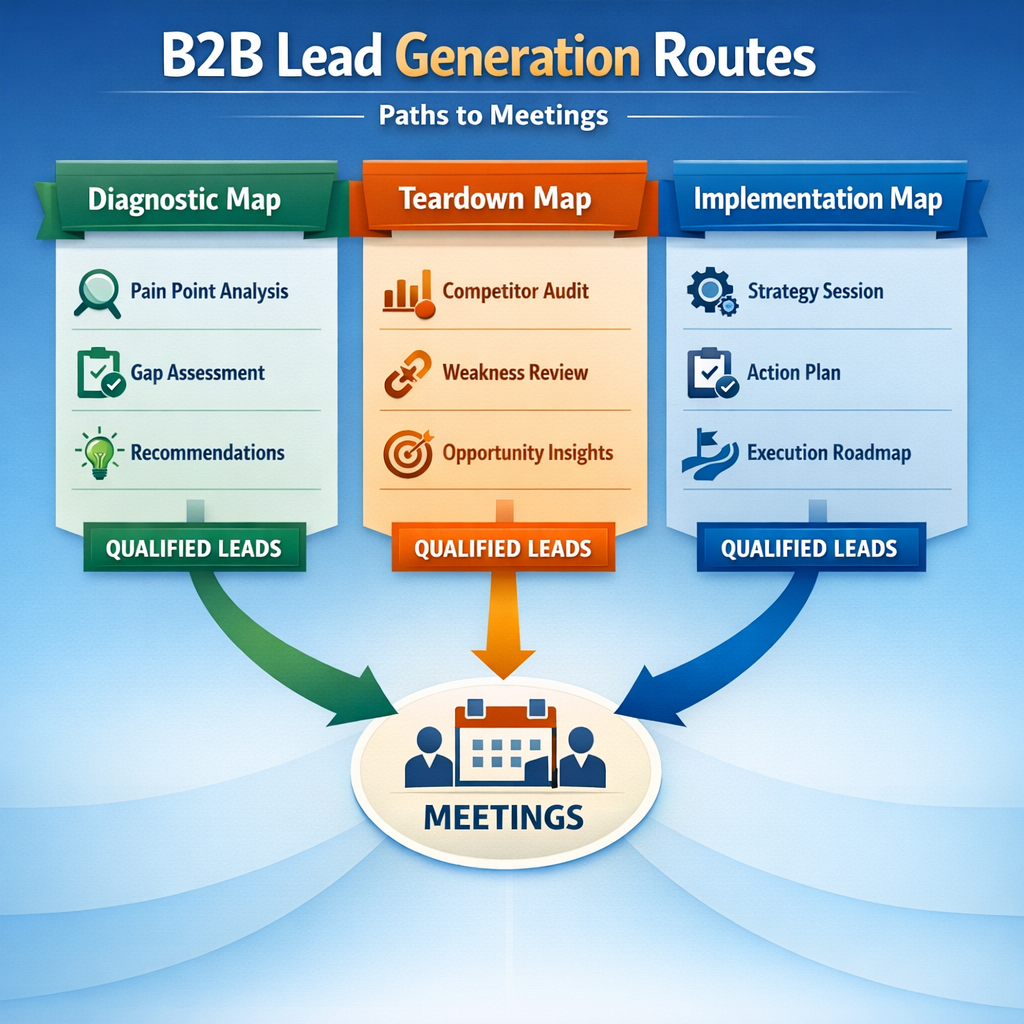
So build three “routes” that match buyer risk tolerance:
Route A: The diagnostic (best for high-ticket, complex offers)
You give them a scorecard. They score themselves. You interpret results.
- CTA: “Want the 12-point scorecard? I’ll send it.”
- Follow-up question: “Which section scored lowest?”
- Meeting offer: “Want me to map fixes to your current stack?”
Route B: The teardown (best for services, audits, optimization)
Teardowns work because they’re specific and buyers love seeing how you think.
- CTA: “Drop your landing page; I’ll do a 3-point teardown.”
- Follow-up: send a short Loom or bullet analysis
- Meeting offer: “Want a deeper teardown with your numbers?”
Route C: The implementation map (best for SaaS and systems)
You show a simple “Week 1–4” implementation blueprint. People who care will raise their hand.
And yes, you can support this with tools—just don’t buy shiny objects to avoid doing the work.
Practical picks (search links only):
Bottom line: routes win because they create a micro-commitment that feels safe, useful, and relevant.
B2B social media ROI: measure what finance respects
If you want b2b social media ROI, stop reporting “reach” like it’s revenue.
ROI requires attribution. Attribution requires instrumentation. Instrumentation requires discipline.
Here’s the minimum viable setup:
- UTMs on every link (campaign = initiative, content = post theme, source = platform)
- Dedicated landing pages for routes (scorecard/teardown/blueprint)
- CRM campaign fields (or at least a “source details” field) to store the UTM data
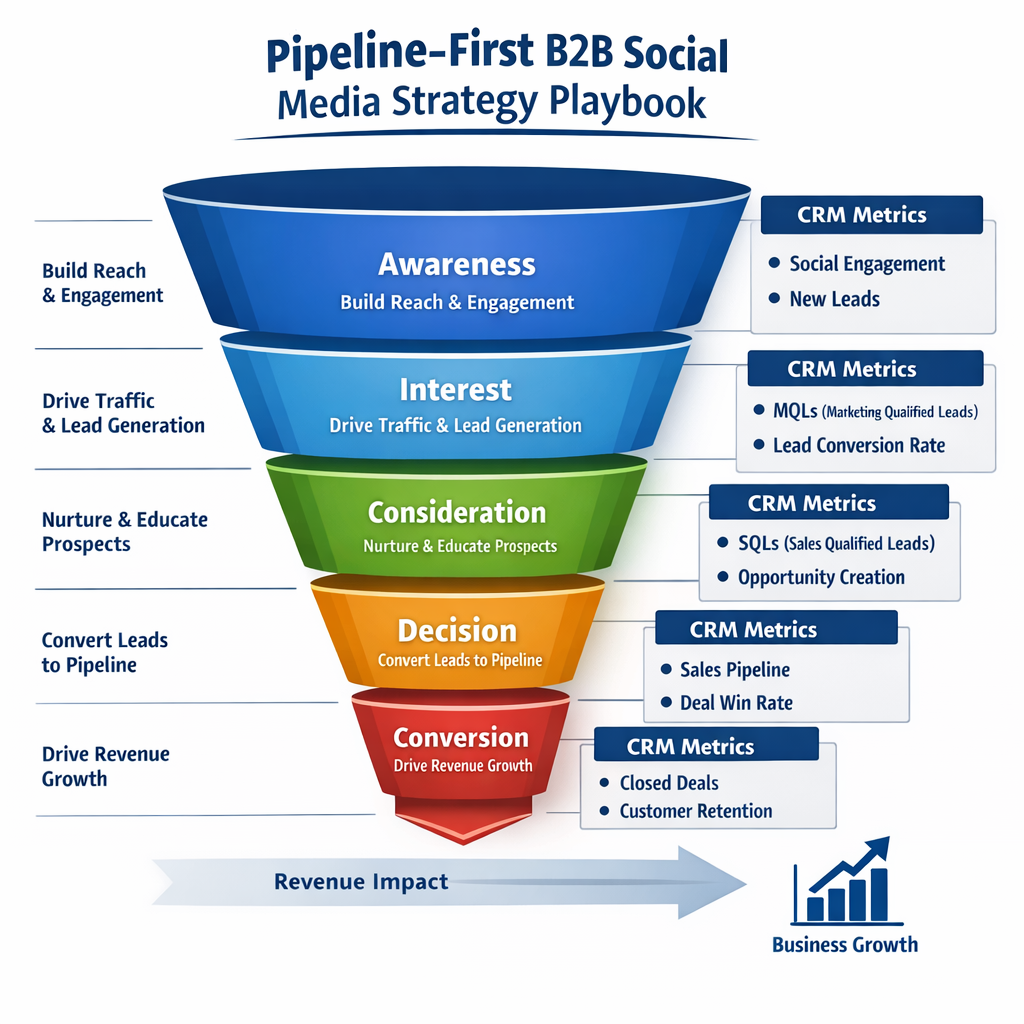
- Lifecycle stages that reflect reality: Inquiry → Meeting → SQL → Opportunity → Closed
Then report ROI like an adult:
- Influenced pipeline: $ value of opps with social touches
- Sourced pipeline: opps where social was first recorded touch
- Meeting rate: route conversions to booked calls
- Win rate & cycle time: did social shorten sales cycles or improve close rates?
Also, if your thought leadership is generic, your ROI will be generic. Edelman’s research is pretty blunt that buyers use thought leadership to judge competence, and quality matters. Source
One more thing: if deals stall because internal stakeholders aren’t aligned, your content should be engineered to help champions sell internally—slides, one-pagers, “how to evaluate vendors,” implementation risk checklists. That’s not “branding.” That’s deal acceleration. Source
If you need a clean framework to organize all this in one place, wire your measurement plan into your social media strategy planning template so tracking doesn’t become an afterthought.
Tooling stack: boring tools, aggressive consistency
Most “stacks” are shopping lists. That’s not strategy. That’s retail therapy.
Here’s the stack that actually supports a b2b social media framework:
- Scheduling: use something reliable; don’t over-automate tone
- Link tracking: UTM builder + a simple spreadsheet you actually maintain
- CRM hygiene: enforced fields for source and lifecycle stage
- Asset delivery: instant download + auto-email + human follow-up
- Content bank: a living doc of Signal/Proof/Route topics by pipeline stage
Opinion: If your team can’t execute with basic tools, adding “AI workflow automation” will just help you fail faster.
Start with the fundamentals, then optimize. Engineering 101.
Frequently Asked Questions
How long does it take for a B2B social media strategy to generate pipeline?
Expect leading indicators in 2–4 weeks (profile views, qualified DMs, sales page traffic), meetings in 4–8 weeks, and consistent pipeline in 8–16 weeks—if your ICP is tight and you have a follow-up system. If you post randomly and measure likes, you’ll get exactly what you’re measuring: likes.
Is LinkedIn the only channel that matters for B2B?
No, but it’s usually the highest-leverage starting point for most B2B offers because buyers and stakeholders are already there. Use LinkedIn as the distribution backbone, then repurpose into YouTube (search + authority) and email (conversion). Pick one secondary channel only when you can sustain weekly output.
What should I track for B2B social media ROI beyond impressions?
Track: target-account engagement, site visits to high-intent pages, CTA clicks, demo requests, booked meetings, opportunity creation, pipeline amount influenced, and revenue. Use UTMs + CRM campaign fields so you can tie content to stages. If your CRM can’t answer “which posts influenced this deal,” fix instrumentation first.
How do I generate B2B leads without sounding salesy?
Lead with problem clarity and decision support: explain tradeoffs, constraints, and how to evaluate options. Then offer a simple next step that reduces risk (e.g., a diagnostic checklist or a 15-minute fit call). “Buy now” is cringe in B2B. “Here’s how to avoid a bad decision” works.
Do I need a big following for B2B lead generation?
No. You need the right people to see the right ideas repeatedly. A small audience of your ICP plus consistent distribution (employees, partners, targeted outreach, newsletters) beats a giant audience of randoms. Pipeline comes from relevance and repetition, not vanity follower counts.
Exit strategy: the insider takeaway
Here’s the insider takeaway: your content is a pre-sales asset. Treat it like one.
Build Signal that attracts the right buyers, Proof that shows you can deliver, and Routes that turn intent into tracked actions. Instrument it. Follow up like you mean it.
Bottom line: If your social isn’t connected to pipeline stages and CRM outcomes, it’s not strategy. It’s performance art.
Now go ship the boring system that makes money. I’ll take boring revenue over exciting vanity metrics every day.
As an Amazon Associate, I earn from qualifying purchases.


One Comment
Comments are closed.