
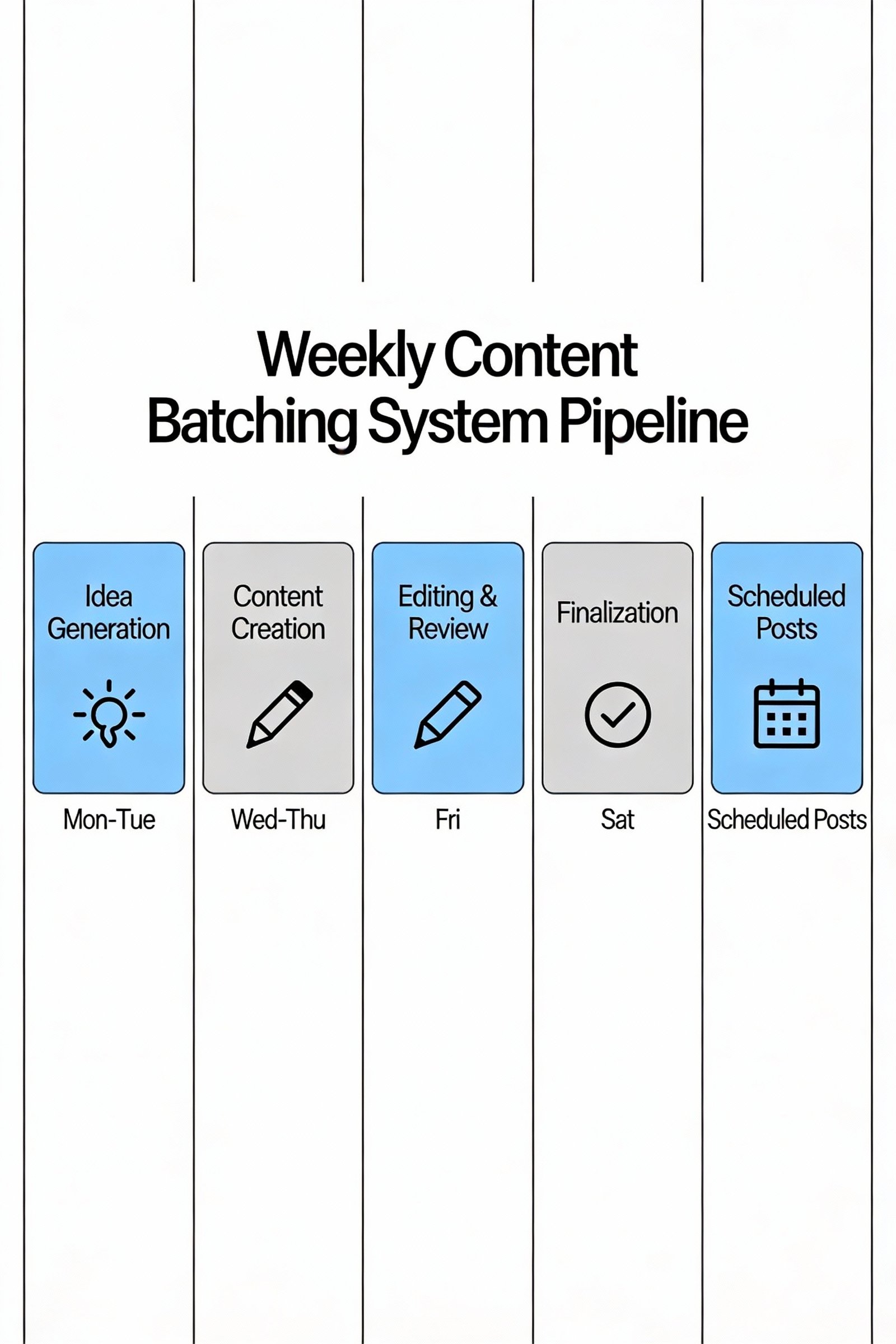
Your social media content batching system isn’t failing because you’re “not consistent.” It’s failing because you’re trying to run a production line like it’s improv night at a comedy club.
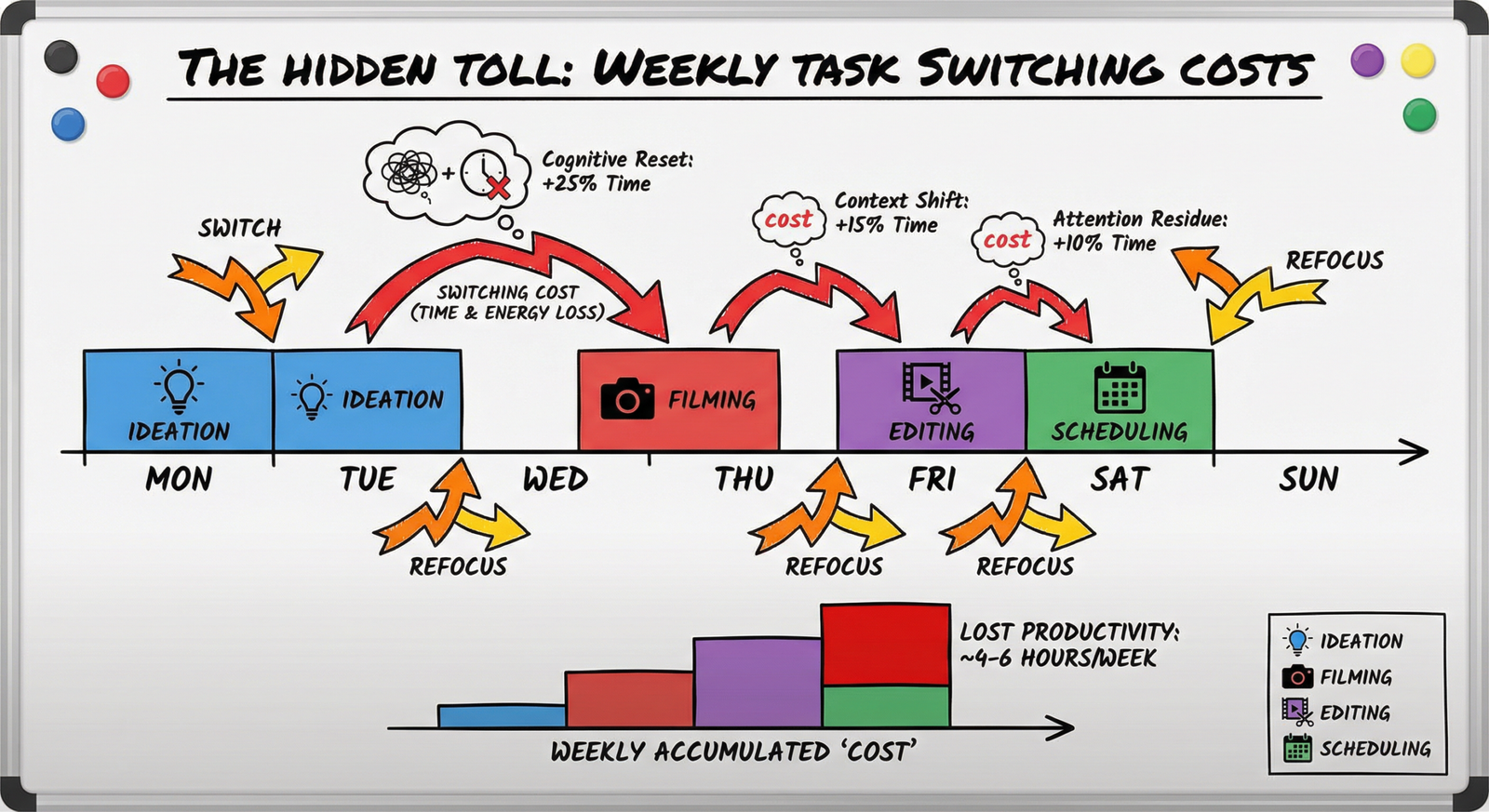
The problem is you’re mixing ideation, scripting, filming, editing, captioning, scheduling, and analytics into one chaotic daily soup. Your brain pays switching costs every time you bounce tasks—and those costs add up fast. The American Psychological Association has a clean explanation of how task switching slows people down and piles up errors. Source.
Bottom line: if you want output that scales, you need a system that’s boring, repeatable, and slightly ruthless.
Table of Contents
- Why your content production feels like a hamster wheel
- The social media content batching system (technical definition)
- The 4-block weekly content system that scales
- Batch content workflow: the real pipeline
- Content batching template: copy this cadence
- Tool stack: keep it boring, keep it fast
- The failure modes and how to fix them
- Frequently Asked Questions
- Final take: ship, don’t babysit
Why your content production feels like a hamster wheel
Snippet trap: A scalable batching system separates thinking from making from publishing. You batch similar tasks into focused blocks, use a single weekly cadence, and rely on templates to reduce decisions. The result is more posts with less stress, because you stop paying the “context switching tax” all day.
Here’s the truth: most creators don’t need “motivation.” They need less friction.
When you create content daily, you’re constantly interrupted—by notifications, client messages, “quick” tweaks, and your own second-guessing. Research commonly cited from UC Irvine shows it can take roughly 20+ minutes to fully get back on task after an interruption; even conservative breakdowns show meaningful recovery time. You can see interruption and return-to-task stats summarized here. Source. If you want the academic backbone, Gloria Mark’s work on interrupted tasks is widely referenced. Source.
So when you “just do one post,” you’re not doing one post. You’re paying a stack of hidden costs: ramp-up time, decision fatigue, and the doom loop of rewriting captions you already rewrote yesterday.
Fast forward to the real fix: treat content like a pipeline, not a mood.
If you’re also running paid campaigns, this gets even more important because your creative production has to feed testing and optimization. That’s why pairing batching with a structured ops cadence (like this rapid paid-ads setup sprint framework) is how you avoid “random acts of marketing.”
The social media content batching system (technical definition)
A social media content batching system is a repeatable production process where you:
- Group similar tasks (writing hooks, recording, editing, scheduling) into dedicated time blocks.
- Standardize inputs (templates, naming conventions, file structure) so nothing gets lost.
- Run a weekly content system that outputs consistent volume without daily creation.
It’s basically applying “batch processing” logic from operations: you minimize setup time and maximize throughput by doing like-with-like. Call it industrial. Call it boring. Call it what it is: effective.
Also, it’s not optional if you want scale. Daily creation is fine when you’re learning. It’s a liability when you’re trying to grow.
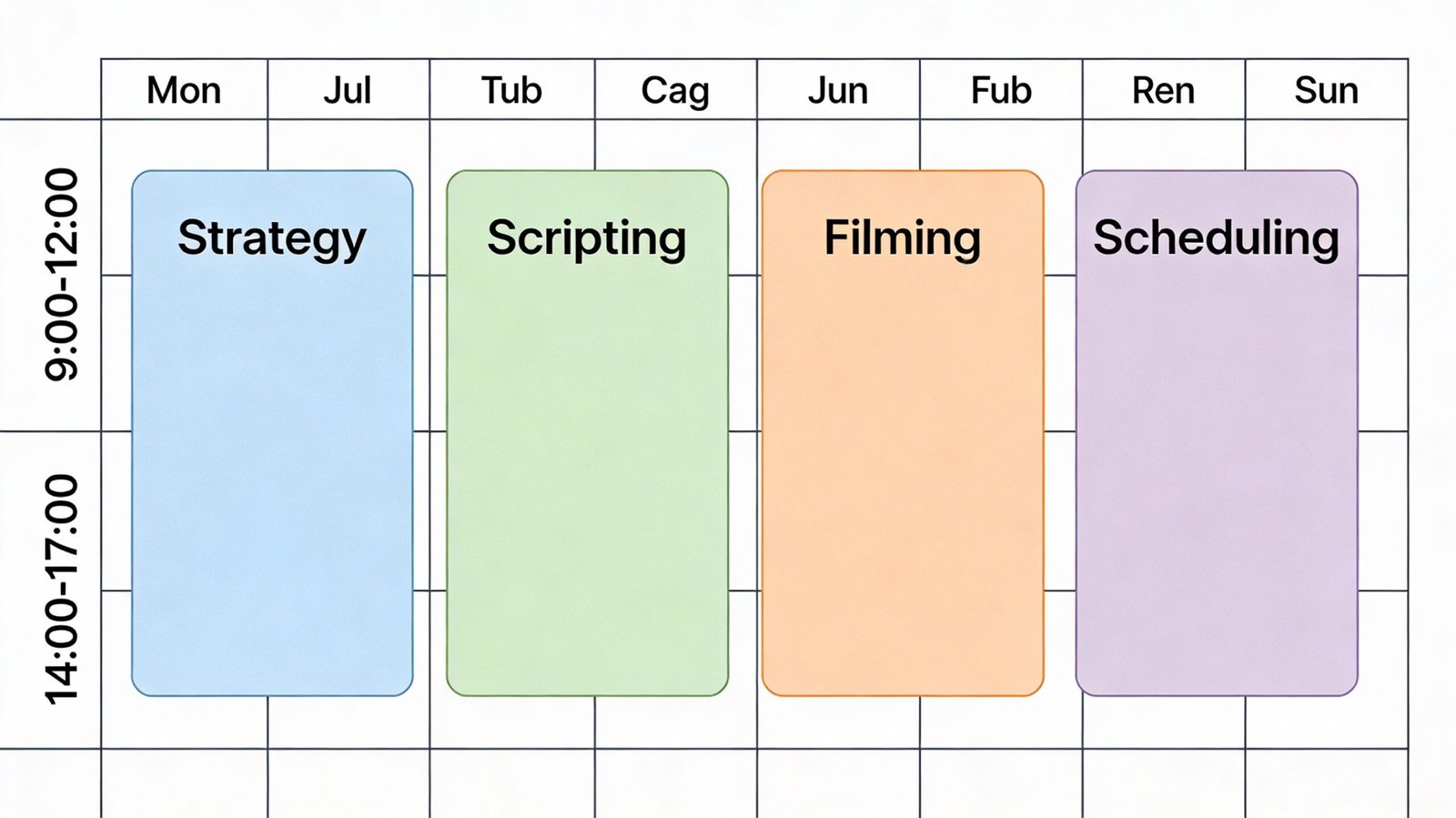
The 4-block weekly content system that scales
If your current week is “post when I have time,” you don’t have a workflow. You have a hope-and-pray strategy.
Here’s a weekly content system that actually survives real life:
Block 1: Strategy + topic selection (45–60 minutes)
Your job is to pick fights worth winning. You choose the 3–5 core problems your audience is actively bleeding from, then you decide how you’ll show up (short video, carousel, text thread, etc.).
- Pull 10 audience pain points from comments, DMs, and search suggestions.
- Pick 5 themes that match your monetization path (affiliate offers, lead magnet, service).
- Decide your weekly mix: 60% evergreen, 20% proof/case studies, 20% reactive/trend.
Keep it tight. If you spend two hours here, you’re not “planning,” you’re hiding.
Block 2: Script + hook batching (90 minutes)
Write hooks in bulk. Not because you love writing, but because hooks are the bottleneck. Batch 20 hooks, then expand the best 8–12 into short scripts.
- Use a hook bank: “Stop doing X,” “Most people get Y wrong,” “I tested Z so you don’t have to.”
- One script = one point. One point = one outcome.
- End with one CTA: save, comment, click, or DM. Don’t stack four actions like a menu.
Want extra leverage? Map your weekly content to your promotion calendar so your organic posts support paid campaigns and landing pages—again, the 7-day paid ads setup sprint mentality helps you think in systems, not vibes.
Block 3: Production batching (2–3 hours)
Record all A-roll in one go. Same lighting, same setup, same mic, same framing. The goal is to reduce setup resets to near-zero.
- Record 8–12 clips back-to-back.
- Keep takes “good enough.” Perfection is just procrastination wearing makeup.
- Label files immediately: DATE_TOPIC_HOOK_01. Future-you will say thank you.
Block 4: Edit + schedule batching (2–4 hours)
Editing is an assembly line. You don’t “edit a video.” You apply the same steps to every asset: trim, captions, b-roll, export, upload, schedule.
If you do this block while multitasking, you lose. Timeboxing can help if you treat it like a constraint, not a suggestion; Harvard Business Review has practical coverage of timeboxing concepts. Source.
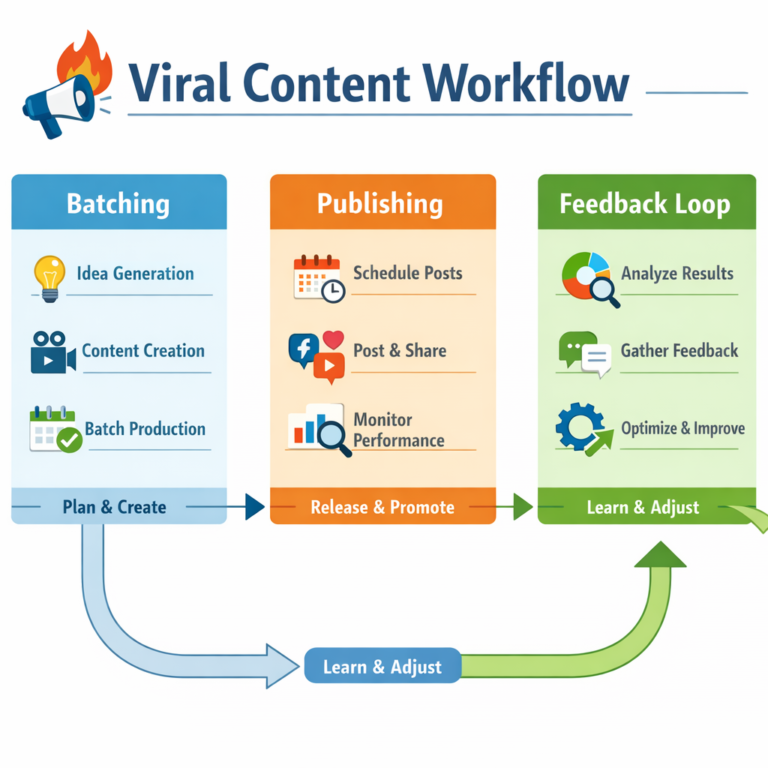
Batch content workflow: the real pipeline
Most creators describe their process like this: “I had an idea, I made a post.” That’s not a workflow. That’s a diary entry.
A real batch content workflow has stages, gates, and outputs:
- Input: raw ideas (pain points, objections, myths, “how-to” steps, mini case studies).
- Transform:
- Output:
- Feedback loop:
Two key rules that make this pipeline scale:
Rule #1: Separate creation from distribution. Creation is deep work. Distribution is ops. Mixing them is how your “creative day” turns into checking analytics every 7 minutes.
Rule #2: Build repurposing into the pipeline. One recorded core idea becomes:
- 1 short video
- 1 carousel summarizing the steps
- 1 text post with a contrarian hook
- 1 story sequence (poll + tip + CTA)
That’s how you scale without inventing brand-new concepts daily. And if you’re running paid traffic, this pipeline also gives you a steady supply of creatives to test—tie it back to your campaign ops like the rapid paid ads setup sprint so your content isn’t disconnected from revenue.
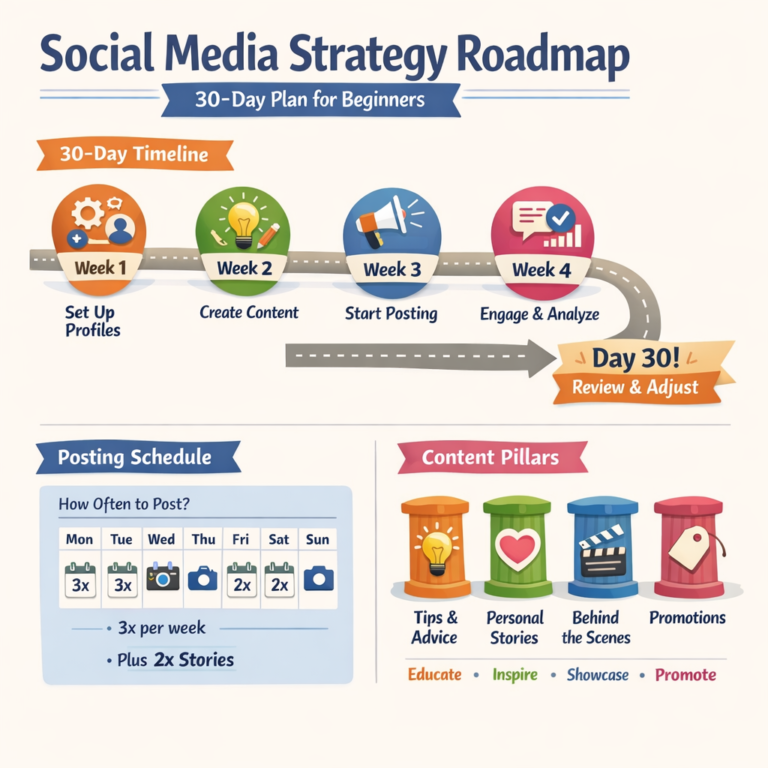
Content batching template: copy this cadence
Here’s a content batching template you can actually use without turning into a spreadsheet goblin.
Weekly Output Target (starter): 12 assets total
- 6 short videos (15–45 seconds)
- 3 carousels
- 3 text posts
Monday (45–60 min): Topic selection + outline your week
- Pick 5 pain points
- Assign formats (video/carousel/text)
- Define one CTA per post
Tuesday (90 min): Hook + script batch
- Write 20 hooks
- Expand 8–12 into scripts
- Create captions as bullet points (not essays)
Wednesday (2–3 hrs): Record batch
- Film all A-roll
- Capture 10 minutes of generic b-roll (keyboard, whiteboard, screenshots)
Thursday (2–4 hrs): Edit + schedule batch
- Apply one editing checklist
- Export in platform-friendly ratios
- Schedule all posts for next week
Friday (30–45 min): Review + iterate
- Identify top 3 winners by retention/saves
- Write 5 new hooks based on what worked
- Archive what flopped (no moral drama)
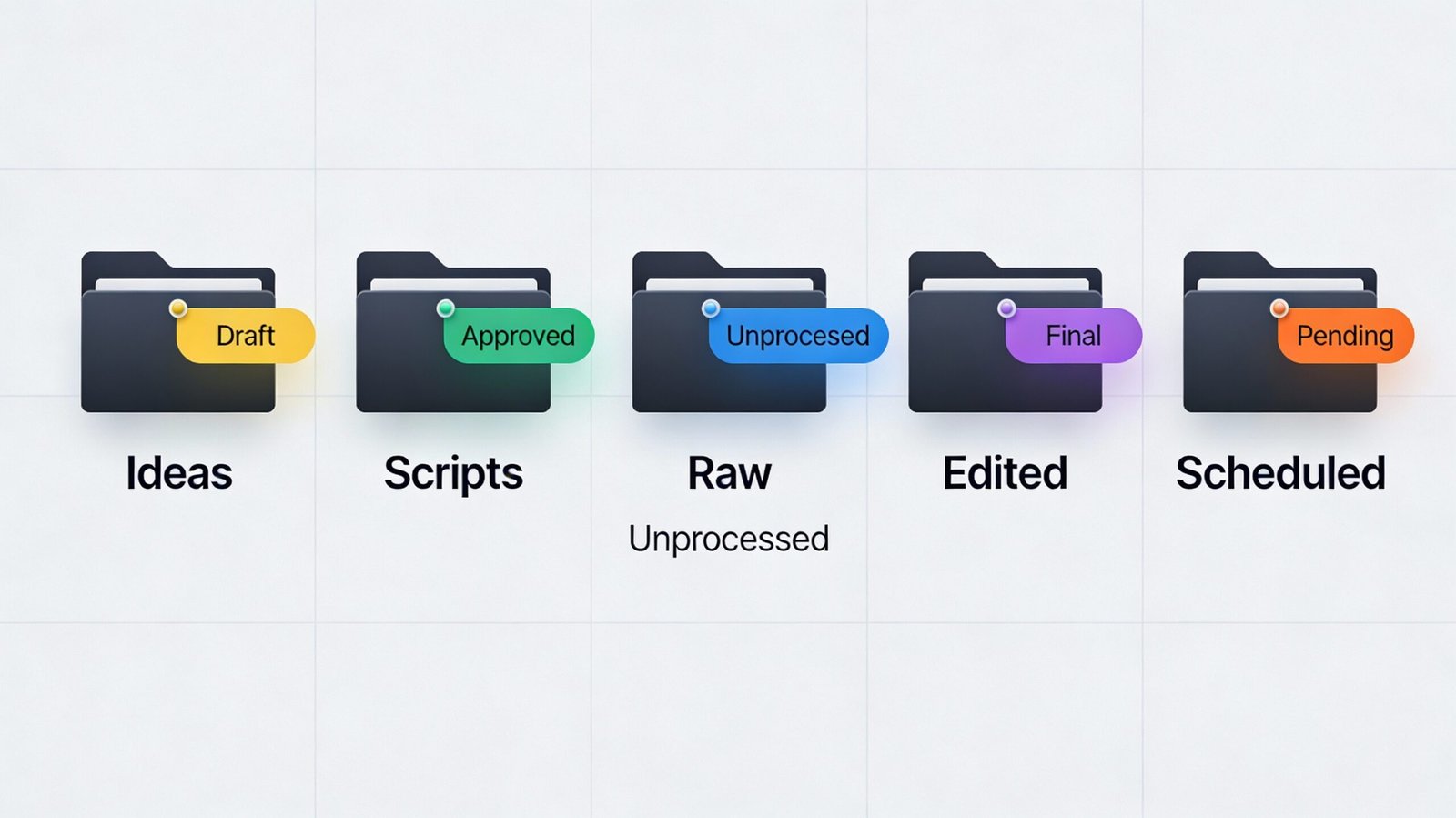
One more practical detail: keep a single “source of truth” folder with strict naming and status labels. If your files look like “final_final_v3_reallyfinal.mp4,” your system is lying to you.
Tool stack: keep it boring, keep it fast
Most “creator stacks” are just shopping lists disguised as strategy. Here’s what actually matters:
- Capture:
- Edit:
- Schedule:
- Track:
If your tools add choices, they’re not tools. They’re noise.
If you want a simple physical setup that eliminates “my audio looks bad” excuses, search these on Amazon (safe search links):
And if you’re doing anything paid, your content calendar and ad calendar should talk to each other. A clean way to force that alignment is to anchor your week around an execution sprint like this paid ads setup sprint—because it makes you plan creative like a grown-up.
The failure modes and how to fix them
Most batching systems fail in predictable ways. Here are the usual suspects.
Failure mode #1: You batch ideas, but not production
Symptom:
Fix:
Failure mode #2: You over-engineer the “content system”
Symptom:
Fix:
Failure mode #3: You ignore performance data
Symptom:
Fix:
Failure mode #4: You chase “daily trends” and destroy your cadence
Symptom:
Fix:
And yes: multitasking is part of the problem. If you want a reality check on the cognitive cost, start with the APA’s summary of switching costs. Source.
Frequently Asked Questions
How many posts should I batch per week to see results?
Batch enough to cover consistency without burning out. For most creators, 3–5 posts per platform per week is the sweet spot. Start with 8–12 total assets and schedule them. Then scale volume only after your workflow is stable.
How do I batch content if trends change every day?
Build an 80/20 split: 80% evergreen, 20% reactive. Keep a weekly “trend slot” where you adapt one pre-written hook to a trend instead of nuking your entire plan.
What if I can only create content on weekends?
Weekend batching is ideal. Do production on Saturday (scripts + recording), then do editing + scheduling on Sunday. The weekly content system exists so you don’t need daily creation to publish daily.
Do I need Notion or Airtable for a batching system?
No. Use whatever reduces decisions. If your tool becomes your procrastination bunker, you picked wrong. A spreadsheet + clean folder structure is enough for most operators.
How do I avoid sounding repetitive when batching?
Reuse the insight, rotate the angle. Change your hook type, example, objection, and CTA. The audience wants repetition of value, not repetition of phrasing.
Final take: ship, don’t babysit
Here’s the insider takeaway: scale comes from standardizing decisions. The fewer choices you make per post, the more posts you ship. And the more you ship, the more the data tells you what to double down on.
If your current content process depends on feeling inspired, it’s not a system—it’s a weather forecast.
Build your batching cadence, run it for four weeks, and treat edits like manufacturing, not art therapy. Then use the extra bandwidth to do the things that actually move revenue: better offers, smarter distribution, and tighter campaign execution (start here if you need structure: a rapid 7-day paid setup sprint).
Now go batch. Your future self is tired of your “I’ll post later” promises.
As an Amazon Associate, I earn from qualifying purchases.


2 Comments