
Meta Advantage+ Creative Testing: 2026 Profit Playbook starts with a surprising reality: most failing Meta campaigns don’t collapse because targeting breaks. They collapse because creative signals decay faster than advertisers expect. If your cost per acquisition suddenly jumped, your ROAS dropped, and yesterday’s winner turned into today’s budget drain, you’re not alone.
The problem frustrates almost every advertiser. The pain grows when you keep tweaking audiences, budgets, and bid strategies without results. The solution sits in a more disciplined creative testing system. In this guide, I’ll show you exactly how I diagnose stalled Meta campaigns, identify hidden creative fatigue, and build a testing framework that gives Meta’s algorithm stronger signals to work with.
Table of Contents
- Why Meta Ads Stop Working and What Advantage+ Sees
- Creative Fatigue Diagnosis Framework
- Building a Reliable Advantage+ Testing Structure
- Advanced Creative Testing Tactics for 2026
- Metrics That Actually Predict Winners
- Troubleshooting Common Performance Crashes
- FAQ: Meta Advantage+ Creative Testing
- My Top Recommended Gear
Why Meta Ads Stop Working and What Advantage+ Sees
Meta Advantage+ Creative Testing works best when advertisers isolate creative variables, refresh concepts before fatigue appears, and evaluate engagement quality alongside conversion data. Most performance declines stem from creative deterioration, not audience settings, making structured testing the fastest path to recovery.
Have you ever noticed a campaign fall apart even though nothing changed? That question catches many advertisers off guard.
From Meta’s perspective, something did change. User behavior shifted. Engagement signals weakened. Attention declined. The platform continuously evaluates how people react to images, videos, copy, headlines, and offers.
According to Search Engine Journal, creative quality remains one of the strongest performance drivers inside automated campaign systems. Meta’s machine learning models reward content that earns attention and positive engagement.
Here’s the counterintuitive part: sometimes your ad still generates sales while quietly losing efficiency. Many advertisers miss this early warning signal. I’ll come back to that in a moment because it explains why so many accounts experience sudden drops instead of gradual declines.
Before scaling anything, I recommend ensuring campaign foundations remain clean. If your account setup feels messy, review this paid ads setup sprint framework to eliminate avoidable structural issues.
Creative Fatigue Diagnosis Framework
What if the ad isn’t bad, but the audience simply stopped caring?
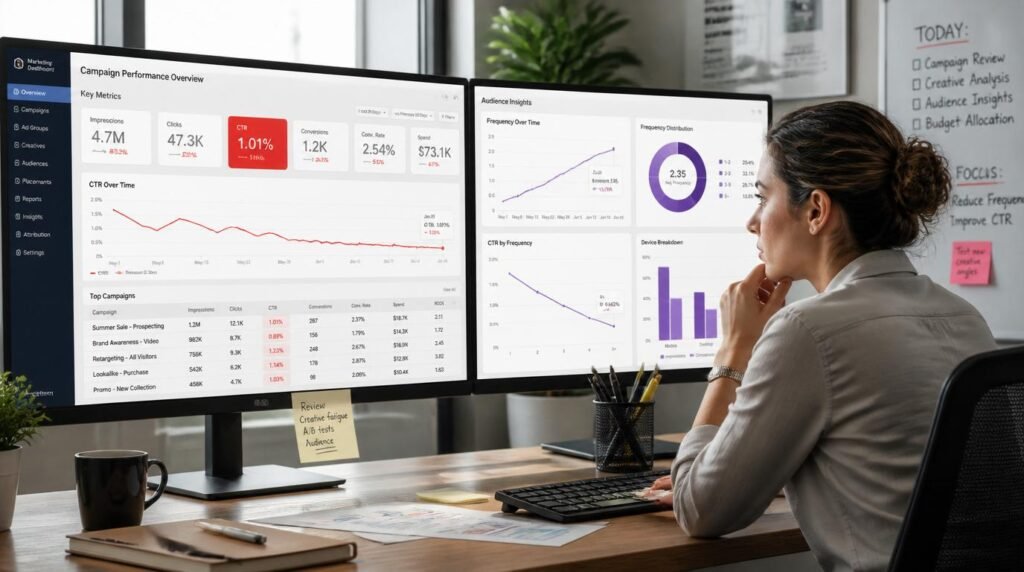
That’s usually where I start. Creative fatigue rarely announces itself. Instead, it sneaks in through declining click-through rates, weaker hold times, higher CPMs, and reduced conversion rates.
How can I tell if creative fatigue is the real problem?
- CTR trends downward for 5-10 consecutive days
- Frequency increases while conversions flatten
- CPA rises despite stable targeting
- Video watch-through rates decline
- Comments become repetitive or disappear entirely
The unresolved tension from earlier? A campaign can still produce revenue while losing efficiency. Ngl, this traps experienced advertisers more often than beginners.
I compare current metrics against peak-performance periods rather than yesterday’s results. That approach reveals deterioration sooner.
Which creative elements fatigue first?
In many ecommerce and lead-generation accounts, hooks fatigue before offers. The first three seconds of a video often determine whether Meta receives positive engagement signals.
Research from MIT News consistently highlights how attention patterns influence decision-making. Digital advertising reflects the same behavior. If attention drops, performance usually follows.
One insider detail many articles skip: I rarely test minor headline tweaks first. I test new angles. A fresh concept often beats dozens of cosmetic edits.
Building a Reliable Advantage+ Testing Structure
Why do some advertisers test constantly yet learn almost nothing?
Because they change too many variables simultaneously.
Meta Advantage+ thrives on strong learning signals. When advertisers alter copy, visuals, offers, landing pages, and audiences at once, meaningful insights disappear.
What testing structure creates clean data?
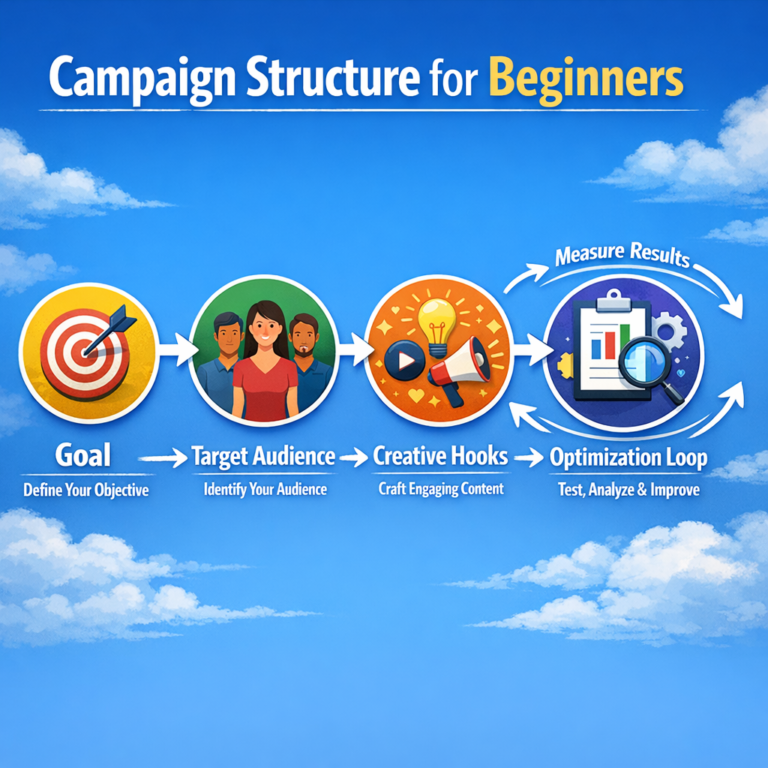
I use a simple hierarchy:
- Test concepts first
- Test hooks second
- Test formats third
- Test copy variations last
Concept testing asks whether the message resonates. Hook testing measures attention. Format testing evaluates delivery. Copy optimization fine-tunes performance.
For newer advertisers, a streamlined architecture helps maintain clarity. This clean 3-layer campaign structure pairs well with Advantage+ testing workflows.
How many creatives should I launch at once?
I typically launch three to six unique concepts. Each concept targets a different psychological trigger:
- Problem awareness
- Desired outcome
- Social proof
- Comparison framing
- Speed or convenience
- Risk reduction
TBH, many advertisers create six versions of the same idea and call it testing. That’s variation, not concept testing.
Meta’s systems learn faster when creative diversity reflects genuine differences in user motivation.
Advanced Creative Testing Tactics for 2026
This section goes beyond standard advice because 2026 competition demands deeper analysis.
What advanced tactic produces outsized gains?
I call it creative clustering.
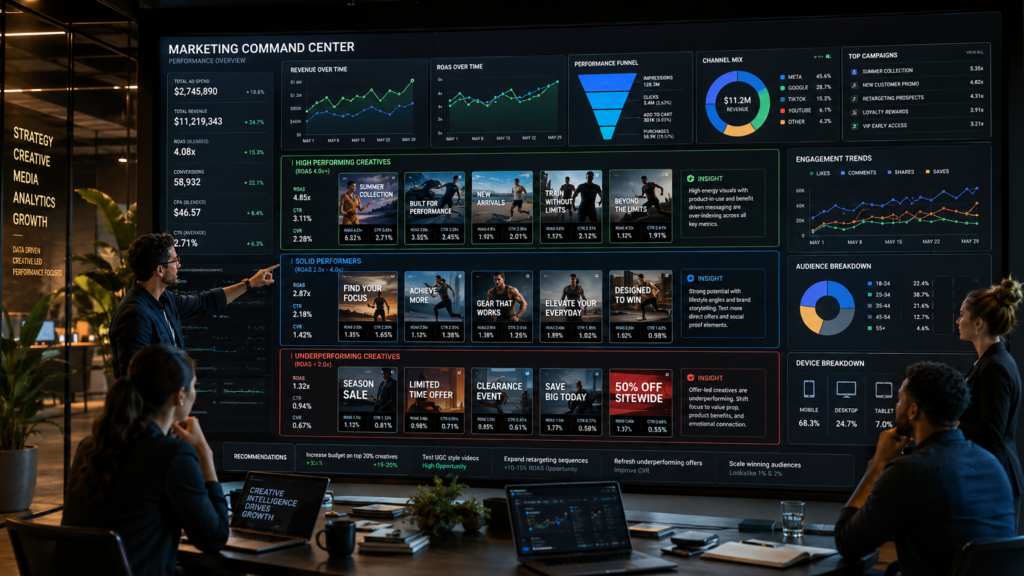
Instead of judging individual ads in isolation, I group creatives by messaging category. For example:
- Authority cluster
- Transformation cluster
- Problem agitation cluster
- Product demonstration cluster
After enough impressions, patterns emerge. Often an entire messaging category outperforms others.
That discovery changes everything. Rather than scaling a single winner, you scale a winning psychological framework.
Meta’s advertising systems increasingly reward broad learning patterns. The account that identifies message-level success gains an advantage over advertisers chasing individual ads.
For measurement standards, I often reference guidance from the National Institute of Standards and Technology regarding experimentation principles and statistical rigor. Advertising isn’t laboratory science, but disciplined testing still matters.
Should I trust Meta’s automated creative enhancements?
Not blindly.
This is a common myth. Many advertisers assume every automated enhancement improves performance. My account reviews show mixed outcomes.
Automation helps when the underlying concept already works. Automation rarely rescues weak messaging.
I test enhancements separately and compare conversion quality, not just volume. Sometimes the cheapest lead becomes the least valuable customer.
That distinction matters more than ever as AI-generated content floods advertising feeds.
Expert Commentary: This video breaks down practical Meta creative testing workflows and demonstrates how experienced buyers isolate variables. Pay close attention to the sections covering creative fatigue and performance interpretation.
Metrics That Actually Predict Winners
Many advertisers obsess over ROAS alone. I understand why. Revenue matters.
Yet strong campaigns leave clues before purchases happen.
Which metrics should I monitor first?
- Thumb-stop rate
- Video hold rate
- Outbound click-through rate
- Landing page view rate
- Conversion rate
- Cost per acquisition
- Return on ad spend
Here’s the emotional reality that hits around the midpoint of every recovery effort: when campaigns fail, advertisers often feel pressure to change everything. Resist that impulse.
The best recoveries I’ve seen came from patient testing, not frantic adjustments. 🙂
When evaluating lower-funnel performance, remember that retargeting still plays a major role. I frequently pair fresh creatives with this 7-14-30 day retargeting setup to recover lost conversions efficiently.
Google Scholar research frequently demonstrates the value of controlled experimentation and behavioral analysis in decision-making environments. See Google Scholar for related studies on consumer response and attention patterns.
Troubleshooting Common Performance Crashes
What should you do when performance drops overnight?
Start with diagnosis, not assumptions.
Why did CPMs suddenly increase?
Possible causes include seasonal demand, stronger competitors, lower engagement quality, or audience saturation. Check engagement metrics before changing budgets.
Why does CTR look strong but sales fell?
Investigate landing page experience, offer-market fit, and conversion tracking. Attractive creatives sometimes generate curiosity clicks without purchase intent.
Why are new creatives underperforming immediately?
New creatives often need enough delivery volume to generate stable signals. Evaluate trends after meaningful impression counts rather than reacting after a few hundred impressions.
When should I kill a creative?
I retire creatives when performance consistently lags category averages and multiple metrics confirm weakness. One bad day rarely justifies elimination.
The strongest Meta advertisers don’t search for magic ads. They build systems that repeatedly discover winning ads. That mindset creates durable results long after individual creatives fade.

FAQ: Meta Advantage+ Creative Testing
What is Meta Advantage+ Creative Testing?
Meta Advantage+ Creative Testing is a structured process of testing creative variables inside Meta’s automated advertising environment to identify combinations that improve engagement, conversions, and return on ad spend.
Why did my Meta ads suddenly stop working?
Meta ads often decline because of creative fatigue, audience saturation, tracking changes, offer mismatch, or increased auction competition rather than campaign settings alone.
How many creatives should I test in Advantage+ campaigns?
Most advertisers benefit from testing three to six distinct creative concepts before creating variations, allowing clearer performance comparisons and stronger learning signals.
Which metrics matter most for Meta Advantage+ Creative Testing?
Focus on thumb-stop rate, click-through rate, outbound clicks, cost per acquisition, conversion rate, and return on ad spend instead of relying on a single metric.
Can Advantage+ Creative Testing improve ROAS in 2026?
Yes. Advertisers who consistently refresh concepts, isolate variables, and align creative with audience intent often improve efficiency and stabilize ROAS even in competitive auctions.
My Top Recommended Gear
- Apple MacBook Air M3 — I recommend it for fast reporting, creative review, and smooth multitasking during campaign management.
View on Amazon - LG UltraFine 32-Inch 4K Monitor — Extra screen space makes creative comparisons and dashboard analysis far easier.
View on Amazon - Logitech MX Master 3S Mouse — I use it for efficient workflow management across ad platforms and analytics tools.
View on Amazon
Disclaimer: This post contains affiliate links. As an Amazon Associate, I may earn a commission from qualifying purchases at no additional cost to you. I only recommend products I’ve personally tested or rigorously researched.