📋 Table of Contents
- Why You Think YouTube Ads Are a Scam (And Why You’re Half Right)
- Mistake #1: One Campaign to Rule Them All
- Mistake #2: Ignoring Conversion Tracking (or Setting It Up Wrong)
- Mistake #3: Targeting Like a Billboard Instead of a Sniper
- Mistake #4: Using the Wrong Campaign Subtype
- Mistake #5: Skipping YouTube Retargeting Entirely
- Mistake #6: Lazy Creative With Zero Hook
- Mistake #7: Setting and Forgetting Your Bid Strategy
- The Campaign Structure That Actually Works
- My Top Recommended Gear
- FAQ
Why You Think YouTube Ads Are a Scam (And Why You’re Half Right)
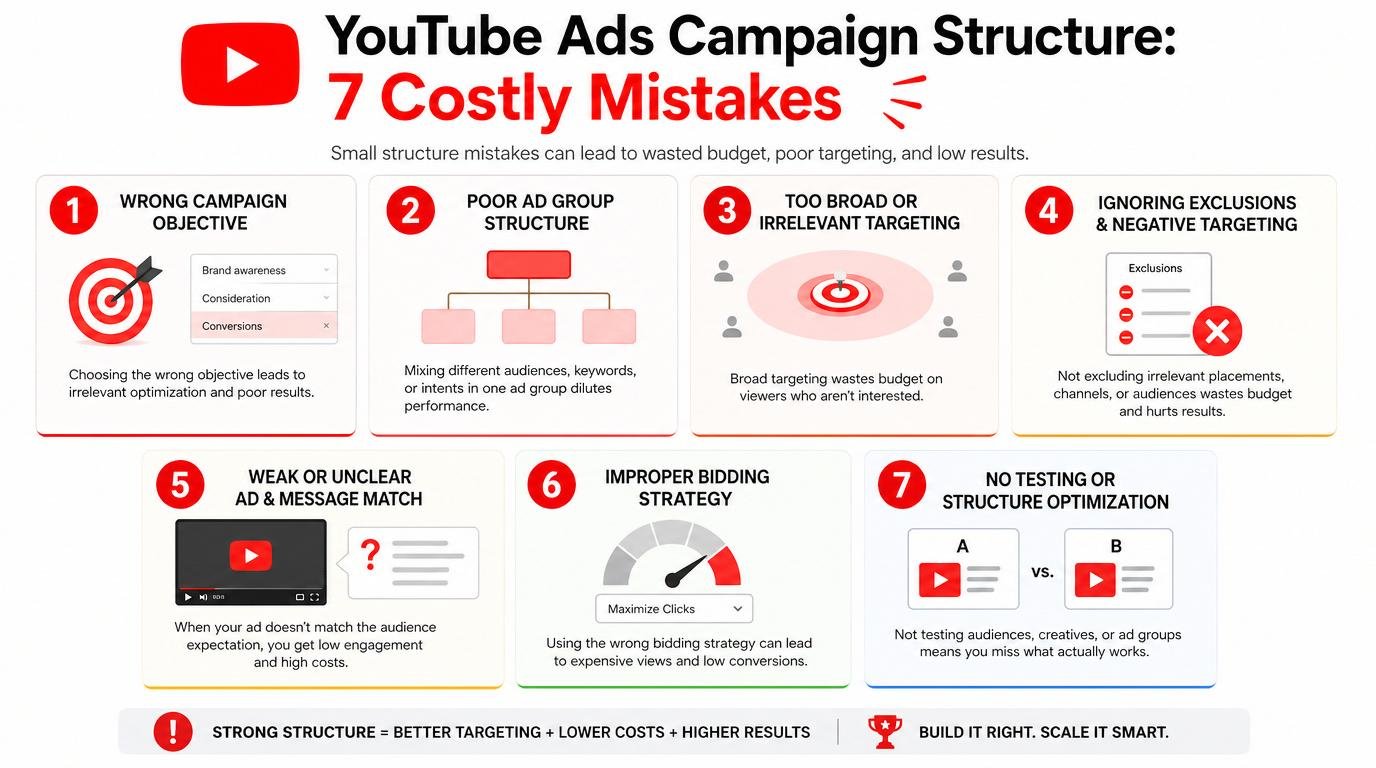
A broken YouTube ads campaign structure is the #1 reason small advertisers waste money on video ads. The platform itself works — but most advertisers set up campaigns using Google’s default settings, which optimize for views, not sales. Fix the structure, and YouTube becomes one of the most profitable paid traffic channels available.
You are completely right that YouTube ads feel like a money pit. You ran a campaign, watched your budget evaporate, and got a bunch of “views” from people who couldn’t care less about your product. That’s a real experience. I’m not going to gaslight you into thinking it didn’t happen.
Here’s the thing, though. Your frustration actually proves my point.
YouTube didn’t fail you. Your YouTube ads campaign structure failed you. Google Ads gives you default settings that are optimized for Google’s revenue, not yours. Most advertisers accept those defaults, light their budget on fire, and then blame the platform.
I’ve managed over $2M in YouTube advertising spend across dozens of accounts. I’ve seen the same structural mistakes over and over. Every single time someone tells me “YouTube ads don’t work,” I audit their account and find at least three of the seven mistakes I’m about to show you.
These aren’t obscure, advanced tactics. They’re foundational errors in ad campaign setup that silently drain your budget before a single real prospect ever sees your video.
Let’s fix them. One at a time.
Mistake #1: One Campaign to Rule Them All
This is the most common structural sin I see. Someone creates a single campaign, throws all their ad groups into it, targets both cold and warm audiences together, and uses one daily budget for everything.
That’s like putting your rent money, grocery money, and vacation fund in the same checking account with no labels. Good luck tracking anything.
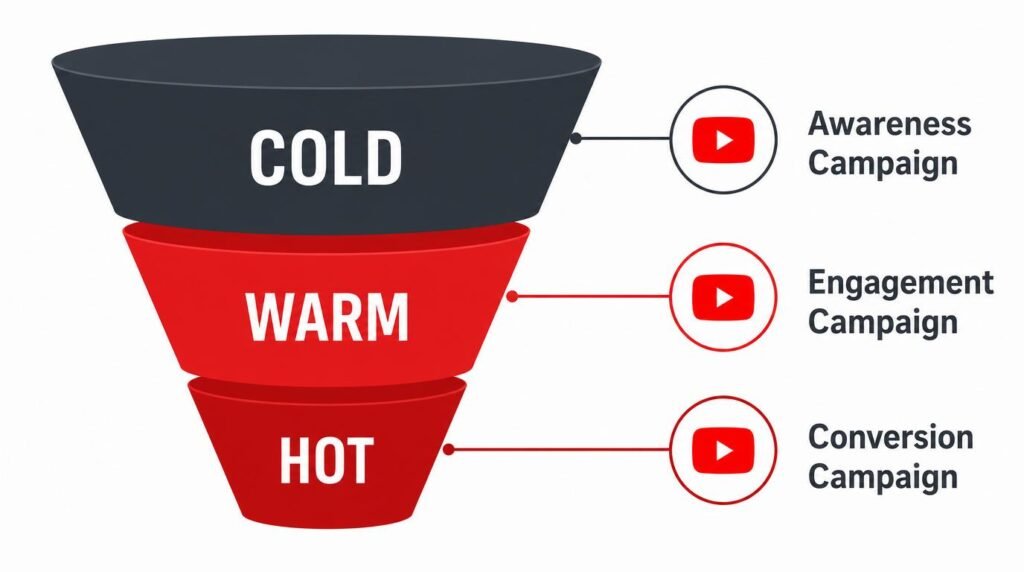
A proper YouTube ads campaign structure separates campaigns by funnel stage. Period. Here’s why:
- Cold audiences need different creative, different bids, and different goals than warm audiences.
- Budget allocation becomes impossible when everything shares one pot.
- Google’s algorithm optimizes at the campaign level. Mix signals, and it gets confused.
At minimum, you need three campaigns: Top of Funnel (awareness/prospecting), Middle of Funnel (engaged viewers), and Bottom of Funnel (retargeting and conversions). Each gets its own budget. Each gets its own bid strategy. Each gets measured differently.
I know that sounds like more work. It is. It’s also the difference between profitable paid traffic and expensive vanity metrics.
Mistake #2: Ignoring Conversion Tracking (or Setting It Up Wrong)
Let me be blunt. If you don’t have conversion tracking set up correctly, you are flying blind. You are literally giving Google zero data to optimize toward.
And “set up” doesn’t mean you just pasted the Google tag on your site and called it a day.
I audit accounts where the conversion action is set to “page view” instead of “purchase.” Or where the tracking fires on every page load, not just the thank-you page. Or — my personal favorite — where there are 14 different conversion actions and half of them are duplicates.
Google’s algorithm uses your conversion data to find more people like your converters. Feed it garbage data, and it finds you garbage people. Simple as that.
Here’s what proper conversion tracking looks like for YouTube advertising:
- One primary conversion action per campaign (purchase, lead, signup).
- The Google tag fires only on the confirmation page.
- You’ve verified it works using Google Tag Assistant or the Google Ads conversion diagnostics tool.
- Enhanced conversions are enabled (Google’s own documentation on enhanced conversions walks you through this).
This isn’t glamorous work. Nobody posts Instagram reels about fixing their conversion tracking. But I’ve seen this single fix cut cost-per-acquisition in half within two weeks. No exaggeration.
Mistake #3: Targeting Like a Billboard Instead of a Sniper
Google Ads gives you beautiful targeting options for video ads. Custom intent audiences. Affinity audiences. In-market segments. Placement targeting. Topic targeting. Keyword targeting.
Most advertisers pick one broad option and pray.
“I’ll just target everyone interested in fitness.” Cool. That’s 800 million people. Your $50/day budget is really going to make a dent there. 😅
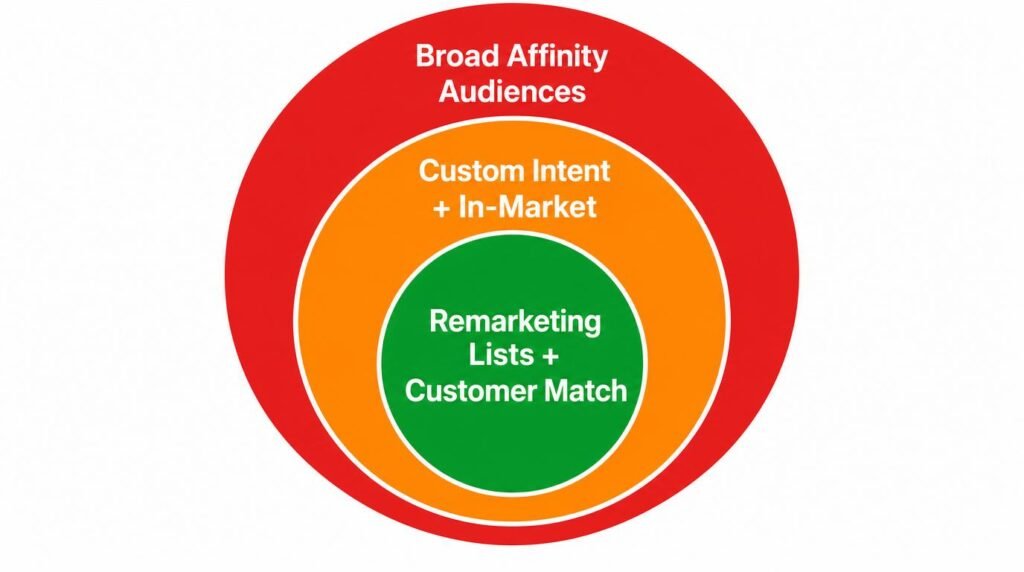
The fix? Layer your targeting. And match it to the funnel stage from Mistake #1.
For cold campaigns, I use custom intent audiences built from competitor URLs and specific search terms. These are people actively researching solutions. If someone just searched “best project management software,” they’re way more qualified than someone who Google thinks “likes technology.”
For warm campaigns, I target people who watched 50%+ of my cold campaign videos. That’s behavioral proof of interest, not Google’s guess.
For hot campaigns, I use website visitor remarketing lists. These people already know me. The same keyword-level precision you’d use in Search campaigns should inform your YouTube targeting strategy.
Specificity wins. Every time.
Mistake #4: Using the Wrong Campaign Subtype
This one drives me absolutely nuts. Google Ads offers multiple campaign subtypes for video, and each one behaves completely differently. Choosing the wrong one is like ordering a steak at a sushi restaurant — technically possible, but you’re gonna have a bad time.
Here’s the quick breakdown:
- Video Reach Campaigns: Optimized for maximum impressions. Great for awareness. Terrible for conversions.
- Video View Campaigns: Optimized to get people to watch. Good for engagement. Still not conversion-focused.
- Video Action Campaigns (VAC): Optimized for conversions. This is what you want for leads and sales. Full stop.
I’ve lost count of how many accounts I’ve audited where someone wanted sales but chose a reach or views campaign. Google happily spent their money getting lots of cheap views from people who will never buy anything.
If your goal is conversion tracking-driven performance, you need Video Action Campaigns. They show your ads with prominent CTAs, they optimize toward your conversion events, and they run across YouTube, Google video partners, and Discover.
Match the subtype to the goal. Sounds obvious. Most people get it wrong.
Mistake #5: Skipping YouTube Retargeting Entirely
This one physically hurts to see. Someone spends $2,000 driving cold traffic to their videos… and never retargets a single viewer.
Those viewers are warm leads. They watched your content. They know your face, your voice, your offer. And you just… let them walk away?
YouTube retargeting is hands-down the highest-ROI move in video advertising. Here are the remarketing lists you should build immediately:
- People who viewed any video from your channel.
- People who viewed specific videos (your best-performing ones).
- People who visited your channel page.
- People who liked, commented, or shared your videos.
- People who visited your website (via Google tag).
Then you create a separate Bottom of Funnel campaign (remember Mistake #1?) that shows a direct-response ad only to these warm audiences. Your CPAs will plummet. I’ve seen retargeting campaigns deliver 3-5x the ROAS of cold campaigns consistently.
This is also where a multi-platform strategy shines. If you’re also running Facebook ads for similar offers, you can coordinate messaging across both platforms for maximum impact. The retargeting game is cross-platform IMO, and the marketers who understand that win big.
Expert Commentary: This walkthrough from Google’s own channel covers the foundational campaign setup process — pay close attention to the campaign subtype selection step, which is where most structural mistakes begin.
Mistake #6: Lazy Creative With Zero Hook
Your YouTube ads campaign structure can be flawless. Perfect funnel separation. Airtight targeting. Correct campaign subtypes. None of it matters if your video creative is boring.
YouTube gives viewers a skip button after 5 seconds. Five. Seconds.
That means your first 5 seconds are everything. Not your logo animation. Not a slow pan of your office. Not “Hey guys, welcome to my channel.”
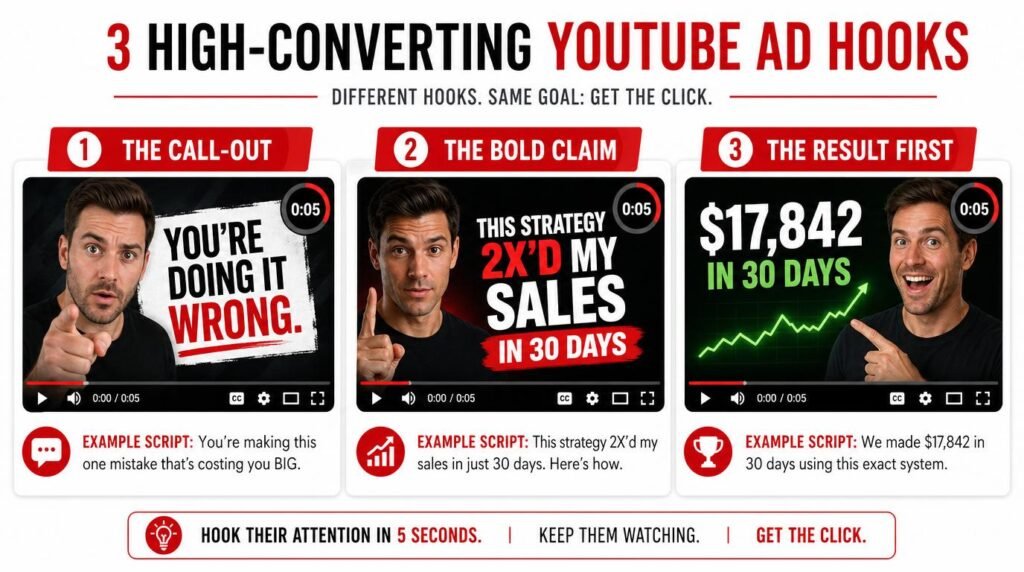
Your hook needs to do one of three things instantly:
- Call out the viewer directly: “If you’re spending money on Google Ads and getting zero sales, watch this.”
- State a bold, specific claim: “I cut my client’s cost per lead from $47 to $11 using one targeting change.”
- Show the result first: Display the dashboard, the revenue screenshot, the before/after — immediately.
According to research from Think with Google, ads that hook viewers in the first 5 seconds see 2-3x higher view-through rates. That’s not my opinion. That’s Google’s data.
Ngl, I’ve tested hundreds of hooks across accounts. The “call-out” style wins almost every time for direct response. Lead with the pain point. Agitate it. Then offer the solution in the rest of the video.
Mistake #7: Setting and Forgetting Your Bid Strategy
Google Ads offers several bid strategies for video ads: Maximize Conversions, Target CPA, Target ROAS, Maximum CPV, and more. Picking the right one at the right time is critical.
Here’s the mistake: people launch a brand-new campaign with Target CPA at $15 when the account has zero conversion history.
Google’s algorithm needs data to optimize. Without at least 30-50 conversions over 30 days, Target CPA and Target ROAS are basically guessing. And Google’s guesses are expensive.
My approach for a new ad campaign setup:
- Week 1-2: Start with Maximize Conversions (no cap). Yes, CPAs will be high. You’re buying data.
- Week 3-4: Once you have 30+ conversions, review your average CPA and switch to Target CPA at 20% above your actual average.
- Week 5+: Gradually lower your Target CPA by 10-15% every two weeks as the algorithm stabilizes.
Patience is the hardest part. Most advertisers panic after 3 days of “bad” performance and blow up their campaign. The algorithm needs a learning period. Google’s own help documentation on bidding explains this, but almost nobody reads it.
Resist the urge to tinker daily. Check weekly. Adjust biweekly. Let the machine learn.
The Campaign Structure That Actually Works
Let me pull everything together into a structure you can steal today. This is the exact YouTube ads campaign structure I use for clients spending $3K-$50K/month:
Campaign 1: Cold Prospecting
- Type: Video Action Campaign
- Targeting: Custom intent audiences (competitor URLs + high-intent search terms)
- Creative: 60-90 second video with strong 5-second hook
- Bid: Maximize Conversions (no cap) for first 2 weeks
- Budget: 50-60% of total video budget
Campaign 2: Warm Engagement
- Type: Video Action Campaign
- Targeting: Video viewers (50%+ watched), channel visitors
- Creative: Testimonial or case study video, 30-60 seconds
- Bid: Target CPA (set after gathering data from Campaign 1)
- Budget: 20-25% of total video budget
Campaign 3: Hot Retargeting
- Type: Video Action Campaign
- Targeting: Website visitors, cart abandoners, email list (Customer Match)
- Creative: Direct offer, urgency-driven, 15-30 seconds
- Bid: Target CPA or Target ROAS
- Budget: 15-25% of total video budget
This isn’t theory. This is battle-tested across ecommerce, SaaS, coaching, and local service businesses. The structure scales. The specifics (creative, targeting keywords, bid amounts) change by niche. The architecture stays the same.
Want someone to set this up for you fast? Check out the 7-day paid ads setup sprint if you want the heavy lifting handled.
My Top Recommended Gear
You don’t need a Hollywood studio to create YouTube ads that convert. But you do need decent audio and lighting. Here’s what I use and recommend:
1. Elgato Ring Light — Clean, professional lighting that makes any room look like a studio. Huge difference in perceived credibility.
Search on Amazon →
2. Rode PodMic USB — Crystal clear audio matters more than video quality for ad performance. This mic delivers broadcast quality without complexity.
Search on Amazon →
3. Logitech Brio 4K Webcam — If you’re recording ads at your desk, this webcam beats your laptop camera by a mile. Sharp, natural color.
Search on Amazon →
Frequently Asked Questions
What is the best YouTube ads campaign structure for beginners?
Use a three-tier approach. One campaign for cold audiences with custom intent targeting. One for warm audiences using video viewer remarketing. One for hot audiences retargeting website visitors. Each campaign gets its own budget and bid strategy. Start simple. Scale what works.
How much budget do I need for YouTube advertising?
You can start testing with $20-$30 per day per campaign. The key is proper structure and conversion tracking, not raw budget. A well-structured $30/day campaign crushes a sloppy $300/day campaign. Every. Single. Time.
Why are my YouTube ads getting views but no conversions?
Views without conversions almost always mean a structural problem. Three usual culprits: your targeting is too broad, your conversion tracking is broken or misconfigured, or your landing page doesn’t match your ad’s promise. Fix the structure before you blame the platform.
Should I use TrueView or bumper ads for conversions?
For direct conversions, Video Action Campaigns (formerly TrueView for Action) are the way to go. Bumper ads are best for awareness and building remarketing lists. Use bumpers to warm people up, then retarget them with action-focused ads.
Affiliate Disclaimer: Some links in this article are affiliate links. If you purchase through these links, I may earn a small commission at no additional cost to you. I only recommend products I personally use or have thoroughly evaluated. This does not influence my editorial opinions.