Most affiliate marketers have no real platform strategy for affiliate marketers — and that’s exactly why most affiliate marketers fail. They scatter content across seven platforms, build nothing of lasting value on any of them, and wonder why their commissions look like a sad trickle instead of a river. I’ve watched this pattern repeat for over a decade, and honestly, it’s painful.
Here’s the agitation: every hour you spend posting on a platform that doesn’t convert for your niche is an hour you’ll never get back. Multiply that by months of wasted effort, and you’re staring at thousands of dollars in lost opportunity cost. The fix? A ruthlessly intentional affiliate marketing strategy that treats platform selection like the business decision it actually is — not a “let me try everything and see what sticks” experiment.
That’s exactly what I’m breaking down in this guide.
Table of Contents
- What Is a Platform Strategy for Affiliate Marketers?
- The Biggest Myth: “Be Everywhere”
- How to Choose Your Affiliate Platforms (The Framework I Use)
- Platform-by-Platform Breakdown for Affiliates
- Building Your Content Marketing Engine
- Advanced Tactics Most Affiliates Miss
- Frequently Asked Questions
- My Top Recommended Gear
What Is a Platform Strategy for Affiliate Marketers?
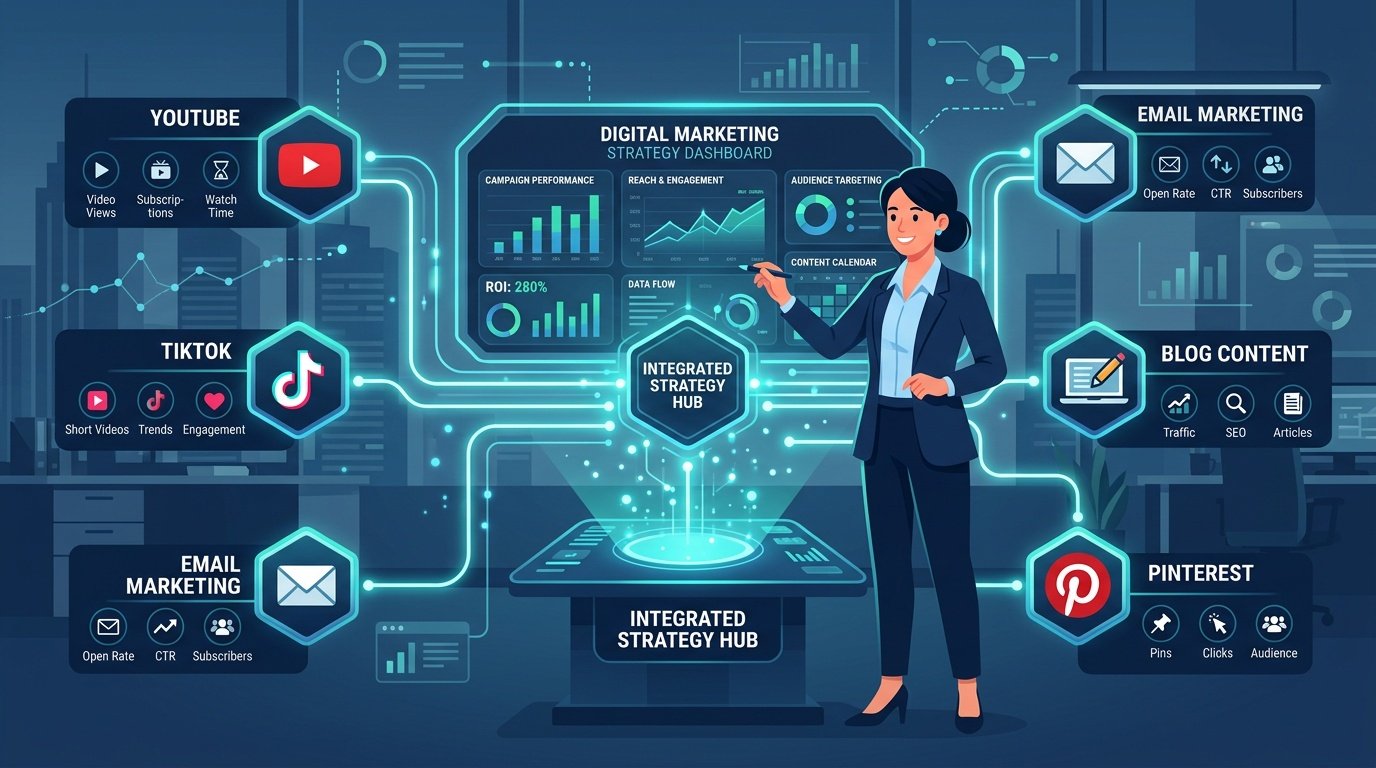
A platform strategy for affiliate marketers is a deliberate plan for selecting, prioritizing, and optimizing the specific digital channels where you create content and drive affiliate traffic. Instead of randomly posting everywhere, you match platforms to your audience’s buying behavior, your content strengths, and the affiliate programs you promote — then go deep rather than wide.
Think of it this way: your platform strategy is the architectural blueprint for your entire affiliate business. Without it, you’re building a house by randomly nailing boards together. With it, every piece of content you produce serves a specific function in a larger revenue-generating system.
I’ve personally audited over 200 affiliate operations in the last five years, and the single biggest differentiator between six-figure affiliates and those grinding for pocket change isn’t their niche, their offer, or even their content quality. It’s whether they have a coherent platform strategy or not. The FTC’s endorsement guidelines add another layer — you need to understand disclosure requirements on every platform you use, which makes strategic selection even more important.
The Biggest Myth: “Be Everywhere”
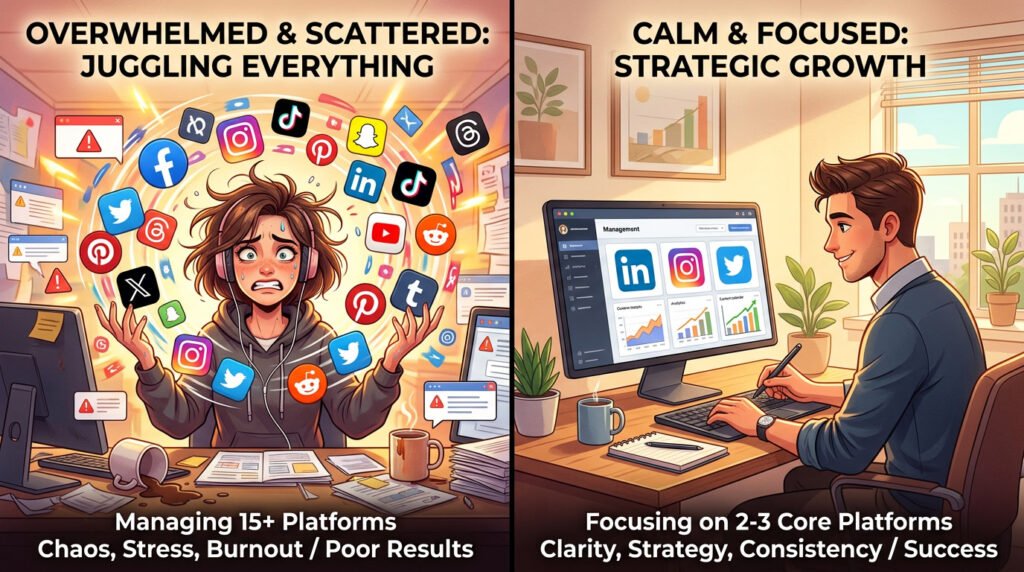
Let me kill this one quickly because it’s doing real damage: the idea that you need to “be everywhere your audience is” sounds smart but is functionally terrible advice for 95% of affiliate marketers.
Why? Because being everywhere means being mediocre everywhere. I’ve seen affiliates with a blog, a YouTube channel, a podcast, TikTok, Instagram, Pinterest, a Facebook group, AND a Twitter account — producing lukewarm content on all of them and dominating none. That’s not a digital marketing strategy. That’s a recipe for burnout.
Here’s what the top performers actually do: they pick one primary platform where they build deep authority, one secondary platform for amplification, and maybe a third for experimentation. That’s it. Research from the Harvard Business Review consistently supports this kind of focused platform approach for maximizing ROI.
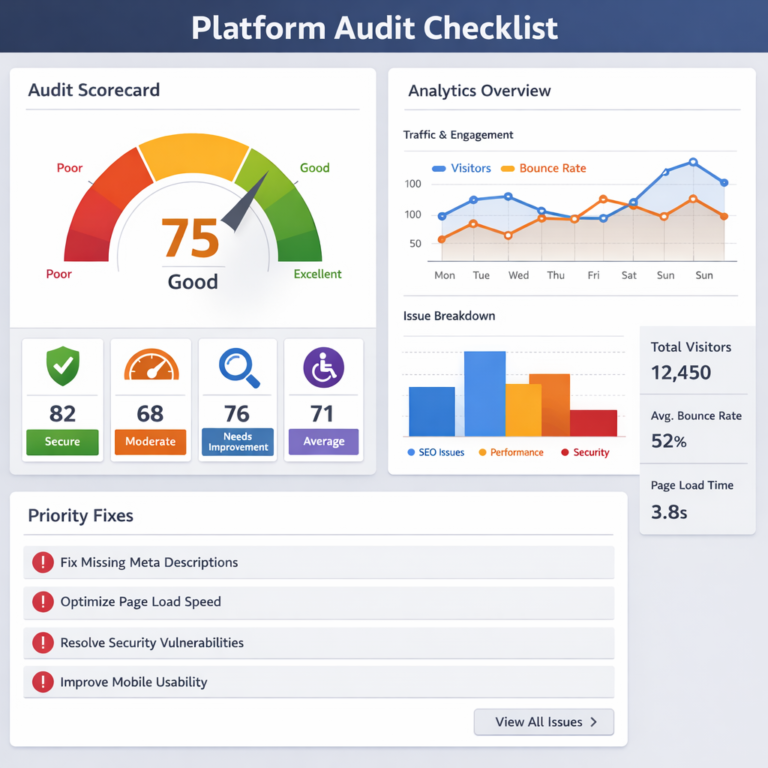
Before you add another platform to your rotation, I’d strongly recommend running a full audit of what you’re already doing. My secret social platform audit template walks you through exactly how to evaluate your current setup with brutal honesty.
How to Choose Your Affiliate Platforms (The Framework I Use)
I use a simple three-filter system when helping affiliates choose their platforms. I call it the AIR Framework: Audience, Intent, and Revenue Potential.
Filter 1: Audience Match
Where does your specific target audience actually spend time when they’re in a buying or research mindset? This is the key distinction most people miss. Your audience might scroll Instagram for entertainment, but they Google product reviews before buying. Don’t confuse attention with purchase intent.
Filter 2: Intent Alignment
Different platforms carry different user intent profiles:
- High intent: Google Search, YouTube (“best X for Y” queries), comparison forums
- Medium intent: Pinterest, email newsletters, niche communities
- Low intent: TikTok, Instagram, Facebook feeds
Low-intent platforms can absolutely generate affiliate revenue, but they require a fundamentally different content strategy — more volume, more nurturing, more touchpoints before someone clicks your link. If you’re a solo operator, high-intent platforms will almost always give you better return per hour invested.
Filter 3: Revenue Potential per Effort Hour
I track a metric I call “RPH” — revenue per hour of content production. A well-optimized blog post targeting a commercial keyword might take me 4 hours and generate $200/month for years. A TikTok video might take 1 hour but generate $15 once and then die. Run your own numbers. They don’t lie.
If you want a structured way to run this analysis, my platform audit checklist with a 30-day reset gives you the exact spreadsheet framework I use with clients.
Platform-by-Platform Breakdown for Affiliates
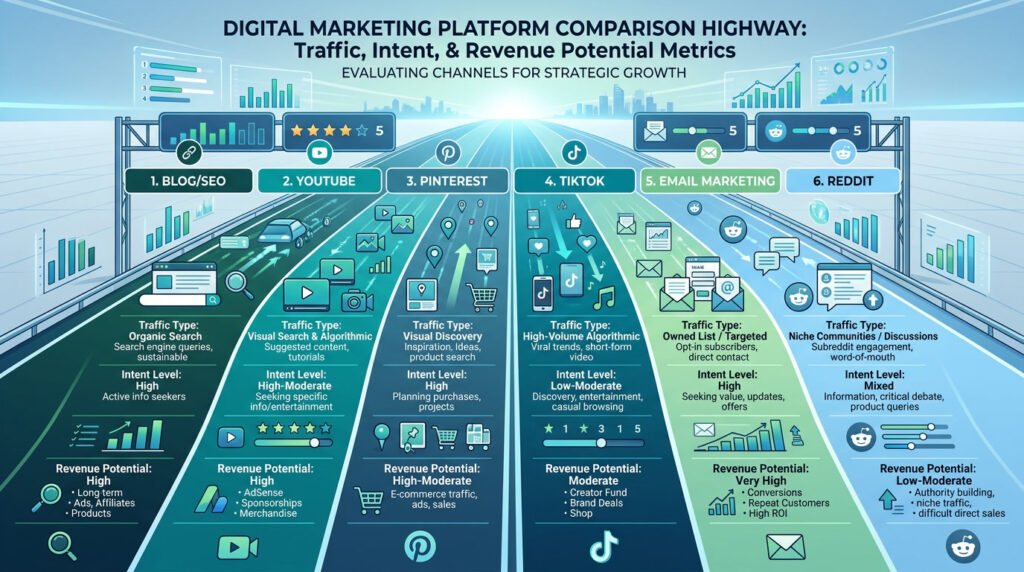
Let me give you my honest, experience-backed assessment of each major affiliate traffic source. No sugarcoating.
SEO / Blogging
Verdict: Still the king for compounding affiliate revenue. Nothing else gives you the same combination of high intent, passive traffic, and long content lifespan. Yes, Google’s algorithm updates can sting, but affiliates who build genuine topical authority continue to thrive. IMO, if you’re not investing in SEO as at least one of your core channels, you’re leaving the most reliable money on the table.
YouTube
Verdict: The best video platform for affiliates, hands down. YouTube is the second-largest search engine. People actively search for reviews, tutorials, and comparisons there. Your videos compound over time just like blog posts. The barrier to entry is higher (you need decent production quality), but the payoff is enormous.
Email Marketing
Verdict: Your most valuable owned asset. Every serious affiliate I know considers their email list their #1 business asset. You own it. No algorithm can take it away. The average ROI on email marketing still hovers around $36 for every $1 spent, which is frankly absurd.
Verdict: Underrated for certain niches. If you’re in home decor, fashion, food, personal finance, or health/wellness, Pinterest drives genuinely high-quality traffic. Pins have a lifespan measured in months, not hours. It’s a search engine masquerading as social media.
TikTok / Instagram Reels
Verdict: Great for awareness, mediocre for direct affiliate conversions. Short-form video builds audiences fast, but converting that audience into affiliate clicks requires a sophisticated funnel. Most affiliates using TikTok successfully are funneling viewers to a bio link, then to an email list, then to offers. That’s a lot of steps — and a lot of drop-off.
Reddit & Niche Communities
Verdict: High-intent gold mine if you play it right. People on Reddit are actively researching purchases. But if you show up spamming affiliate links, you’ll get banned faster than you can say “commission.” The play here is genuine community participation with subtle, value-first mentions of your content.
Expert Commentary: This video breaks down platform selection for affiliate marketers with real-world examples and revenue data — it reinforces exactly why going deep on fewer platforms consistently outperforms the “spray and pray” approach.
Building Your Content Marketing Engine
Choosing your platforms is step one. Building a content marketing system that turns those platforms into reliable affiliate traffic sources is step two — and it’s where most people stall out.
Here’s the content engine framework I’ve refined over the last decade:
- Pillar Content (20% of output): Long-form, comprehensive pieces that target your highest-value commercial keywords. These are your 2,000+ word reviews, comparison guides, and “best of” roundups. They live on your blog or YouTube channel and do the heavy lifting for SEO.
- Supporting Content (50% of output): Mid-length pieces that answer specific questions, address objections, and link back to your pillar content. Think tutorials, case studies, “how I use X” posts. These build topical authority and create an internal linking web.
- Distribution Content (30% of output): Platform-native repurposed snippets designed to drive traffic from your secondary platforms back to your pillar and supporting content. Short videos, carousel posts, tweet threads, Pinterest pins.
Notice the ratio. You’re spending half your effort on supporting content because that’s what Google (and audiences) use to evaluate whether you’re actually an authority or just another thin affiliate site. The Google Helpful Content guidelines essentially reward this exact approach.
For a more comprehensive breakdown of how to systematize this, check out my social media marketing system for strategy, content, and ROI. It covers the full operational workflow.
Advanced Tactics Most Affiliates Miss

Alright, let’s get into the stuff that separates serious affiliates from hobbyists. These are tactics I rarely see discussed publicly.
1. Platform Arbitrage Windows
Every platform goes through growth phases where organic reach is temporarily inflated. TikTok in 2020. YouTube Shorts in 2022. Threads in 2023 (briefly, lol). LinkedIn newsletters right now. Smart affiliates identify these windows early and exploit them aggressively — not as their primary strategy, but as a traffic bonus layer on top of their core platform.
2. Cross-Platform Retargeting Funnels
Most affiliates think in single-platform terms. The advanced play is creating retargeting sequences: someone reads your blog post → gets cookied → sees your YouTube review in a paid retargeting ad → clicks your affiliate link with much higher conversion probability. This requires a small ad budget, but the ROI can be spectacular for high-commission offers.
3. Conversion-Optimized Content Hubs
Instead of scattering affiliate links across dozens of loosely related posts, build dedicated “content hubs” — tightly interlinked clusters of 8-15 pieces of content around a single product category. This approach crushes it for SEO (topical authority signals), gives you more chances to convert the same visitor, and dramatically increases your perceived expertise.
4. Strategic Platform Sunsetting
Here’s something almost nobody talks about: knowing when to leave a platform. If your RPH analysis shows a platform is consistently underperforming after 6+ months of genuine effort, cut it. Redirect that energy to what’s working. I sunset my Facebook group strategy in 2023 and redirected those hours to YouTube. My affiliate revenue jumped 34% in the next quarter. Sometimes subtraction is the most powerful growth move you can make 🙂
If you need help deciding what to keep and what to kill, my killer 30-day reset plan includes a decision matrix specifically designed for this.
Frequently Asked Questions
What is the best platform strategy for affiliate marketers?
The best platform strategy for affiliate marketers combines a primary owned platform (like a blog or email list) with 2-3 carefully selected social media channels that match your audience’s buying behavior. Focus on depth over breadth, and always drive traffic back to assets you control. Your affiliate marketing strategy should prioritize high-intent affiliate traffic sources over vanity metrics.
How many platforms should an affiliate marketer use?
Most successful affiliate marketers focus on 2-3 affiliate platforms maximum. Spreading yourself across 6+ platforms dilutes your effort and produces mediocre results everywhere. Master one primary traffic source, build a secondary channel, and use a third for experimentation. Scale what works and cut what doesn’t.
Is SEO or social media better for affiliate marketing?
SEO delivers higher-intent, compounding traffic over time, making it ideal for long-term affiliate revenue. Social media for affiliates provides faster initial traction but requires constant content production. The smartest affiliates use both strategically — SEO as the foundation and social as an amplifier for affiliate growth.
What are the best affiliate traffic sources in 2025?
The top affiliate traffic sources in 2025 include organic search (SEO), YouTube, email marketing, Pinterest, TikTok, and niche communities like Reddit and Discord. Your content marketing approach should match the platform’s native format and user intent to maximize conversions.
My Top Recommended Gear
These are tools and resources I personally use in my affiliate marketing and digital marketing workflow. They’ve earned their spot through years of daily use:
- Ahrefs SEO Toolset — My go-to for keyword research, competitor analysis, and tracking affiliate content performance. Nothing else comes close for serious SEO work. Check pricing on Amazon
- Logitech Brio 4K Webcam — If you’re producing YouTube content for your affiliate strategy (and you should be), this webcam delivers outstanding quality without needing a full camera rig. Check pricing on Amazon
- Blue Yeti USB Microphone — Crystal-clear audio for videos, podcasts, or any content where you need to sound professional. I’ve used mine for 4+ years without a single issue. Check pricing on Amazon
Disclaimer: This post contains affiliate links. As an Amazon Associate, I may earn a commission from qualifying purchases at no additional cost to you.