
You know you should be posting on LinkedIn. Your boss knows it. Your competitors are clearly doing it.
So you post a company update. Then a webinar link. Then nothing for three weeks, because the quarter got busy.
Ninety days later you have 14 likes, zero leads and a vague feeling that B2B social media “doesn’t work for us.”
Here’s the truth: it isn’t the platform. It’s the missing plan.
This guide walks you through building a complete B2B social media plan for the next 90 days in a single 60-minute session. No agency, no 40-page strategy deck. Just four focused planning blocks, a weekly rhythm you can actually keep, and a short list of numbers that tell you whether it’s working.
It’s written for beginners: founders, solo marketers and small B2B teams who need pipeline, not vanity metrics.
What you’ll walk away with:
- One clear 90-day goal tied to revenue, not followers
- A one-line description of the buyer you’re posting for
- Three content pillars that never leave you staring at a blank screen
- A weekly posting rhythm that takes about 3 hours
- A month-by-month roadmap: foundation, momentum, pipeline
- Five metrics to review every Friday
Table of Contents
What is a B2B social media plan?
A B2B social media plan is a written, time-boxed schedule that defines who you’re posting for, what you’ll post, where, how often, and which numbers prove it’s generating business. For most B2B companies, it centres on LinkedIn and runs in 90-day cycles.
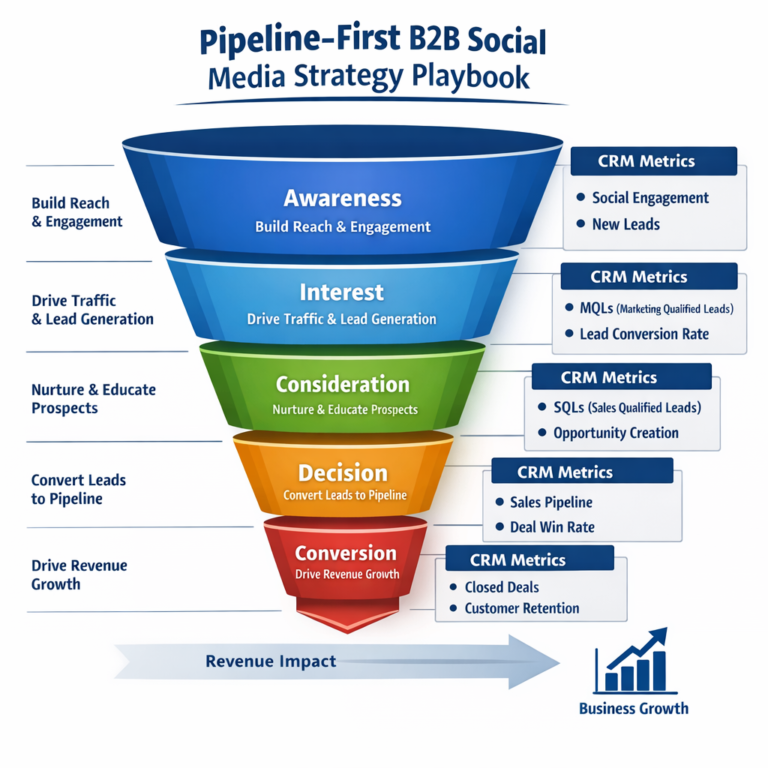
It’s not the same as a B2B social media strategy. The strategy is the big picture: why you’re on social at all and how it fits your sales process. (We cover that in our B2B social media strategy for pipeline guide.)
The plan is the part you execute on Monday morning.
Why 90 days? It’s long enough for consistent posting to compound and short enough that you’ll actually review it. Thirty days rarely shows a trend. A full year usually becomes a document nobody opens again.
How to build your B2B social media plan in 60 minutes
Block out one hour to build your B2B social media plan, close Slack, and open a blank doc. Set a timer for each block. When it rings, move on, even if it isn’t perfect. A finished plan you follow beats a perfect one you never start.

Block 1 (minutes 0–15): Pick one 90-day goal
Most B2B plans fail at step one because they chase five goals at once. Pick one and write it as a number with a date.
Good goals tie social media to the sales process:
- “Book 6 sales calls that started from LinkedIn by January 15”
- “Get 150 downloads of our pricing guide from social traffic this quarter”
- “Grow our newsletter by 200 subscribers from LinkedIn posts”
Weak goals stop at attention: “get more followers” or “increase engagement.” Those can be signals that you’re on track, but they can’t be the goal.
Beginner tip: if you have no baseline, set a modest goal and treat this first cycle as the one that gives you real numbers. Your second 90 days will be much sharper.
Block 2 (minutes 15–30): Describe your buyer in one sentence
You don’t need a five-page persona. You need one sentence that you could read before writing every post:
“We post for [job title] at [type of company] who are struggling with [specific problem] and want [outcome].”
Example: “We post for operations managers at 50–200 person logistics companies who are drowning in spreadsheets and want one reliable view of their fleet.”
Then answer three quick questions:
- Where does this person spend time online? (For most B2B buyers it’s LinkedIn first, then YouTube, newsletters and niche communities.)
- What do they search for or ask about before they buy?
- What objections come up on your sales calls?
Question 3 is gold. Every objection your sales team hears is a post waiting to be written.
Block 3 (minutes 30–45): Choose three content pillars
Content pillars are the three themes you’ll rotate between. They stop you from posting random updates and train the algorithm (and your buyers) to know what you’re about.
A simple B2B formula that works for beginners:
| Pillar | What it does | Example posts |
|---|---|---|
| Teach | Proves you know the problem | How-tos, checklists, mistakes to avoid, answers to common questions |
| Prove | Shows it works | Customer stories, before/after results, behind-the-scenes of how you deliver |
| Point of view | Makes you memorable | Opinions on industry trends, myths you disagree with, lessons learned |
Aim for roughly 50% Teach, 30% Prove and 20% Point of view. Teaching earns trust; proof and opinion turn that trust into conversations.
Don’t skip the Point of view pillar. The Edelman–LinkedIn B2B Thought Leadership Impact Report, a survey of nearly 3,500 business professionals, found that strong thought leadership makes buyers more willing to seek out a company and pay more for its expertise.
Block 4 (minutes 45–60): Set your rhythm and channels
Pick one main platform and, at most, one secondary. For most B2B companies the main platform is LinkedIn. Not sure which fits your niche? Read our guide on choosing the right social media platforms before you commit.
Then decide two things:
- Who posts? The company page and at least one real person: the founder, a sales lead or a subject expert. On LinkedIn, posts from people typically reach far more of their network than company-page posts do.
- How often? Three posts a week is a sustainable starting point for a small team. Consistency matters more than volume.
Finally, put a recurring 90-minute block in your calendar each week for batching (more on that below). If it isn’t in the calendar, it won’t happen.
Your 90-day B2B social media plan, month by month
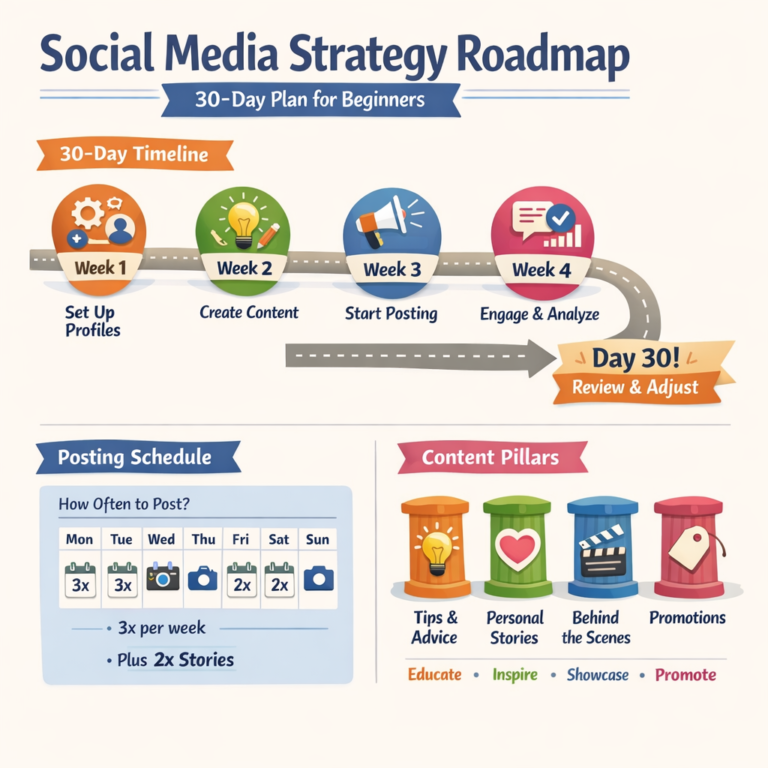
Your B2B social media plan runs in three 30-day phases. Each one has a single job, and each builds on the last.

Days 1–30: Foundation (get found and look credible)
The job this month is simple: when a buyer checks you out, they should instantly understand who you help and why to trust you.
- Fix your profiles. Rewrite the headline and About section on your company page and on each person’s LinkedIn profile around your buyer’s problem, not your job title. “Helping logistics teams replace spreadsheets with one fleet view” beats “CEO at Acme.”
- Add one clear next step to every profile: a link to a guide, a newsletter or a booking page.
- Post 3 times a week using your pillars (two Teach, one Prove or Point of view).
- Set up tracking. Add UTM tags to every link you share so you can see which posts drive website visits and leads. Our UTM tracking for social media guide takes 10 minutes.
- Spend 15 minutes a day commenting on posts from buyers and industry voices. Thoughtful comments are the fastest way for a small account to get seen.
Setting up your company page from scratch? LinkedIn’s official LinkedIn Pages best practices cover the essentials: a complete overview, a call-to-action button, regular posts with images or documents, and inviting employees to follow and share.
Don’t worry about results yet. Month one is about building the habit and the base.
Days 31–60: Momentum (find what works and do more of it)
Now you have a month of data. Use it.
- Find your top 3 posts by saves, comments and profile visits (not likes). Write down what they had in common: topic, format, hook.
- Repurpose the winners. Turn a strong text post into a carousel, a short video or a newsletter section. One idea can become several posts; our creator content pipeline system shows how.
- Bring in a second voice. Ask one colleague (sales or a subject expert) to share or write one post a week. People trust people more than logos.
- Try one new format. If you’ve only posted text, test a document carousel or a 60-second video.
- Start a simple swipe file of questions buyers ask in comments and DMs. These become next month’s posts.
Days 61–90: Pipeline (turn attention into conversations)
This is the month social media starts paying for itself.
- Launch one lead magnet your buyer actually wants: a checklist, template or short guide that solves one problem from your pillars.
- Promote it twice a week inside genuinely useful posts, not as a hard sell.
- Follow up on warm signals. When the same person likes, comments or views your profile repeatedly, send a short, personal DM. Ask a question; don’t pitch.
- Hand warm leads to sales with context: which posts they engaged with and what they asked.
- Run your 90-day review (see the metrics below), then plan the next cycle in another 60-minute session.
Optional boost: once you know which posts perform organically, a small paid test can amplify them. Start small and only boost what has already proven itself; see our beginner campaign structure guide.
Watch: B2B social media marketing in 2026
Prefer to learn by watching? This guide from Exit Five, a community for B2B marketers, walks through how B2B brands are using social media right now. It’s a great companion to the 90-day plan above: watch it once, then come back and run your 60-minute planning session.
The weekly rhythm that keeps your B2B social media plan on track
A B2B social media plan only works if it fits into a real week. It takes about 3 hours. Here’s a rhythm a solo marketer or busy founder can keep:
| Day | Task | Time |
|---|---|---|
| Monday | Batch-write and schedule the week’s 3 posts | 90 min |
| Tuesday | Post #1 (Teach) + 15 min of comments | 15 min |
| Wednesday | 15 min of comments and replies | 15 min |
| Thursday | Post #2 (Prove or Point of view) + 15 min of comments | 15 min |
| Friday | Post #3 (Teach) + 15-min metrics check | 30 min |
| Daily | Reply to every comment and DM within 24 hours | 5 min |
Why reply within 24 hours? Sprout Social’s research on response times shows most people expect brands to answer on social media within a day or less. In B2B, a slow reply to a comment can mean a lost sales conversation.
Want to batch faster? Our content batching system breaks the Monday session into four short blocks. And if you’re choosing a scheduler, start with our list of free social media scheduling tools.
B2B social media metrics that actually matter
Likes feel good, but they don’t pay salaries. Check these five numbers every Friday and write them in one simple spreadsheet:
| Metric | What it tells you | Where to find it |
|---|---|---|
| Profile visits | Your posts make people curious about you | LinkedIn analytics |
| Saves and shares | Your content is useful enough to keep or pass on | LinkedIn post analytics |
| Comments from target buyers | You’re reaching the right people, not just peers | Read your comments |
| Website clicks from social | Posts drive traffic to your offers | Google Analytics 4 with UTM tags |
| Leads and sales conversations | Social media is creating pipeline | Your CRM or a simple lead sheet |
The last one is the number that matches your 90-day goal, and it is the real test of your B2B social media plan. The other four are early signals that tell you whether you’re heading the right way.
To track website clicks properly, tag every link you share with UTM parameters. Google’s own guide, URL builders: Collect campaign data with custom URLs, explains exactly which parameters to use (utm_source, utm_medium and utm_campaign) so your posts show up correctly in Google Analytics.
For a deeper look at connecting posts to revenue, read how to measure social media ROI.

5 beginner mistakes that sink a B2B social media plan
- Posting only from the company page. Buyers connect with people. Pair the page with at least one human voice.
- Talking about yourself in every post. “We’re thrilled to announce…” gets scrolled past. Lead with the buyer’s problem.
- Being on every platform. Two half-hearted channels lose to one done well. Master LinkedIn first.
- Judging success after two weeks. B2B buying cycles are long. Give the plan the full 90 days before deciding it doesn’t work.
- Never asking for the next step. If no post ever invites a download, a reply or a call, you’ve built an audience, not a pipeline.
FAQ
How do I create a B2B social media plan?
Set one 90-day goal tied to leads or sales, describe your buyer in one sentence, choose three content pillars, then pick one main platform and a weekly posting rhythm. That takes about 60 minutes. Then work through three 30-day phases: foundation, momentum and pipeline.
How often should a B2B company post on social media?
Three times a week on your main platform is a realistic starting point for small teams. It’s frequent enough to stay visible and light enough to keep up. Consistency over 90 days matters more than posting daily for two weeks and then stopping.
Which social media platform is best for B2B?
For most B2B companies, LinkedIn is the best place to start because that’s where decision-makers discuss work. YouTube is a strong second channel for in-depth explainers. The right answer still depends on where your specific buyers spend time, so ask your customers.
How long does B2B social media take to generate leads?
Expect the first month to build visibility and the second to show which content works. Many small teams start seeing real conversations in the third month, once they add a lead magnet and follow up on warm signals. Results vary with your niche, offer and consistency.
Do I need paid ads for B2B social media?
No. You can build a working plan on organic posts alone. Paid ads become useful once you know which posts perform well organically, because you can then put a small budget behind proven content instead of guessing.
Your next 60 minutes
You don’t need a bigger budget or a 40-page strategy to win on B2B social media. You need one goal, one buyer, three pillars and a rhythm you’ll actually keep for 90 days.
So block out the next hour, set your timer, and build your B2B social media plan.
Then come back in 30 days, check your five metrics, and adjust. That’s how a plan beats posting on hope.
Want the shortcut? Download our free 2026 Social Media Algorithm Cheat Sheet to see what LinkedIn, Instagram and TikTok reward right now, so every post in your plan has a better chance of being seen.