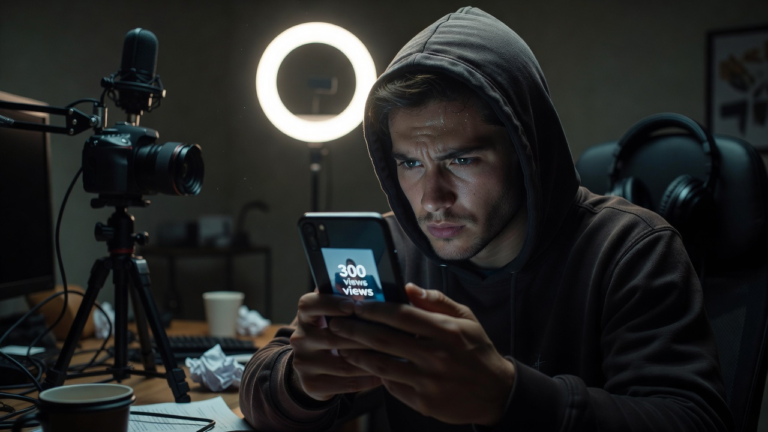

Low production content trend 2026 is here: a single-take phone clip with no script is now beating a polished, $8,000 branded video on watch time, shares, and trust.
That’s not a hot take anymore — it’s the default outcome. This isn’t a TikTok quirk or a budget workaround. It’s the new baseline for what performs, and if your team is still routing every video through a production calendar, a shot list, and three rounds of edits before it sees daylight, you’re optimizing for the wrong thing.
Here’s what’s actually happening, why it’s happening now, and the template I’m using to build raw, high-performing content on purpose — not by accident.
Table of Contents
- Why polish stopped working
- The data behind the shift
- What “low production” actually means (it’s not lazy)
- The single-take content framework
- How to brief your team (or yourself) for raw content
- Where polish still belongs
- Your next move
Why Polish Stopped Working
For a decade, “better production” meant better results. Cleaner lighting, tighter edits, a hired editor — all of it correlated with performance because most of the feed still looked amateur by comparison.
That gap is gone.
Everyone has a good camera. Everyone has access to editing tools. And now everyone has AI tools that can smooth out a video in one click. Production quality stopped being a differentiator the moment it became table stakes, and Hootsuite’s Social Trends 2026 research names the replacement directly: as AI becomes normalized in content creation, imperfection — natural pacing, the occasional stumble, even a typo — is what now signals a real human made this. Over-editing is out. The stutter or the flub is in.
That’s the actual mechanism behind the low production content trend 2026. It’s not that audiences suddenly love bad video. It’s that “flawless” now reads as synthetic, and synthetic reads as untrustworthy.
The Data Behind the Shift
I don’t like citing stats I can’t stand behind on something as widely misunderstood as the low production content trend 2026, so here’s what’s actually holding up under scrutiny right now:
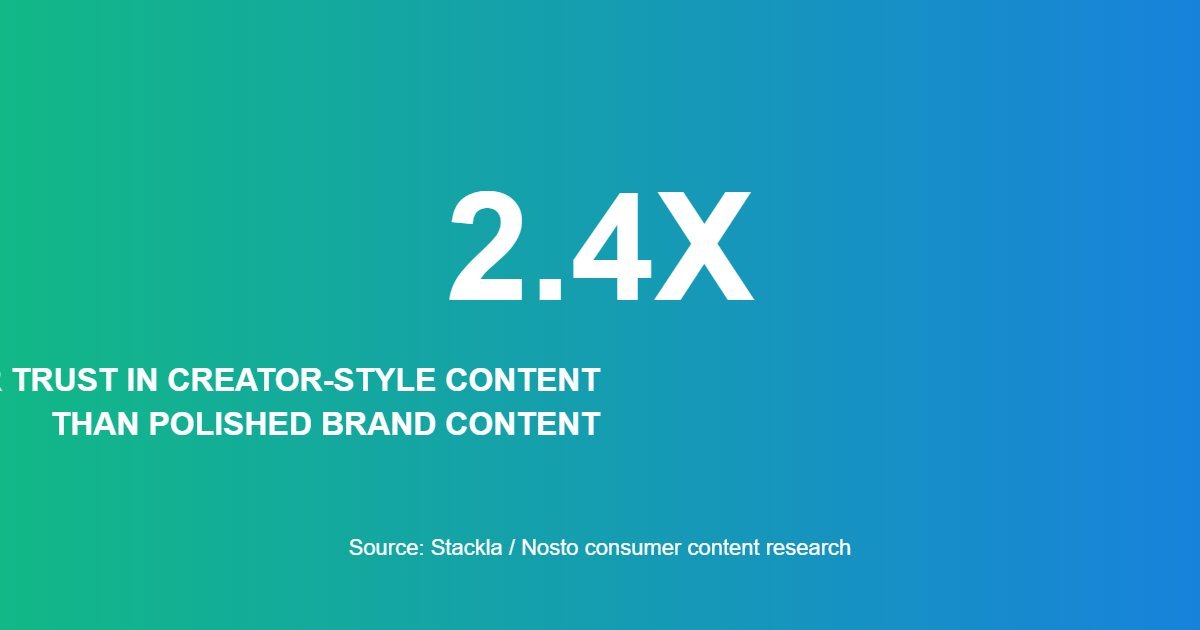
Consumers trust user-generated and creator-style content roughly 2.4x more than brand-produced content, and a large majority of marketers now rate UGC as more authentic than their own branded output. Gen Z is the sharpest version of this pattern: multiple 2026 reports put Gen Z engagement with authentic, lo-fi video well above their engagement with polished corporate clips.
There’s also a trust gap that matters more than any single engagement stat. According to Edelman’s Trust Barometer research, audiences trust individual people — employees, creators, even strangers doing UGC — more than they trust faceless brand accounts. That’s sharper in 2026 because AI-generated content has made “obviously produced” feel adjacent to “possibly fake.” Every polished, over-lit, clearly-scripted brand video is getting swept into that suspicion whether it used AI or not.
Put together: the algorithm isn’t punishing production value directly. Your audience is punishing anything that smells manufactured — and if you’re also optimizing for watch time, credible roughness tends to hold attention longer than a glossy spot with nothing new to say.
What “Low Production” Actually Means (It’s Not Lazy)
This is where most brands get it wrong. They hear “raw wins” and think “post whatever, unedited, no thought.” That’s not what’s winning. What’s winning is content that looks unplanned but is actually well-considered — good hook, one clear idea, real stakes — shot in a way that doesn’t announce itself as marketing.
The phrase I use internally: credible roughness, not careless roughness.
Credible roughness still has:
- A hook in the first 1–3 seconds
- One idea per clip, not three
- Captions, because most of this gets watched muted
- A real reason to exist — a demo, an objection you’re addressing, a behind-the-scenes moment, a genuine opinion
What it drops:
- Multi-camera setups
- Scripted VO
- Heavy color grading
- The “brand voice” filter that scrubs out every human tic
A well-structured video shot on a phone, with something real to say, is beating a fully produced spot with nothing interesting in it. Quality of thinking is now outperforming quality of production — which is good news, because thinking is cheaper than a production crew.
The Single-Take Content Framework
Here’s the actual template I’m using for raw, single-take formats. Steal it.
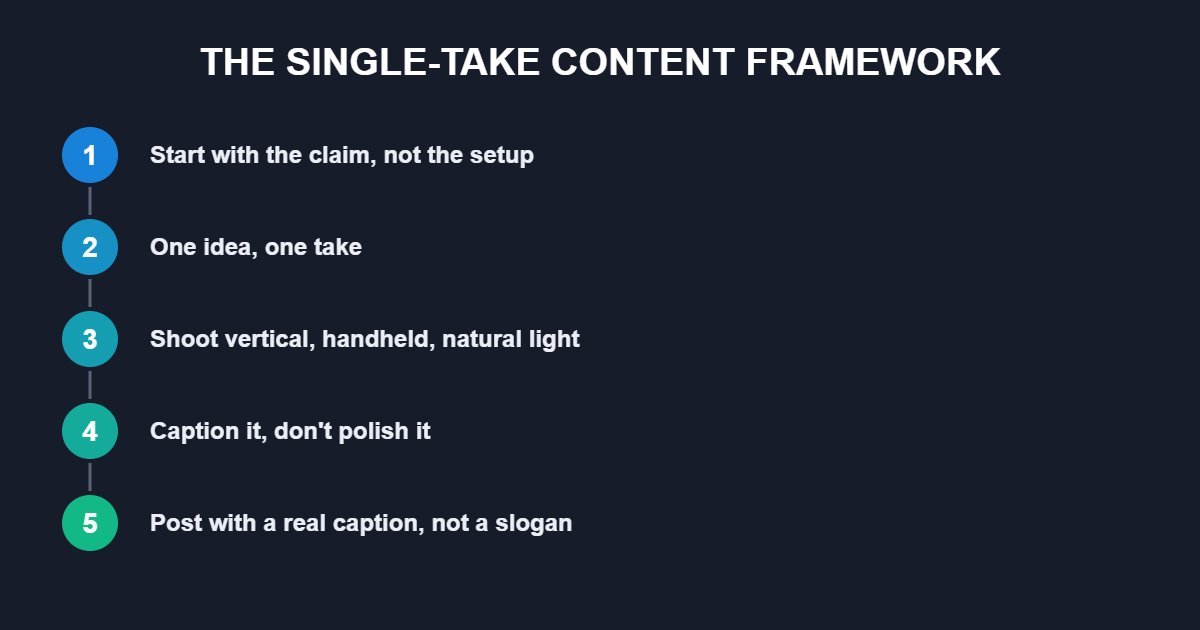
1. Start with the claim, not the setup
Open with the point you’re making, not three seconds of throat-clearing. “Here’s why your ad spend isn’t working” beats “Hey guys, so today I wanted to talk about…” every time. You have one to three seconds before the scroll happens — the same window that matters for watch time optimization on every short-form platform.
2. One idea, one take
Pick a single claim, objection, or demo. Say it once, cleanly, without stopping to restart. If you mess up a word, keep going — the flub is part of what makes it read as real. This is the part teams struggle with most, because the instinct to “just redo that one line” is exactly the instinct that kills the format.
3. Shoot vertical, handheld, natural light
No ring light rig, no tripod-locked symmetry. Handheld movement and natural light aren’t a downgrade — they’re the signal. A locked-off, perfectly lit shot now reads as “ad.”
4. Caption it, don’t polish it
Add captions for accessibility and muted viewing. Don’t add lower thirds, animated logos, or a music bed that screams “brand asset.” Let the audio be room tone.
5. Post with a real caption, not a slogan
Write the caption the way you’d text a colleague the takeaway, not the way you’d write ad copy. This continues the authenticity signal from the video into the text around it.
How to Brief Your Team (or Yourself) for Raw Content
If you run a team, the hardest part of adopting the low production content trend 2026 isn’t the format — it’s unlearning the review process built for polished video. If you’re also using AI workflows to generate content ideas, feed those ideas into this briefing process instead of a traditional script. A few changes that actually work:
Replace the shot list with a talking-point list. One page, three bullets, done.
Cut the approval rounds from three to one. If you’re editing a single-take video more than once, you’ve already broken the format.
Brief for a person, not a persona. Whoever’s on camera should sound like themselves, not like “the brand voice.” That’s the entire value of the format — if you script out their personality, you’ve rebuilt the polished ad you were trying to avoid, just with worse lighting.
Measure watch time and shares, not just views. The formats winning right now are winning because people watch to the end and send it to someone else — vanity reach numbers won’t show you that.
Where Polish Still Belongs
The low production content trend 2026 doesn’t mean burning your entire production budget down. Polish still earns its place in a few spots: top-of-funnel brand films, product launches where craft signals quality (think Apple, not think SaaS explainer), and anything that lives on your website or in a pitch deck where the audience expects a produced asset.
The mistake is applying that same production bar to every piece of social content, especially the day-to-day stuff meant to build trust and get shared. If you haven’t revisited which platforms deserve which production level, start with a platform audit before you rebuild your content calendar — the right production level is platform-specific, not universal.
Your Next Move
If you want proof the low production content trend 2026 applies to your audience specifically, pick one format you currently over-produce — a weekly tip, a product demo, a founder update — and shoot the next version handheld, in one take, on a phone, with zero edits beyond captions. Post it next to your usual polished version and compare watch time and shares after 48 hours, not just impressions.
You’ll have your own data point instead of a stat from a report — proof that the low production content trend 2026 actually works for your audience. That’s the version of this argument that actually changes how your team works.